
🧴 Work Cabinet (Ambrose Caliver, No. 1,568,498)
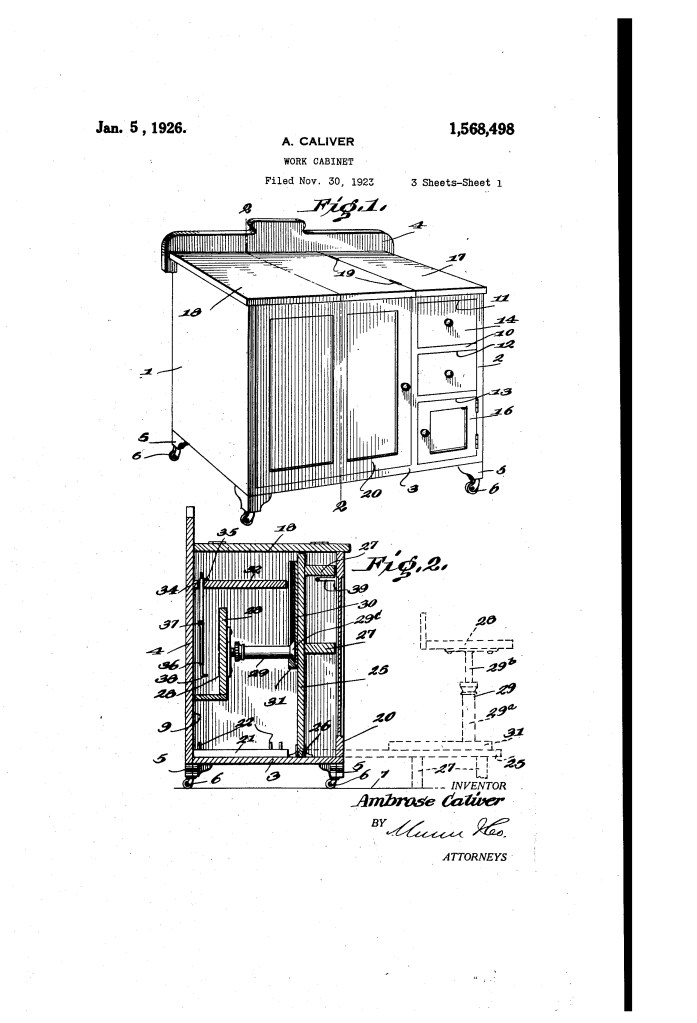
The patent by Ambrose Caliver of Nashville, Tennessee, describes an multifunctional Work Cabinet (Patent No. 1,568,498, 1926). This invention is a specialized, compact workstation designed for hair dressers and beauty culturists. Caliver’s primary objective was to consolidate all necessary equipment—mirrors, basins, storage, and seating—into a single unit that provides comfort for both the worker and the customer. When closed, the cabinet is designed to appear as a standard piece of furniture, making it ideal for home-based businesses or small salons where space and aesthetics are paramount.
Inventor Background: Ambrose Caliver
Dr. Ambrose Caliver (1894–1962) was a distinguished African American educator, administrator, and researcher. Before becoming the first Black professional to be appointed to the U.S. Office of Education, Caliver was a professor at Fisk University and an expert in manual arts and vocational education. His 1926 patent reflects his background in furniture design and his commitment to professionalizing the trades. By engineering a cabinet specifically for “beauty culture,” he provided a technical solution that supported the booming industry of Black cosmetology led by figures like Madam C.J. Walker.
Key Mechanical & Functional Systems
The cabinet operates through a series of unfolding panels and hidden compartments to transform from a “stationary box” into a dual-seat salon station.
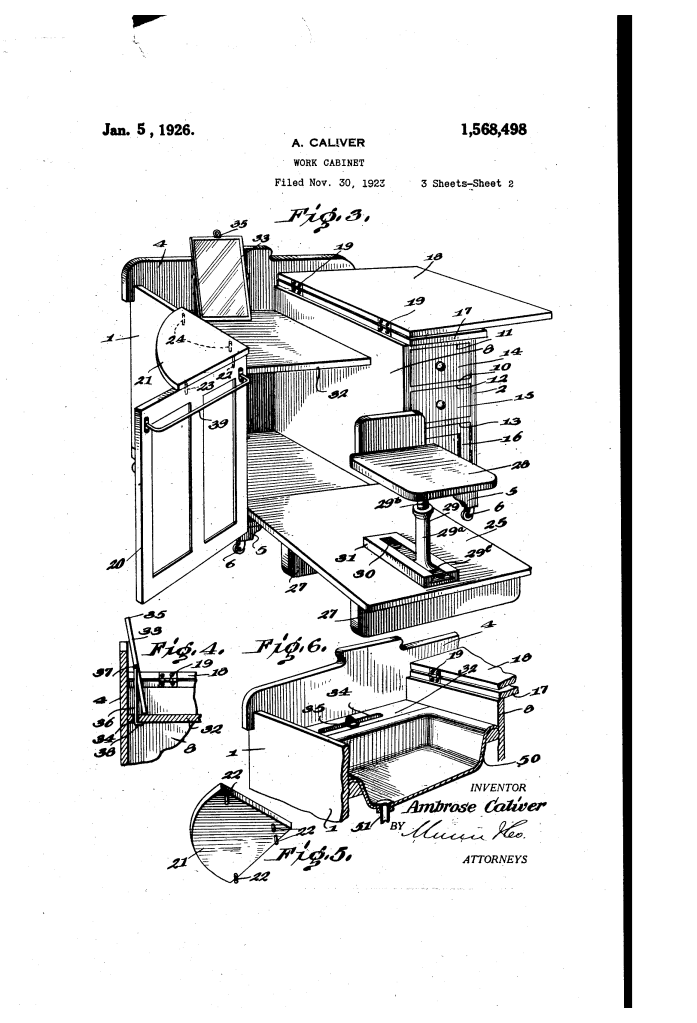
1. The Retractable Customer Seat (25, 28, 29)
- Pivoted Panel (25): A panel is hinged to the bottom of the main compartment (9).
- Adjustable Standard (29): The seat (28) is mounted on a screw-threaded standard that allows for height adjustment (29b) and lateral movement along a mortise guide (30).
- Function: In the inactive position, the seat and panel fold vertically into the cabinet. When opened, the panel swings down to rest on the floor, providing a sturdy, adjustable seat for the customer.
2. The Integrated Basin and Mirror System (32, 33, 60)
The heart of the cabinet is the work surface, which can be configured for washing or styling.
- Combined Shelf and Seat (32): A horizontal plate serves as a workspace or a second seat for the worker.
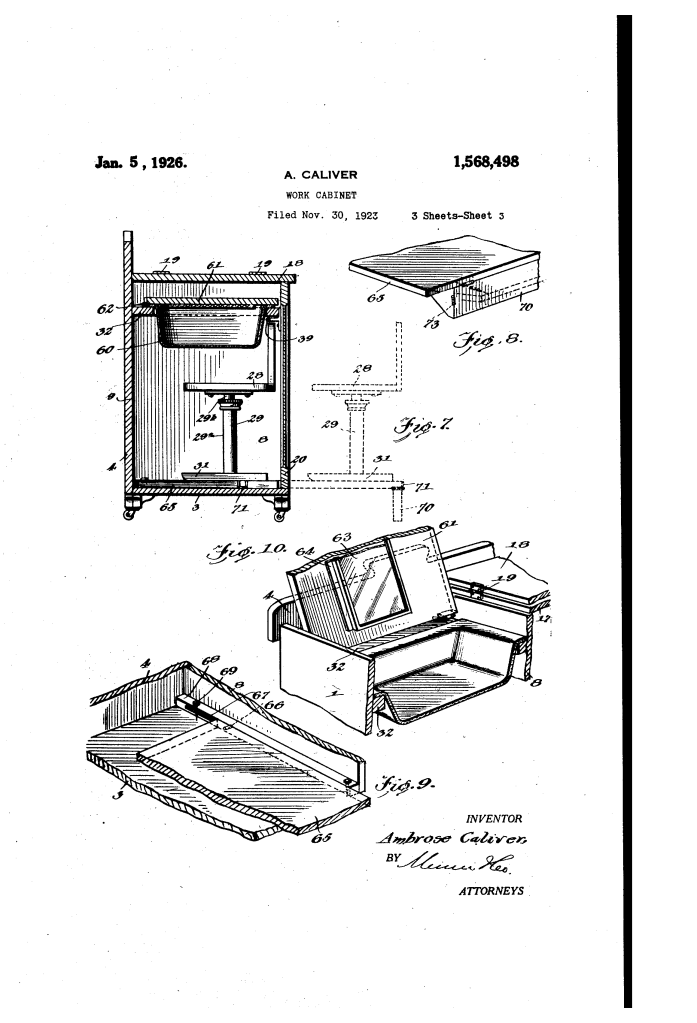
- Variable Mirror (33 or 63): In one version, the mirror (33) hangs from a slot; in a modified version (Fig. 10), the mirror is mounted to the underside of a basin cover (61).
- Fixed or Removable Basin: The cabinet can house a permanent basin (60) with a drain pipe (51), allowing for hair washing without moving the customer.
3. Expandable Work Surfaces (18, 20, 21)
- Swingable Top Section (18): Half of the cabinet top is hinged (19) and opens to a horizontal position.
- Removable Shelf (21): A shelf with pins (22) attaches to the open door (20) and the cabinet side.
- Function: These components create a wide “wrap-around” workspace. This layout keeps tools and supplies within arm’s reach of the worker, reducing fatigue and increasing the speed of the service.
4. The Telescoping Support Leg (70, 73)
- Slidable Base (65): In the modified version (Fig. 7), the seat base slides out on tracks.
- Folding Leg (70): A support leg is attached via a triple-leaf hinge (71) with an end section (73) that acts as a brace.
- Function: This ensures that when the seat is extended far from the cabinet’s center of gravity, the weight of the customer is supported by a rigid, braced leg rather than just the cabinet frame.
Improvements Over Standard Salon Equipment
| Feature | Standard 1920s Salon Gear | Caliver’s Work Cabinet |
| Space Efficiency | Required separate chairs, sinks, and tables. | All-in-one design; folds into a single piece of furniture. |
| Worker Ergonomics | Required worker to stand or move constantly. | Integrated worker’s seat (32) and wrap-around tool shelves. |
| Professionalism | Often looked “clinical” or cluttered. | Designed to have a furniture finish to match home decor. |
| Portability | Fixed plumbing and heavy chairs. | Can be made portable or stationary; features a drain-ready basin. |
Significance to Industrial Design
Ambrose Caliver’s work cabinet influenced the development of compact workstations and professional trade furniture.
- Ergonomic Integration: By providing “comfortable seats for both the customer and the worker,” Caliver pioneered the application of occupational health principles to the beauty industry, aiming to reduce worker fatigue.
- Convertible Design: The logic of a “disappearing” seat that folds into a decorative cabinet is a foundational concept in modern space-saving furniture and urban studio apartment design.
- Sanitation Engineering: The inclusion of a fixed basin with a drain pipe in a compact cabinet anticipated the modular plumbing units found in modern medical and dental offices.
- Multifunctional Surfaces: The use of hinged lids and removable pin-supported shelves to create a temporary “U-shaped” workspace is a common feature in modern professional makeup and tattoo stations.
