
Wire Type Precision Resistor (1959)
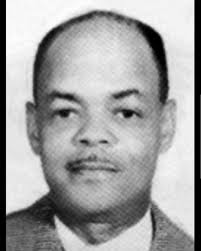
U.S. Patent No. 2,891,227, granted on June 16, 1959, to Otis F. Boykin, introduces a sophisticated design for high-precision electrical resistors. Boykin, an inventor and engineer based in Chicago, Illinois, developed this wire-type resistor to overcome the technical limitations of traditional components used in the rapidly advancing electronics and aerospace industries.
This specific invention solved three critical problems in electrical engineering: how to cancel out unwanted inductance (the resistance to changes in current), minimize capacitance (the storage of an electrical charge), and package a large amount of resistance wire into an incredibly small, durable space.
The Innovation: The “Interleaved Anti-Inductive” Winding
In standard wire-wound resistors, the wire acts like a coil, creating a magnetic field that interferes with high-frequency signals. Boykin’s breakthrough was a geometric solution that used the wire’s own magnetic fields to cancel each other out.
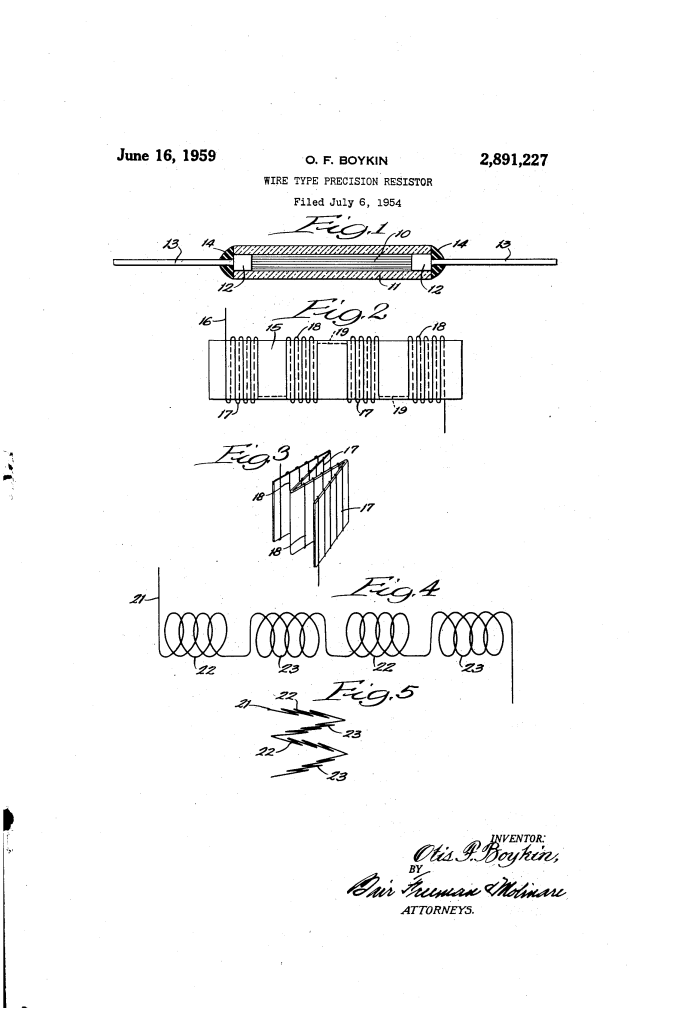
1. Opposing Sections (17, 18)
Boykin wound the resistance wire onto a flat insulating tape in a series of separated sections.
- Directional Reversal: Each section is wound in the opposite direction of the one next to it.
- Flux Cancellation: Because the current flows one way in Section A and the opposite way in Section B, the resulting magnetic fields (flux) are balanced and neutralized.
2. The Pleated Fold (Interleaving)
To save space, the flat tape is slit at the edges and folded over between the sections. This “pleated” relationship stacks the sections on top of one another, further canceling inductive effects while keeping the unit compact enough to fit inside a tiny protective tube.
How the Apparatus Functions
The manufacturing and operational process follows a precise mechanical logic to ensure electrical stability:
| Step | Action | Purpose |
| 1. Primary Winding | Wire is wound onto a flat insulating tape (paper or woven glass fiber). | Establishes the base resistance value. |
| 2. Reversing | The wire is passed through slits (19) to reverse the direction for the next section. | Creates the “anti-inductive” magnetic alignment. |
| 3. Pleating | The tape is folded into a “Z” or accordion shape. | Superimposes the sections to cancel flux and minimize size. |
| 4. Encapsulation | The folded unit is inserted into a ceramic or glass tube (11) and sealed with wax or varnish (14). | Protects the delicate wire from moisture and mechanical vibration. |
| 5. Termination | The ends of the wire are connected to enlarged end portions (12) of the terminals (13). | Ensures a tight, reliable circuit connection for external use. |
Technical Components
- Insulating Tape (15): A flat carrier made of paper, woven glass, or plastic film. It keeps the individual loops of wire slightly separated to minimize capacitance.
- Adhesive Material: In an alternative version (Fig. 4), the wire is held in self-supporting flat loops using wax, varnish, or plastic adhesive instead of a tape carrier.
- Ceramic Body (11): Provides the outer structural rigidity and high-temperature insulation required for precision electronics.
- Flattened Helix: The wire in each section forms a flattened coil, ensuring current flows in opposite directions in closely adjacent portions of each loop.
Historical and Scientific Impact
Otis Boykin’s invention was a milestone in the development of reliable, high-performance electronics during the Space Age and the Cold War.
- Precision and Reliability: These resistors were capable of maintaining stable values under extreme temperature changes and vibrations, making them essential for guided missiles and mainframe computers.
- The Pacemaker: Boykin’s expertise in precision resistors later led to the development of components used in the artificial heart pacemaker, a device that has saved millions of lives.
- Economic Production: The design was specifically optimized for automatic winding machinery, allowing these high-end components to be produced rapidly and inexpensively.
About the Inventor: Otis F. Boykin
Otis Frank Boykin was a prolific African American inventor and engineer who held over 25 patents.
- Scientific Legacy: Born in Texas and educated at Fisk University and the Illinois Institute of Technology, Boykin became a world-renowned expert in resistors and electronic control devices.
- Global Impact: His components were used by the U.S. military, IBM, and in household items like televisions and radios.
- Pioneer Status: At a time when opportunities for Black engineers were often restricted, Boykin’s technical brilliance led him to become a senior project engineer and a consultant for major American and European technology firms.
Summary of Claims
The patent explicitly claims:
- A resistor formed into a plurality of connected but separate sections, with adjacent sections wound in opposite directions.
- A design where the loops of each section lie in parallel planes to achieve magnetic flux cancellation.
- The method of folding or pleating the sections to superimpose them into a compact body.
- The use of insulating means in intimate contact with the turns to sustain their spacing and regular disposition.
