
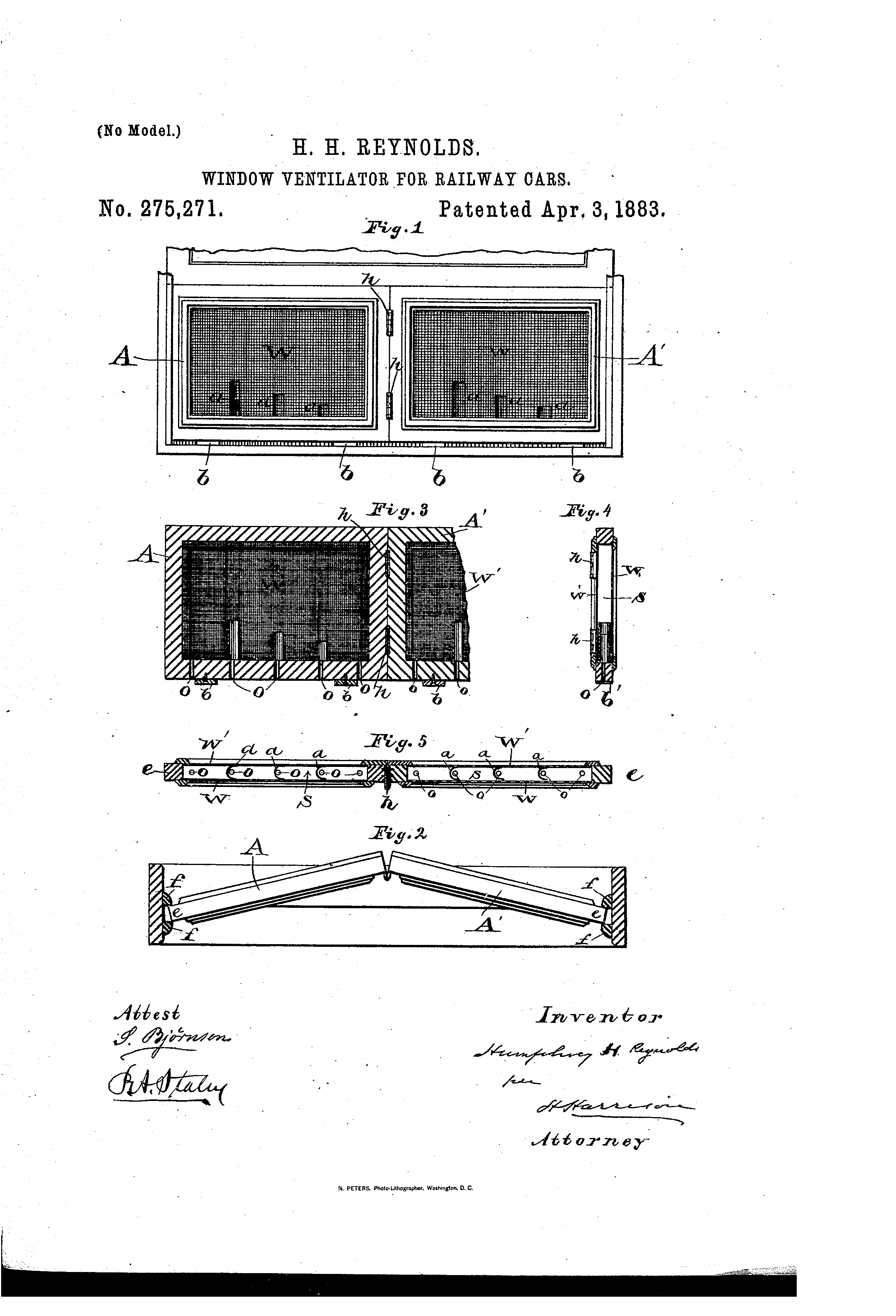
Window-Ventilator for Railway-Cars (Humphrey H. Reynolds, No. 275,271) 🚂
The patent by Humphrey H. Reynolds of Minneapolis, Minnesota, describes a Window-Ventilator for Railway-Cars (Patent No. 275,271, 1883). The object is to provide a simple and inexpensive device to be placed under a window sash to thoroughly ventilate the car without causing a draft and without the admission of cinders, gnats, etc.
Inventor Background: Humphrey H. Reynolds
Humphrey H. Reynolds was an inventor focused on improving the comfort of railway travel, a significant industry in the late 19th century. His invention addresses a common complaint of passengers: the choice between fresh air and being inundated with soot, cinders, and drafts, especially prevalent on steam-powered trains.
Invention and Mechanism (Simplified)
The ventilator is a hinged, double-screened panel designed to be placed under a slightly raised car window sash, using the motion of the train to passively filter and direct air.
- Hinged, Portable Frame: The ventilator consists of two wooden or metal frames that are hinged together. When opened fully, their combined length equals the width of the window sash. When not in use, the device can be folded together for storage.
- Double Filtration (Key Innovation): The frames are covered inside and outside with wire-cloth (screening), leaving a space in between.
- Outer Screen: Comparatively coarse, designed to arrest all cinders and large debris.
- Inner Screen: Very fine, designed to diffuse the air and stop dust and gnats before the air enters the car.
- Draft and Deflector System:
- Air Intake: The frames have a series of small openings on the bottom, which open into the space between the screens. Small pieces of rubber on the bottom slightly lift the frame off the windowsill to keep these openings clear.
- Deflectors: Semi-cylindrical deflectors are placed over these bottom openings, facing the direction the train is traveling.
- Function: The forward movement of the train forces air into the space. The deflectors guide this forward-moving air, which is then diffused through the inner fine screen. This creates a current of cool, refreshing air that is free from impurities and drafts.
- Installation: The sash is raised, the hinged frames are inserted and turned straight, and the sash is lowered to rest on the upper edge of the frame, holding it firmly in position.
Concepts Influenced by This Invention
Reynolds’s ventilator influenced subsequent designs for passive filtration and air management in transportation and buildings, establishing the principle of sequential, differential screening combined with directional airflow modification.
- Sequential/Differential Filtration: The core concept of using two layers of screening of different fineness (coarse outside for debris, fine inside for diffusion and dust) influenced the design of modern air intake systems, cabin air filters, and filtration units that use multiple media stages for comprehensive purification.
- Passive Ram-Air Ventilation: The use of external air deflectors to capture the air stream created by the vehicle’s motion and direct it inward is a form of passive ram-air ventilation. This principle influenced early designs of automotive and rail car ventilation systems.
- Window-Sill/Sash Fit Devices: The invention of a folding, adjustable insert that secures non-destructively under a lowered window sash influenced the design of modern portable window fans, storm window inserts, and temporary window ventilation blocks.
- Draft Diffusion: The inner fine screen serves as a diffuser, breaking up the incoming air current to prevent a harsh draft. This concept is fundamental to modern HVAC vents and air distribution panels.
