
Weather-Shield (Edward H. West, No. 632,385)
The patent by Edward H. West of Boston, Massachusetts, describes a Weather-Shield (Patent No. 632,385, 1899) for street-railway cars. The object is to provide a cheap, efficient, and convenient device that offers complete protection to the motorman from the weather without interfering with his movements or obstructing his vision.
Inventor Background: Edward H. West
Edward H. West was an inventor focused on transit utility and safety. His invention addresses a critical ergonomic and safety issue for motormen in the late 19th century: protecting them from rain, snow, and cold while ensuring they maintained full control and clear visibility, particularly important for open-platform streetcars.
Invention and Mechanism (Simplified)
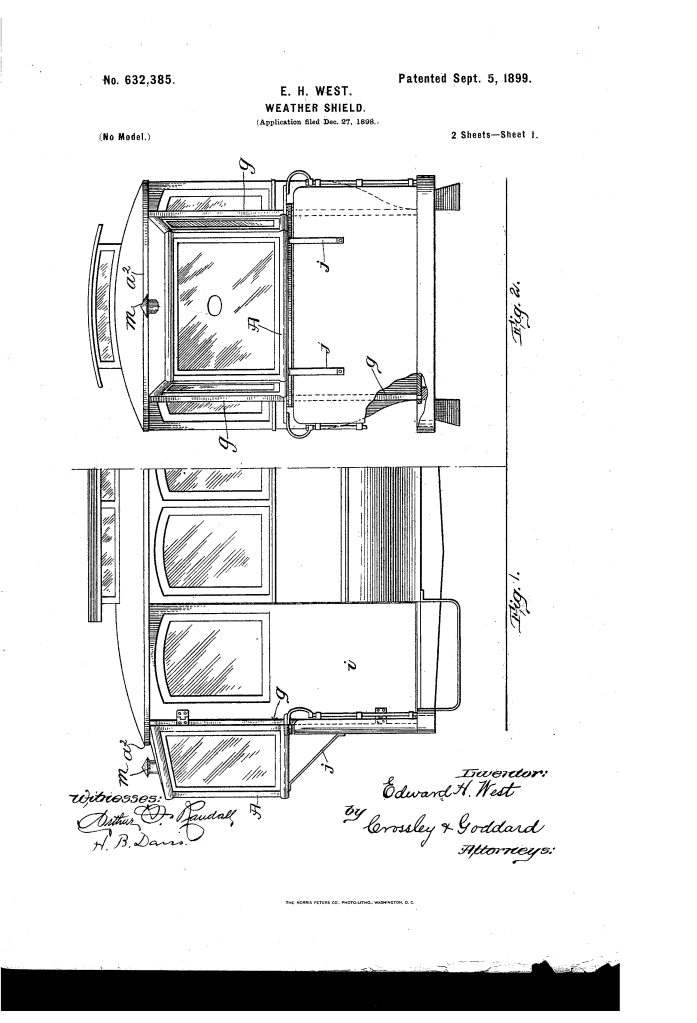
The shield is a modular, transparent casing that clamps onto the front of the car and can be quickly transformed to suit changing weather.
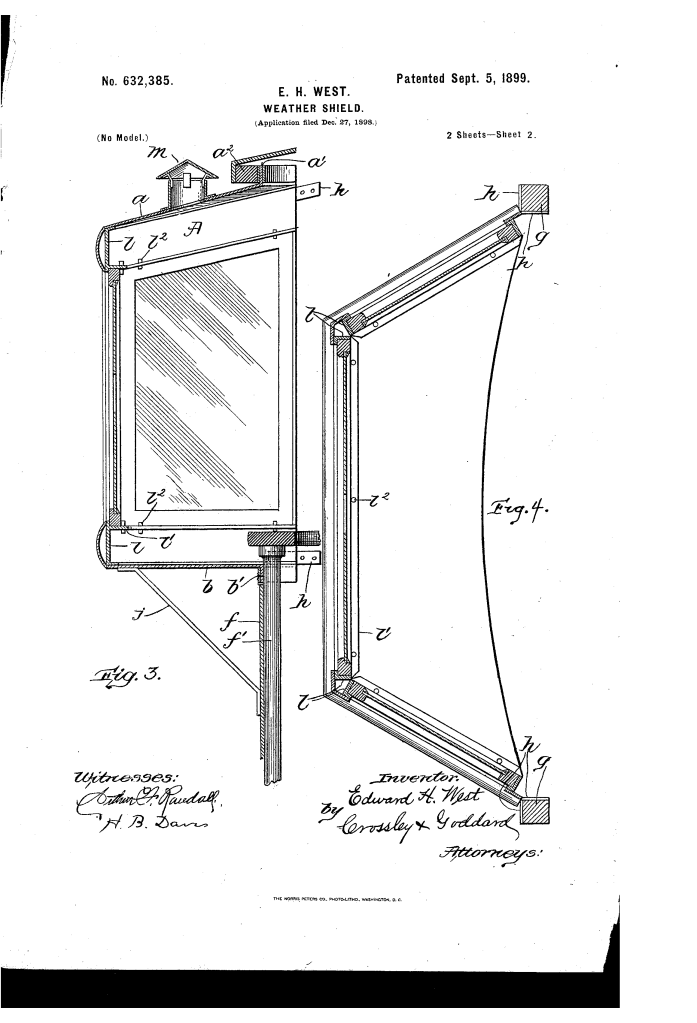
- Skeleton Framework: The device is a lightweight frame built with a top and a bottom that are curved to match the car’s roof and dashboard. The front and sides are designed to hold windows.
- Tool-less Attachment (Clamping): The shield is designed to clamp onto the car without requiring permanent modifications to the car itself.
- Top Lock: The top has an upwardly-turned flange that fits against the protective bead of the car roof and is secured by screws.
- Bottom Lock (Key Innovation): The bottom has a depending flange that is slipped in between the dashboard and its supporting posts. This simple mechanical fit holds the bottom securely.
- Support and Doors:Removable upright posts (g) are stepped into the platform and the roof.
- Function: These posts serve a dual purpose: they secure the shield frame in place, and they act as door-posts to which side doors are hinged, completing the motorman’s enclosure.
- Quick-Change Windows: The window sashes are held in the skeleton frame by simple pins ($l^{2}$) thrust into holes.
- Function: To adapt to sudden weather changes, the windows can be quickly and easily removed by withdrawing the pins, allowing the shield to be instantly transformed from a closed cab to an open windbreak.
- Anti-Fogging: A ventilator ($m$) is provided above the windows to allow warm, moist air (the motorman’s breath) to escape instead of condensing on the glass.
- Ergonomics: The shield projects beyond the dashboard so it doesn’t interfere with the motorman’s operation of the brake or current-controller.
Core Concepts Influenced by This Invention
West’s weather shield influenced subsequent design by pioneering non-destructive, quickly convertible, and modular enclosures for vehicles and equipment.
- Non-Destructive/Mechanical Clamping: The core concept of using a simple structural fit (the bottom flange slipping between the dash and its support posts) for securing a large accessory, rather than extensive bolting, influenced the design of:
- Modular Vehicle Attachments: Tools and accessories that clamp onto existing frame or body structures (e.g., roof racks, truck bed liners).
- Convertible Enclosure Design: The use of removable pins and easily detachable sashes to allow the enclosure to be quickly transformed from a fully shielded cab to an open state influenced the design of:
- Convertible Cabins: Enclosures for forklifts, construction equipment, and golf carts that can be modified for open or closed operation based on weather.
- Multi-Functional Support: The design where the removable upright posts serve the dual role of securing the shield and acting as door hinges influenced the engineering of modular frame systems where every structural component performs at least two distinct functions.
- Passive Anti-Fogging: The inclusion of a simple ventilator ($m$) above the windows to prevent condensation influenced the design of passive ventilation and defrosting systems in enclosed vehicle cabs.
