
Waveguide Components (1962)
U.S. Patent No. 3,046,507, granted on July 24, 1962, to Howard S. Jones, Jr., describes an innovative method for fabricating complex microwave waveguide components. At the time, creating waveguides with “odd” shapes—such as twists or transformers—was extremely expensive and difficult because traditional machining couldn’t always maintain the precise internal tolerances needed for a clean signal (impedance match).
Jones’s solution was to move away from solid-cast or bent-tube construction in favor of a stacked-plate assembly.
The Problem: Complex Internal Geometries
Waveguides are hollow metallic pipes used to carry high-frequency radio waves. To manipulate these waves, engineers often need:
- Twist Sections: To rotate the polarization of the electromagnetic field.
- Transformer Sections: To change the cross-sectional dimensions of the waveguide (impedance matching).
- Combination Sections: Doing both at once in a very short distance.
Machining a smooth, continuous spiral or a tapering internal cavity inside a solid block of metal is a manufacturing nightmare. If the internal dimensions are off by even a tiny fraction, the signal reflects back, causing power loss.
The Innovation: The Stacked Plate Method
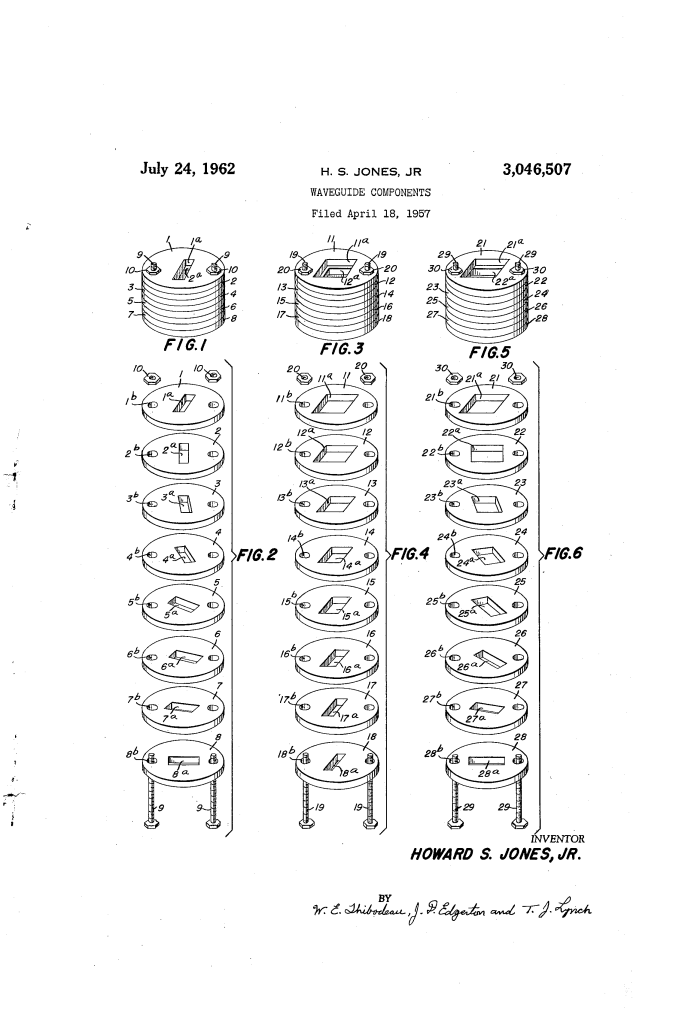
Jones proposed building these complex shapes by stacking a series of thin, flat metallic plates. Each plate has a central slot that is slightly different from the one before it. When fastened together, these individual “steps” create a smooth overall transition for the microwave energy.
1. The Waveguide Twist (FIG 1 & 2)
To create an 80-degree twist, Jones used eight plates.
- Each plate has a rectangular slot in the center.
- Each subsequent plate is rotated 10 degrees relative to the previous one.
- The result is a “staircase” twist that, to a high-frequency wave, behaves like a continuous 80-degree rotation.
2. The Waveguide Transformer (FIG 3 & 4)
To transition a waveguide from “full-width” to “half-width”:
- Eight plates are stacked concentrically.
- The slot in each plate is progressively narrower (e.g., 15/16th width, then 7/8th, etc.).
- This creates a stepped “taper” that effectively matches the impedance between two different waveguide sizes.
3. The Transformer-Twist (FIG 5 & 6)
This is the most complex component. By combining the two previous methods, Jones created a component that simultaneously rotates and narrows the waveguide. Each plate in the stack is both rotated 10 degrees and has a slightly narrower slot than the one preceding it.
Key Technical Features
| Feature | Specification/Detail |
| Material | Circular metallic plates (typically brass or aluminum) |
| Fastening | Guide holes (1b–28b) around the periphery secured by screws (9/19) and nuts |
| Alignment | Precise guide holes ensure each “step” is perfectly indexed |
| Advantages | Inexpensive, high tolerance, allows for extremely short components |
Why This Mattered
Jones’s method turned a high-precision machining problem into a simple stamping or milling task. It allowed for the creation of very short components, which was vital as electronic systems (like radar and missile guidance) became smaller and more compact. It also allowed for “prototyping” odd shapes quickly by simply swapping out individual plates in the stack to tune the performance.
