
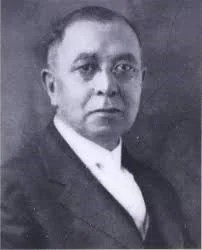
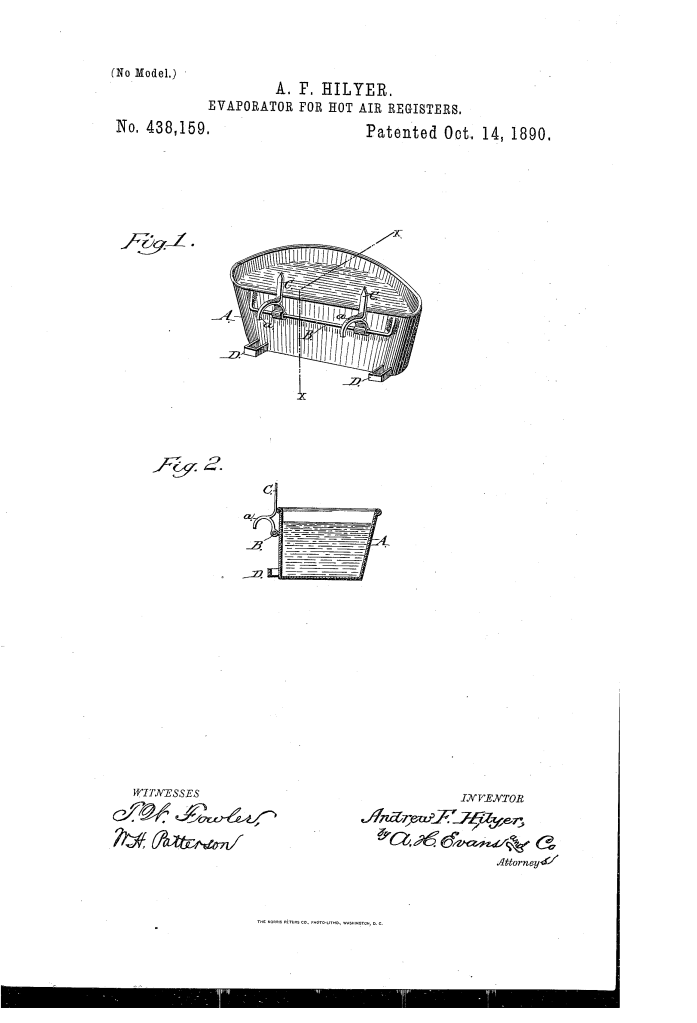
Evaporator for Hot-Air Registers, Andrew F. Hilyer, Patent No. 438,159
The patent by Andrew F. Hilyer of Washington, D.C. describes an Evaporator for Hot-Air Registers (Patent No. 438,159). This invention is a specialized humidification device designed to be retrofitted onto 19th-century heating vents to improve indoor air quality through heat-driven evaporation and capillary action.
The “Why”: Solving the Dry Air Dilemma
During the late 19th century, the transition to coal-fired, hot-air furnaces created a significant “pain point” in American households: extreme respiratory discomfort. These heating systems stripped moisture from the air, leading to dry skin, throat irritation, and the spread of dust. Hilyer recognized that standard water pans were inefficient because they lacked sufficient surface area and could not be positioned effectively within the path of the highest heat.
Inventor Section: The Engineering Philosophy of Andrew F. Hilyer
Andrew F. Hilyer (1858–1925) was a true polymath—an author, lawyer, and civil rights leader who applied a “utility-first” engineering philosophy to household health. As a Black pioneer living in post-Reconstruction Washington D.C., Hilyer’s work was characterized by elegant simplicity. He focused on inventions that were affordable and easily integrated into existing infrastructure, ensuring that improved health and comfort were accessible even to those facing economic marginalization.
Key Systems Section
1. Adjustable Suspension & Leveling System
The device utilizes a mechanical linkage consisting of adjustable hooks (a) journaled upon a horizontal bar (B).
- Modern Translation: This is a pivoting bracket assembly.
- Function: It allows the tank to hang securely from various register sizes. The “stops” (D) at the base act as spacers, ensuring the tank remains perfectly level against the wall to prevent water spillage.
2. Capillary Surface Area Expansion
The most ingenious feature is the use of integrated vertical pins (C) designed to hold a porous cloth.
- Modern Translation: This is a wicking system or passive evaporative media.
- Function: By draping a cloth over the pins with its ends submerged in the tank, the device utilizes capillary attraction (the movement of liquid through a porous material against gravity) to vastly increase the surface area of the water exposed to the hot air.
3. Thermal Positioning
Unlike floor-based pans, Hilyer’s design allows the evaporator to be mounted at the very top of the register.
- Modern Translation: Convective heat transfer optimization.
- Function: By placing the water source at the point of maximum thermal output, the rate of phase change from liquid to vapor is accelerated.
Comparison: Standard Methods vs. The Hilyer Innovation
| Feature | Standard 1890s Methods | Hilyer’s Evaporator |
| Placement | Floor pans or internal furnace pots. | Direct-mount at the heat source (top of register). |
| Surface Area | Limited to the surface of the water in the pot. | Exponentially increased via cloth wicking. |
| Air Quality | Moisture only; often stagnant. | Dual-action: Adds moisture and filters dust via the wet cloth. |
| Adjustability | Static; “one size fits all.” | Adjustable hooks and leveling stops for universal fit. |
Significance
- Precursor to Modern HVAC Humidifiers: The use of a “wick” to pull water into an air stream is the foundational principle of modern whole-home evaporative humidifiers.
- Early Air Filtration: Hilyer explicitly notes that the wet cloth would “catch the dust,” making this an early iteration of a combined humidifier and air filter.
- Ergonomic Design: The dual-purpose pins serve as both wick-holders and handles, showing a sophisticated approach to User Experience (UX) design.
