
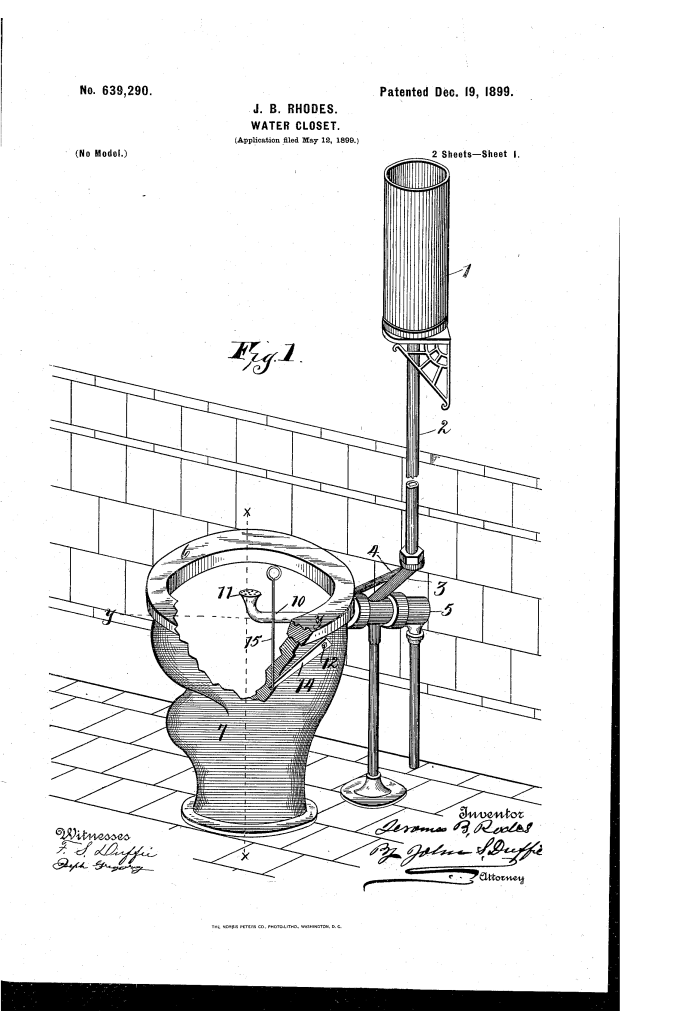
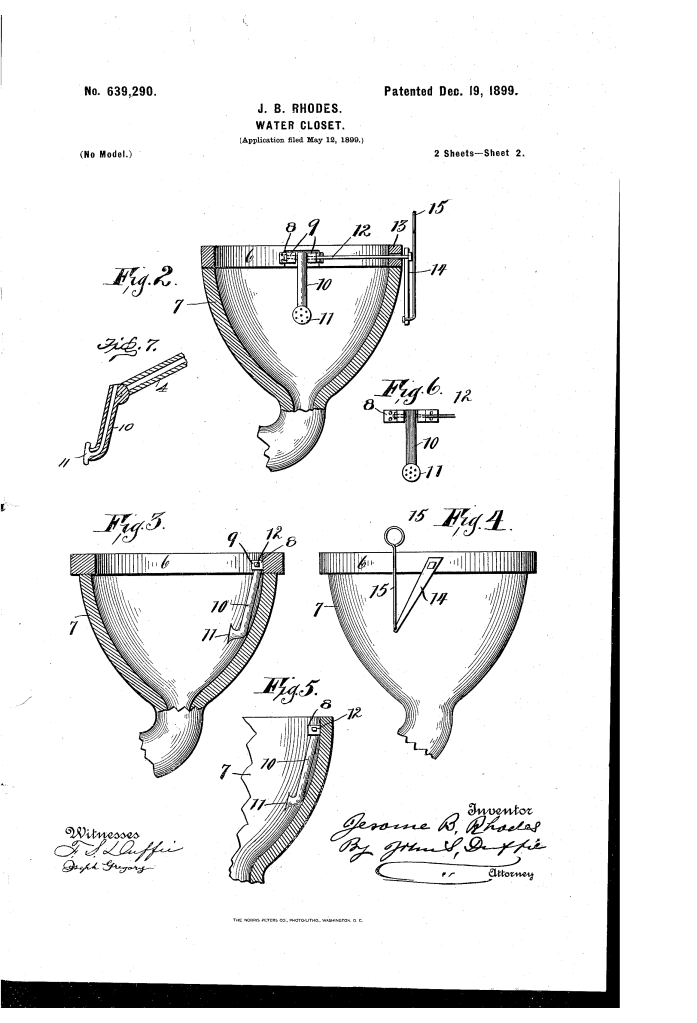
Water-Closet Attachment (1899)
U.S. Patent No. 639,290, granted on December 19, 1899, to Jerome Bonaparte Rhodes, details a targeted therapeutic bidet-style attachment integrated directly into a standard water-closet. Jerome B. Rhodes, an inventor based in Shreveport, Louisiana (Caddo Parish), designed the mechanism specifically for personal hygiene and medicinal relief.
At the turn of the 20th century, internal plumbing and sanitary fixtures were rapidly advancing, yet specialized hygienic devices were largely confined to standalone, high-end European bidet basins. Rhodes identified a practical medical and domestic need: an affordable, retrofittable mechanism that could wash and spray the lower anatomy directly inside standard commodes without obstructing normal fixture use.
The Innovation: The Retractable Pivot Spray
The core problem with introducing a wash pipe inside a commode bowl was sanitation and spatial clearance. If stationary, an interior pipe would quickly become soiled or interfere with standard bowl evacuation.
Rhodes solved this with a pivoting mechanical linkage that serves two simultaneous functions:
- Sanitary Stowing: When not in use, the spray pipe drops down flat against the inner rear wall of the bowl, completely out of the drop line and protected from contamination.
- Integrated Flow Control: Raising the pipe automatically engages water flow, while lowering it cuts off the water supply, functioning much like a swing-faucet valve.
Technical Components
Rhodes designed the apparatus to mount either to a traditional stationary wooden rim or directly to porcelain commode bowls:
| Component | Patent Callout | Mechanical Function |
| Reservoir & Main Supply | Pipes 1, 2, 3 | Feeds overhead water from the main cistern down toward the fixture. |
| Spray Supply Pipe | Pipe 4 | Dedicated conduit drawing pressurized water directly to the internal assembly. |
| Hinged Mounting Bracket | Bracket 8 / Lugs 9 | Secured to the rear rim or inner wall; features perforated lugs that cradle the pivoting pipe. |
| Spray-Pipe & Nozzle | Pipe 10 / Spray 11 | Retractable pipe terminating in an upward-facing rose nozzle designed for focused washing. |
| Pivot Rod | Rod 12 | Horizontal axle passing through the bowl or rim wall to translate external movement to the internal pipe. |
| Leverage Linkage | Arm 14 & Lifting-Rod 15 | External crank arm and pull rod accessible above the casing for seated manual operation. |
How the Apparatus Functions
The apparatus relies on a direct mechanical sequence operated entirely from outside the basin:
| Step | Action | Mechanical & Hygienic Purpose |
| 1. Stowed State | Spray-pipe 10 rests downward against the back wall of bowl 7. | Keeps the nozzle clean, unsoiled, and out of the way during standard commode use; water supply remains cut off. |
| 2. Engagement | The user pulls upward on external lifting-rod 15. | Pivots arm 14 and rotates horizontal rod 12 through aperture 13. |
| 3. Deployment | Spray-pipe 10 swings upward and forward into the center of the bowl. | Aligns spray nozzle 11 into position beneath the user. |
| 4. Washing | The pivoting joint opens water passage from supply-pipe 4 into spray 11. | Directs a therapeutic upward spray for personal washing and medical cleansing. |
| 5. Retraction | The user releases or lowers rod 15. | Swings pipe 10 back down against the porcelain wall, automatically cutting off the water flow. |
Historical and Practical Significance
Rhodes’s design addressed both preventative hygiene and post-operative or chronic medical care at the close of the 19th century:
- Therapeutic Treatment: The patent explicitly notes its utility when pelvic or rectal areas are diseased (such as hemorrhoidal inflammation or post-surgical recovery), providing non-contact hydrotherapy when manual contact was painful or unhygienic.
- Universal Retrofitting: The patent outlines two distinct installations: anchoring directly into the standard wooden box casings of the late Victorian era, or drilling directly through vitreous china/porcelain sinks using bolts and waterproof cement.
- Precursor to Modern Add-On Bidets: Decades before retrofittable mechanical bidet seats became common domestic household items, Rhodes established the foundational mechanics of a concealed, swinging nozzle actuated by a single exterior lever.
About the Inventor: Jerome Bonaparte Rhodes
Jerome Bonaparte Rhodes was an inventor based in Shreveport, Louisiana, active during the late 19th and early 20th centuries. His work with water-closet attachments reflects the creative municipal and residential adaptations developed by independent southern inventors to solve domestic sanitation challenges before standardized modern bathroom fixtures became universal.
Summary of Claims
The patent explicitly claims:
- The combination with a water-closet bowl of supply-pipe 4 connected to the main water line and routed to the interior.
- An internal bracket 8 with perforated lugs 9 anchored to the inner wall or wooden casing.
- A spray-pipe 10 hinged between the lugs, communicating at its rear with supply-pipe 4 to supply spray nozzle 11.
- A transverse rod 12 extending through the bowl structure, connected to external arm 14 and an upward-extending vertical lifting-rod 15 for manual actuation.
