
Ventilator (John Thomas Darkins, No. 534,322)
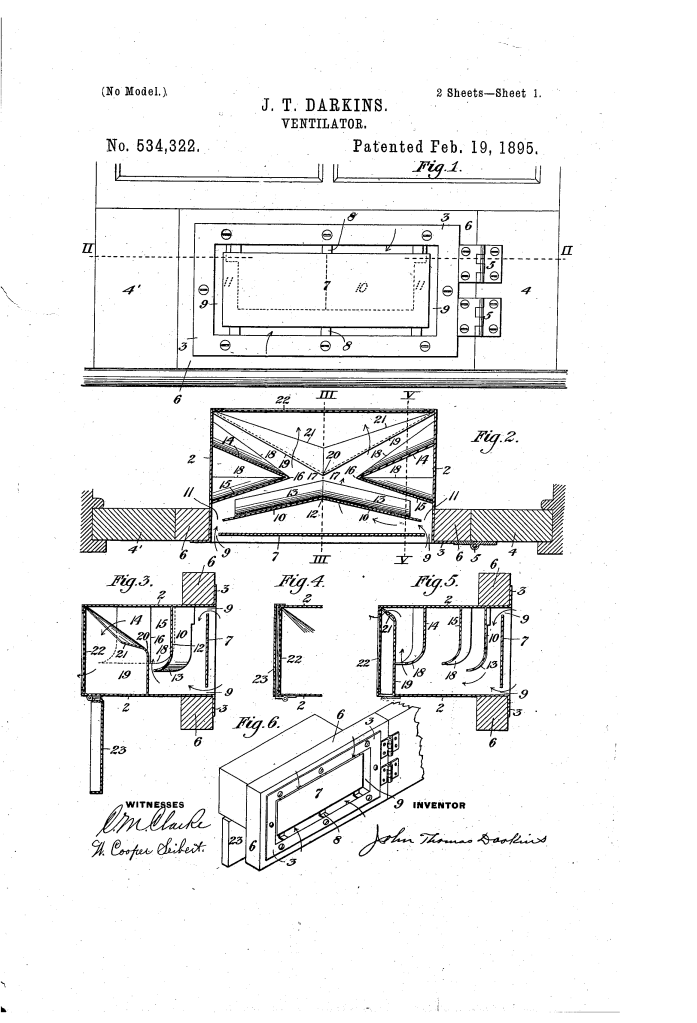
The patent by John Thomas Darkins of Allegheny, Pennsylvania, describes an improved Ventilator primarily designed to secure a constant supply of fresh air or removal of foul air in windows of buildings, and particularly in railway cars, vessels, or other moving structures. The main objective is to facilitate air passage while simultaneously excluding rain, dust, cinders, and other foreign matter using a series of strategically angled baffle plates.
Invention and Mechanism
The ventilator is a rectangular box or case, primarily constructed of light sheet metal, featuring two main designs: one for stationary use (windows) and one for moving vehicles (railway service).
1. General Principles (Baffle Walls)
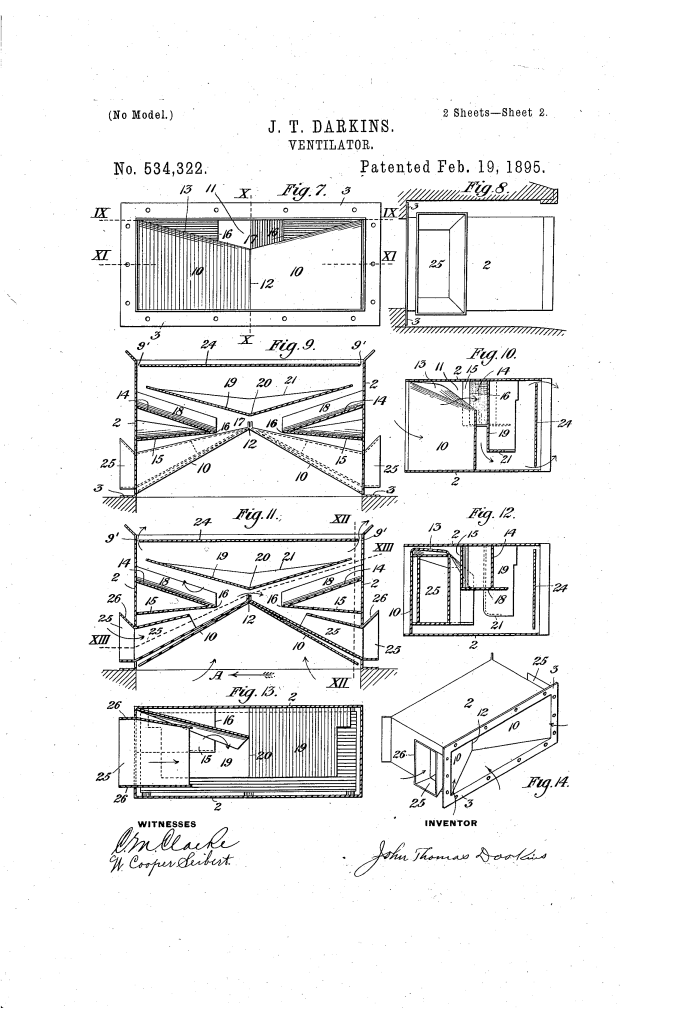
Both versions rely on internal deflecting plates, or baffle walls, set at different angles to guide air and trap particulates.
- Partitions (10, 14, 15, 19): These walls are arranged to create a tortuous path for the air current (indicated by arrows).
- Rounded Edges: The lower edges of partitions (10, 14, 15) are curved under (13, 18) in the direction of the air current to offer a rounded surface and minimize resistance to air flow.
- Filtration: Foreign matter hitting the partitions is thrown downward onto the bottom of the case, from which it can be easily removed.
2. Stationary Ventilator (Sheet 1)
This form is designed for windows and functions as both an induction (fresh air intake) and eduction (foul air exhaust) ventilator by reversing its position.
- Window Mounting: The ventilator case (2) is hinged (5) to a swinging block (6), which is fitted against a partition block (4). This assembly is designed to completely fill the space under a raised window sash.
- Air Flow Components:
- Diaphragm (7): Secured slightly back from the front face, leaving a surrounding space (9) for air to enter or exit.
- Wire-Gauze Screen (22): Covers the outside of the case to prevent the passage of insects.
- Hood (23): Hinged to the bottom, it can be swung up over the case to completely close the opening if desired.
3. Railway Ventilator (Sheet 2)
This form is optimized for motion, typically placed high on the car (under the upper deck/roof) to withdraw foul air.
- Exclusion of Diaphragm: The diaphragm (7) is replaced by a simple partition (24) with a surrounding space (9′).
- Air Induction Funnel (25): A funnel with flaring, outwardly projecting lips (26) is placed at each end of the case.
- Function: This funnel is the key feature for moving vehicles, designed to collect and conduct air rushing in during the car’s movement (indicated by arrow A), thereby increasing the natural draft by suction to remove foul air from the car interior.
Historical Significance and the Inventor
John Thomas Darkins’s 1895 patent addresses critical issues in public health and comfort during the late 19th-century.
- Public Health and Air Quality: Ventilation was a major public health concern, especially in crowded spaces like railway cars. Without proper air exchange, conditions were stuffy, and the spread of disease was facilitated. Darkins’s system directly responded to the need for a constant, fresh air supply.
- Railway Comfort: The railway version of the ventilator was vital for passenger comfort. Trains of the era were powered by coal and steam, meaning open windows brought in copious amounts of smoke, cinders, and dust. Darkins’s complex system of baffles was an advanced mechanical solution to allow air exchange while excluding these irritants, vastly improving the passenger experience.
- The Inventor (John Thomas Darkins): Darkins was typical of inventors focused on improving the utility and comfort of specialized machinery and public conveyance systems in rapidly industrializing areas like Allegheny, Pennsylvania (now part of Pittsburgh). His work fits within the larger engineering trend of using simple sheet metal construction and passive mechanics to solve complex fluid dynamics problems.
Relation to Current Items
Darkins’s design is the direct conceptual antecedent for modern air handling and passive filtration:
- Louvered and Baffled Vents: The use of multiple angled internal plates to block rain and foreign matter while allowing airflow is the fundamental principle of modern louvered vents, air intake grilles, and furnace cowls , which must protect interiors from environmental debris.
- Passive Air-Oil Separators: The technique of causing particulates (dust, cinders) to hit a surface and drop out of the air stream is analogous to modern cyclone separators and inertia separators, used in industrial ventilation and dust collection systems.
- Ram-Air Induction: The railway design, which utilizes the forward motion of the vehicle (ram air) and the funnel (25) to actively draw air into or out of the car, is a direct precursor to modern ram-air intake systems used in performance vehicles and aircraft to pressurize the cabin or boost engine power.
