
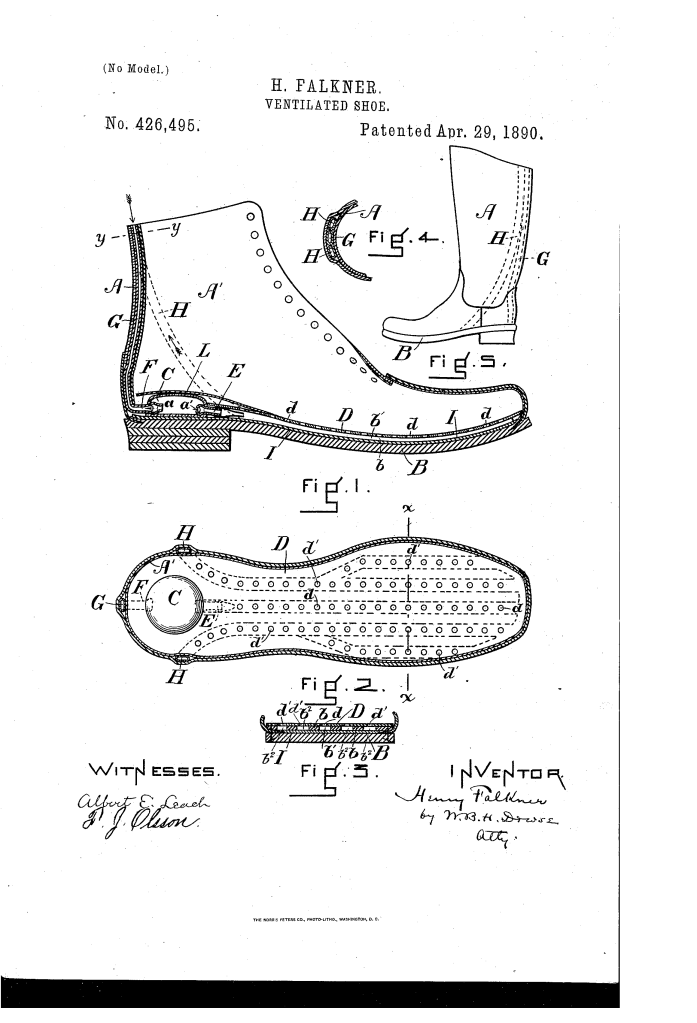
Ventilated Shoe (1890)
U.S. Patent No. 426,495, granted on April 29, 1890, to Henry Falkener, introduces a mechanical solution to the age-old problem of “hot and uncomfortable” footwear. Falkener, a resident of Cambridge, Massachusetts, designed an automated air-circulation system built directly into the structure of a boot or shoe.
This invention addressed the specific health needs of individuals suffering from chilblains, cramps, and habitually moist feet. By utilizing the natural motion of walking, Falkener transformed the shoe into a self-contained bellows that constantly swapped “foul air” for fresh, outside air.
The Innovation: The “Heel-Pump” Mechanism
The heart of the design is a hidden, flexible rubber bulb (C) situated in the heel. Unlike static ventilation holes that rely on passive airflow, Falkener’s system is active. It uses the weight of the wearer to physically pump air through the garment.
- The Intake: As the wearer lifts their heel during a stride, the bulb expands, creating suction that pulls fresh air down a tube located at the back of the leg.
- The Compression: When the heel strikes the ground, the bulb is compressed, forcing the fresh air through a valve and into the sole of the shoe.
How the Apparatus Functions
The process follows a rhythmic cycle that ensures the foot remains dry and the temperature regulated:
| Step | Action | Result |
| 1. The Lift | Heel rises; Bulb (C) expands. | Fresh air is drawn through Inlet Tube (G) into the heel. |
| 2. The Strike | Heel presses down; Bulb (C) collapses. | Air is forced past Valve (a) into the central sole passage. |
| 3. Distribution | Air enters through Perforations (d). | Fresh air is delivered directly to the sole of the foot. |
| 4. Exhaust | Pressure pushes old air into Side Passages (b2). | “Foul air” and moisture are expelled out through Outlet Tubes (H). |
Key Technical Components
Falkener’s design was sophisticated, requiring a multi-layered sole to keep the air channels separate and functional:
- Perforated Inner Sole (D): Features rows of holes that allow air to move between the foot and the internal air channels.
- Metal Inner Sole (I): A thin metal layer placed above the outer sole to prevent external moisture (like puddles or rain) from entering the ventilation system.
- Longitudinal Passageways (b1, b2): A system of three independent channels; a central “fresh air” lane and two flanking “exhaust” lanes.
- The Valve-Case (F): A critical check-valve that ensures air only moves in one direction, preventing the wearer from simply “inhaling” the same air back into the pump.
Historical and Scientific Impact
At the time of its filing in 1889, the “Ventilated Shoe” represented a shift toward hygiene-focused footwear.
- Climate Adaptability: Falkener specifically noted that the shoe was “especially adapted for dry hot climates.” However, he included a “winter mode” where the tubes could be closed to make the shoe as airtight as standard footwear.
- Application to Rubber Boots: The patent highlights the particular discomfort of rubber boots, which are waterproof but trap sweat. This invention provided the first viable way to make a rubber boot “breathe” without compromising its waterproof integrity.
- Podiatric Health: By keeping the foot dry, the invention aimed to reduce the bacterial and fungal growth associated with moist environments, which was a significant concern in the late 19th century.
About the Inventor: Henry Falkener
Henry Falkener was an inventor based in Cambridge, Massachusetts. His work reflects the late-Victorian era’s obsession with “healthful” living and the application of mechanical engineering to daily attire. His design was unique for its time because it did not interfere with the comfort of the wearer; he noted that the bulb was shallow enough that the “slightest movement” was sufficient to trigger the circulation.
Summary of Claims
The patent explicitly claims:
- A combination of air-admitting and air-expelling tubes placed between the outer material and the lining of the upper.
- A separate and independent system of longitudinal passages in the sole.
- The use of an operating-bulb in the heel to drive the entire pneumatic system through the act of walking.
