
Self-Propelled Automatic Lawn Mower (1963)
U.S. Patent No. 3,077,067, granted on February 12, 1963, to C. Nokes, introduces an early vision of robotic lawn care: a self-propelled mower designed to operate entirely without manual guidance. Nokes developed this system to alleviate the repetitive labor of yard maintenance by using an automated control device to navigate complex patterns.
While self-propelled mowers existed at the time, they still required a human operator to steer. Nokes’s invention solved the problem of manual labor by incorporating a programmable steering mechanism that could guide the machine in a predetermined square, rectangular, or polygonal spiral path.
The Core Design: The “Timer-Solenoid” Steering System
The brilliance of the Nokes mower is its automated steering geometry. Instead of sensors or perimeter wires found in modern robotic mowers, this 1963 model relied on mechanical timing and electromechanical force to change direction.
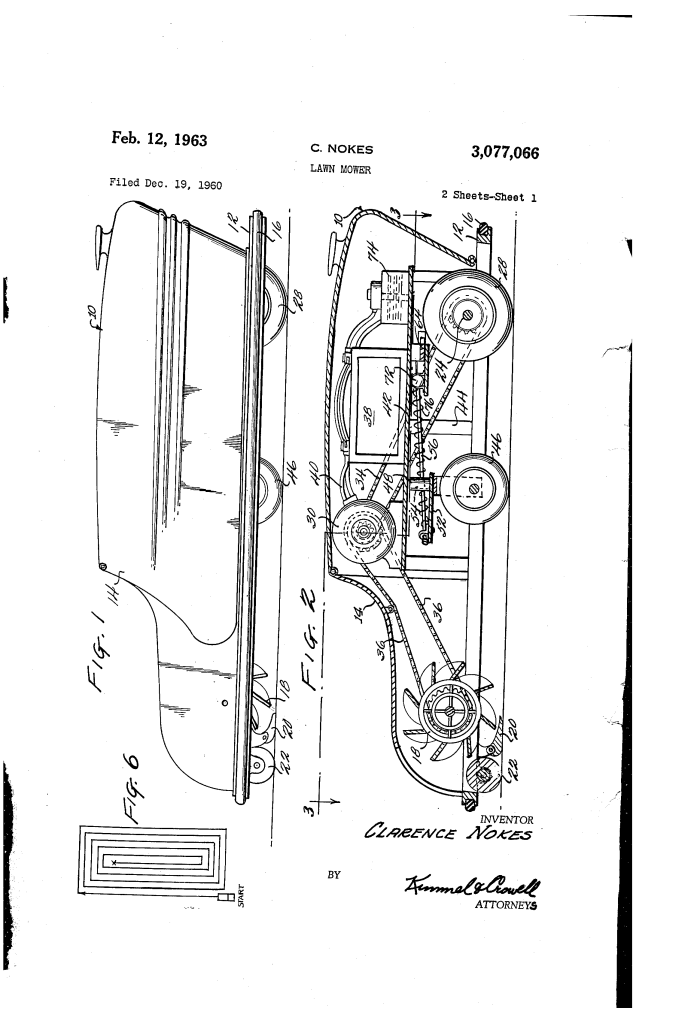
1. The Steerable Swivel Wheel (46)
The mower is supported by a single front wheel capable of 360-degree rotation about a vertical axis. This swivel movement allows the mower to make the sharp turns necessary for a spiral cutting pattern.
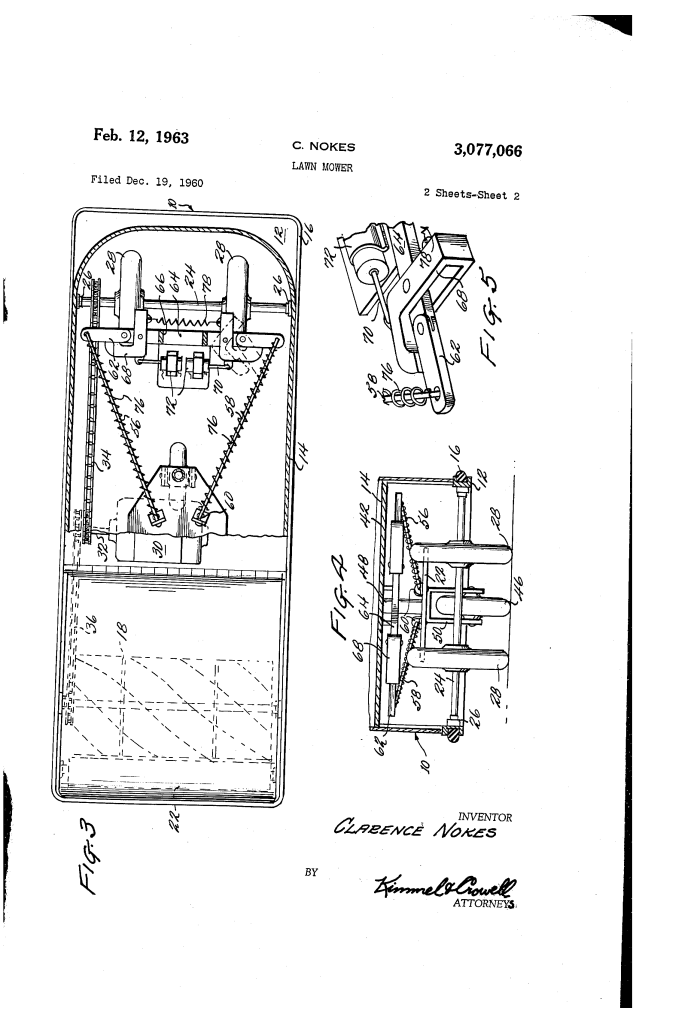
2. The Electromechanical Actuators (72)
To turn the wheel, Nokes utilized a pair of solenoids—devices that convert electrical energy into linear motion.
- When a solenoid is energized, it pulls an actuator rod (70).
- This motion travels through a bell crank (68) and a series of links to pivot the front wheel.
- Centralizing Springs (76, 78): These ensure that once the turn is complete, the wheel automatically snaps back to a straight-ahead position.
How the Apparatus Functions
The mower operates as a fully integrated mobile robot, following a specific sequence programmed into its onboard “brain”:
| Step | Action | Purpose |
| 1. Programming | The user sets the Timer (74) based on the dimensions of the lawn. | Determines when and for how long the mower will turn. |
| 2. Propulsion | An Electric Motor (30) drives the rear axle and the cutting reel simultaneously. | Provides the “work” force for both movement and mowing. |
| 3. Navigation | At a set interval, the timer sends a pulse of electricity from the Battery (38) to a solenoid. | Triggers a turn at a specific corner of the yard. |
| 4. Correction | Springs pull the steering linkage back to the center once the pulse ends. | Resumes straight-line travel until the next timed interval. |
Technical Components
- Storage Battery (38): The primary power source, making the mower a remarkably early example of a cordless, electric-powered outdoor tool.
- Rotary Reel (18): A traditional reel-type cutting assembly associated with an adjustable cutter bar for a clean, precision snip of the grass.
- Resilient Bumper (16): A protective guard surrounding the frame to prevent damage to trees or the housing in the event of an accidental collision.
- Transverse Roller (22): Located behind the cutter bar, this allows the user to adjust the height of the cut for different grass types.
Historical and Scientific Impact
C. Nokes’s invention was a significant precursor to modern autonomous vehicle technology and robotics.
- Early Automation: It demonstrated that “timed logic” could replace human intervention for domestic tasks long before the advent of microprocessors.
- Efficiency: The spiral path (FIGURE 6) was mathematically chosen to ensure complete coverage of a rectangular area, moving from the outside perimeter toward the center.
- Battery Innovation: By utilizing a storage battery and electric motor, Nokes anticipated the current shift toward zero-emission, quiet lawn maintenance.
About the Inventor: C. Nokes
C. Nokes focused on the intersection of mechanical engineering and electrical controls. His work aimed to transform the lawn mower from a simple tool into an “easy to operate, dependable” appliance. By utilizing “commercially available” timers, Nokes proved that sophisticated automation could be manufactured inexpensively for the average homeowner.
Summary of Claims
The patent explicitly claims:
- A mower frame featuring steerable wheel means capable of pivoting about a vertical axis.
- A control system consisting of a timer and a pair of solenoids to automate steering.
- The use of interconnected springs to bias the steering wheel toward a straight-line condition.
- An integrated power system where a single motor and battery drive both the propulsion and the mowing assembly.
