
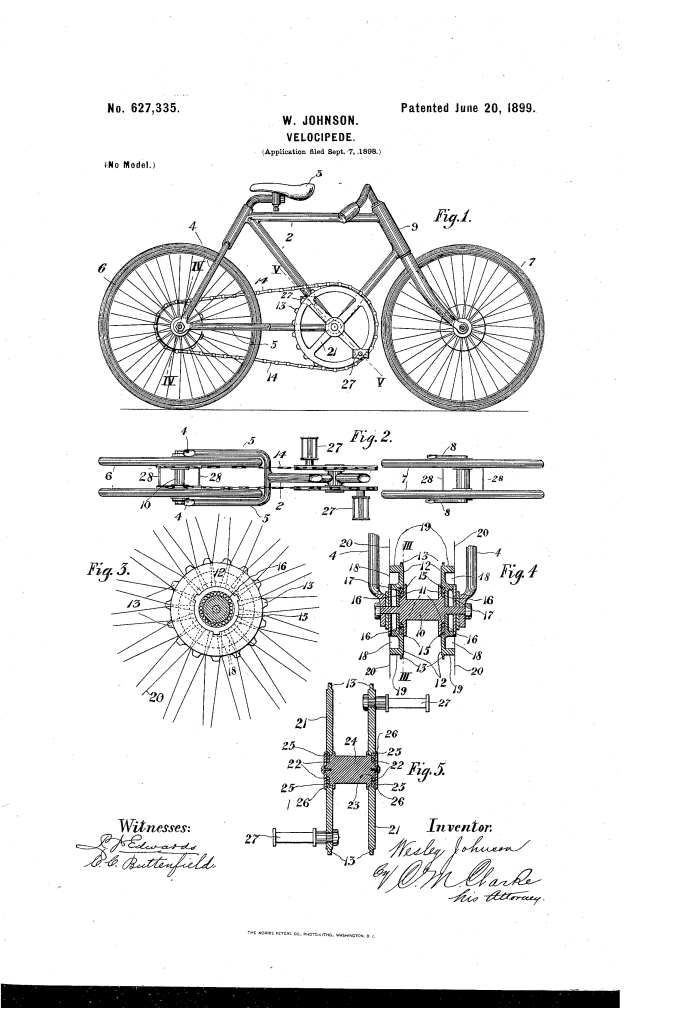
Velocipede (Wesley Johnson, No. 627,335)
The patent by Wesley Johnson of Pittsburg, Pennsylvania, describes a new and useful improvement in a Velocipede (Patent No. 627,335, 1899). The invention is essentially a four-wheeled machine built on a frame similar to a bicycle, designed to provide great stability and safety—making it especially suitable for beginners, elderly people, or invalids—without the danger of falling.
Inventor Background: Wesley Johnson
Wesley Johnson was an inventor focused on mechanical design and accessibility in transportation. His invention addressed the inherent instability of the two-wheeled bicycle, creating a four-wheeled version that retained the basic riding geometry but provided stability at rest and in motion, opening the market to users who lacked the balance required for a traditional bike.
Invention and Mechanism
The machine is a four-wheeled vehicle built on a standard diamond frame, featuring unique double-wheel and double-drive systems that keep the width minimal.
- Four-Wheel Stability:
- Frame (2): A standard diamond frame (or drop-frame) of a size conforming to an ordinary bicycle.
- Double Wheels: The machine has two rear driving-wheels (6) and two front steering-wheels (7).
- Narrow Track: The wheels are mounted between widely separated forks (4, 5, 8), but the main frame itself is narrow, ensuring the rider is not inconvenienced by “excessive width.”
- Driving and Steering:
- Steering: The forward wheels (7) are mounted between swivel-bearing forks (8) (like a bicycle fork) for steering.
- Rear Drive (Key Innovation: Independent Bearings): The rear wheels (6) revolve on a stationary axle (10) fixed between the rear forks. The wheel hubs are mounted on ball races (11) and rows of balls (16) to minimize friction.
- Double Drive Sprockets: The two driving sprocket-wheels (21) are independently mounted on separate rows of balls (22) on the central sprocket shaft (24). Pedals (27) are secured directly to these independent sprocket wheels.
- Function: This independent mounting ensures smooth operation and allows the double sprockets to be used without increasing the tread (the distance between the pedals), maintaining a comfortable riding stance.
- Reinforcement:
- High-Diameter Hub: The rear wheels are constructed with a large-diameter central hub (plate 12 and flange 19) connected by spokes (18, 20).
- Function: This construction stiffens the wheel and overcomes the tendency to buckle, which is a key issue in using straight spokes on a wider stance.
Concepts Influenced by This Invention
Johnson’s velocipede influenced the subsequent design of specialty vehicles by pioneering stability-enhancing dual-wheel systems and optimized independent drive trains.
- Stabilized Dual-Track Vehicles (Quads/Tricycles): The core concept of adding dual, widely-spaced wheels to a narrow frame to provide stability while maintaining the core riding geometry influenced the design of modern recumbent bikes, adult tricycles, and utility quads .
- Independent Bearing Assemblies: The use of multiple, distinct sets of ball bearings to mount the wheels (16) and the driving sprockets (22) on their respective shafts influenced the design of multi-speed gearboxes and specialized wheel hubs, prioritizing low friction and high mechanical efficiency across multiple moving parts.
- Non-Buckling Wheel Design: The use of large-diameter hub plates and flange extensions to stiffen the wheel against lateral forces influenced the design of highly stressed bicycle wheels (e.g., racing and utility wheels) that require resistance to buckling.
- Ergonomics for Accessibility: The explicit focus on creating a machine that is safe for beginners, the elderly, or invalids influenced the design philosophy of accessible transportation and specialized therapeutic equipment.
