
The Cherry Velocipede (Matthew A. Cherry, No. 382,351)
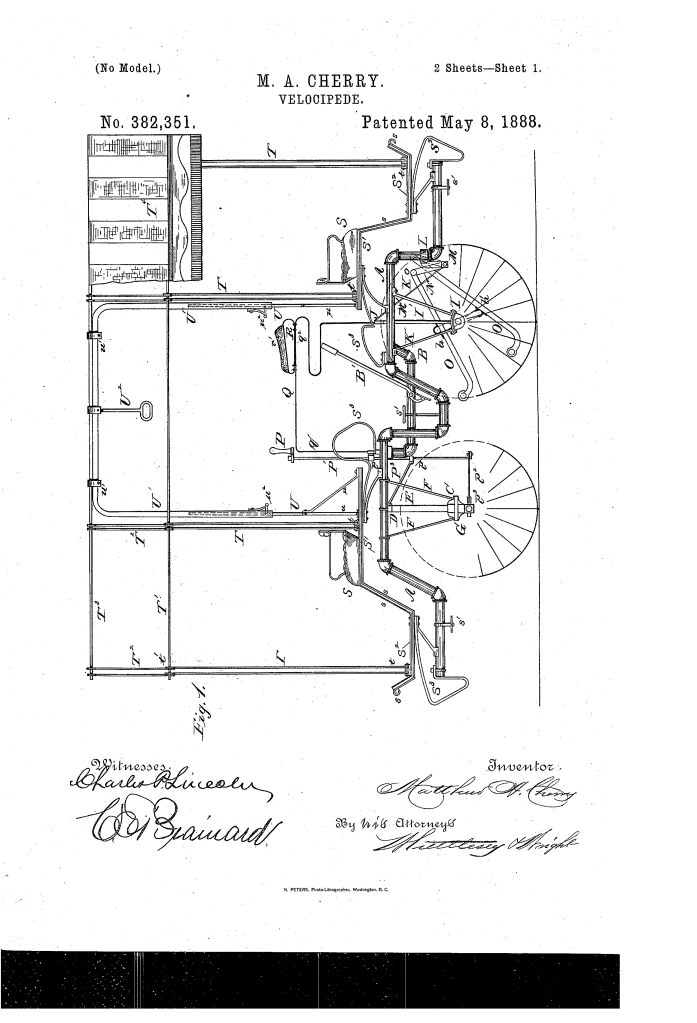
The patent by Matthew A. Cherry of Washington, D.C., describes an advanced Velocipede (Patent No. 382,351, 1888). This invention is a multi-passenger human-powered vehicle—essentially an early precursor to the quadricycle or “surrey” bike. Cherry’s primary objective was to engineer a stable, comfortable vehicle capable of carrying three or more people while remaining easy enough for a single operator to propel. His design featured a sophisticated tubular frame, an adjustable treadle system, and a unique collapsible awning for all-weather travel.
Inventor Background: Matthew A. Cherry
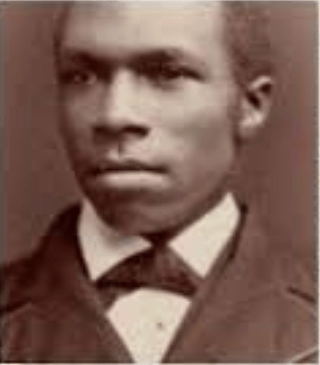
Matthew A. Cherry was a prolific African American inventor based in the District of Columbia. While he is often remembered for his improvements to the “Hearth” (fender for fireplaces) and the streetcar fender, his 1888 Velocipede patent showcases his mastery of structural engineering and transportation design. Living in the capital during the post-Civil War era, Cherry worked to improve urban mobility. His velocipede was not just a toy; it was designed as a practical, lightweight alternative to horse-drawn carriages, focusing on passenger comfort and mechanical advantage.
Key Mechanical Components & Functions
The vehicle is built on a specialized “M-shaped” frame and uses a reciprocating treadle drive.
1. The M-Shaped Tubular Frame (A)
- Structural Geometry: The side frames (A) are formed in a distinct “M” shape using tubular metal.
- Support System: This frame is braced by a W-shaped frame (E) at the front and a slightly arched cross-bar (J) at the rear.
- Function: The tubular M-shape provides a high strength-to-weight ratio, ensuring the vehicle is stiff enough to carry multiple passengers (S) without buckling, yet light enough to be propelled by one person.
2. The Cranked Axle and Adjustable Treadles (H, O, N)
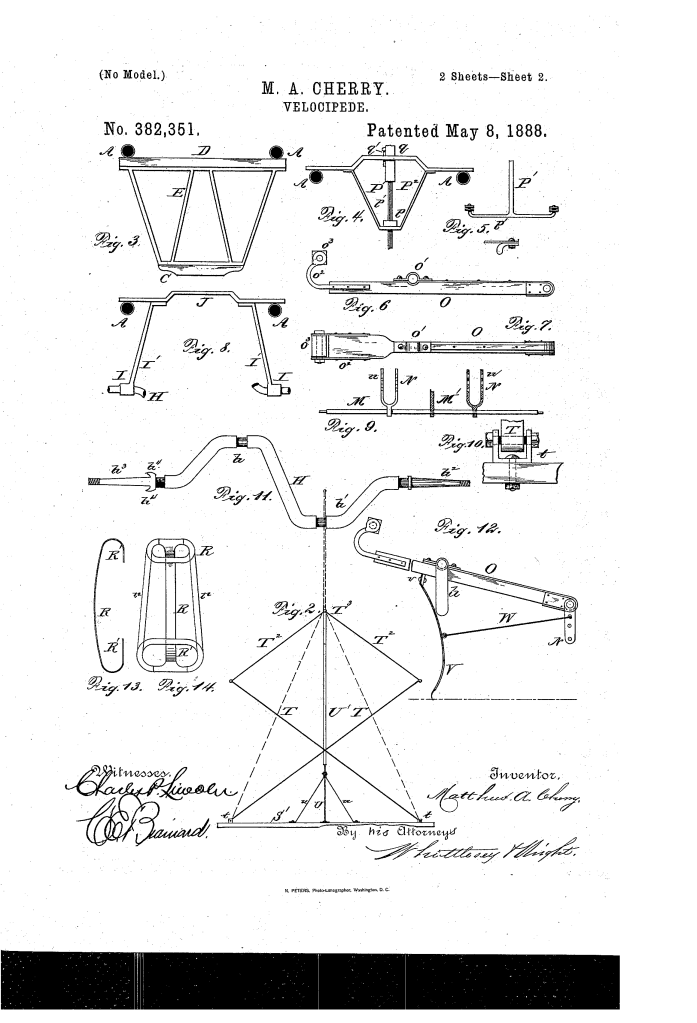
- Crank Axle (H): The rear axle features two oppositely-disposed cranks (h, h).
- Adjustable Forks (N): The treadles are pivoted to forks (N) that hang from a rod (M). These forks have multiple perforations (n).
- Function: By moving the pivot pin to different holes, the operator can regulate the range of movement of the pedals. This allows riders of different heights or strengths to adjust the mechanical advantage for easier pedaling.
3. Steering and Suspension (P, Q)
- Upright Steering Shaft (P’): The rider turns a horizontal handle-bar (P) connected to a vertical shaft.
- Linkage System: Cross-bars and links (p²) connect the shaft to the front axle (C).
- S-Spring Seat (Q): The rider’s seat is mounted on a bar (Q) bent into a reversed S-shape.
- Function: This acts as a shock absorber (q²), protecting the operator from the vibrations of the road, a critical feature for a vehicle with rigid wheels.
4. The Collapsible Awning (T, U)
- X-Shaped Uprights (T): The awning is supported by four pairs of uprights that cross like the letter “X”.
- Telescoping Standards (U, U’): In the center of the machine is a standard (U) with a sliding tube (U’).
- Action: By pushing the handle (U²) upward, the rider can collapse the awning into a flat, vertical state. This allows passengers to get in and out easily and protects them from sun or rain when deployed.
5. The Winter “Ice-Pusher” (V, W)
- Pusher (V): For use on snow or ice, Cherry designed a sharp-pointed pusher (V) made of spring metal.
- Function: It is pivoted to the treadle and vibrates as the crank revolves, digging into the ice to provide forward traction when the wheels might otherwise slip.
Improvements Over Standard Velocipedes
| Feature | Standard 1880s Velocipedes | Cherry’s Improved Velocipede |
| Capacity | Usually 1-2 persons. | Specifically designed for 3 or more occupants. |
| Drive System | Fixed pedal stroke. | Adjustable pivot points (n) to customize pedal range. |
| Operator Comfort | Rigid, uncomfortable seating. | Integrated S-spring suspension and leather saddle. |
| Weather Protection | None; open to elements. | Collapsible, height-adjustable awning cover. |
| Traction | Limited to dry pavement. | Optional “spring-pusher” (V) for snow and ice. |
Significance to Mechanical Engineering
Matthew A. Cherry’s velocipede influenced the development of recreational vehicles and ergonomic drive systems.
- Tubular Frame Construction: The use of tubular metal in an “M” configuration is a precursor to the modern bicycle and motorcycle frames, which rely on hollow tubes for strength and lightness.
- Adjustable Kinematics: By providing multiple holes for the treadle pivot, Cherry applied the concept of variable leverage, a fundamental principle in modern adjustable exercise equipment and high-end cycling.
- Integrated Suspension: The “reversed S” spring is a classic example of cantilever suspension, ensuring that the mechanical vibrations of the machine are not transferred directly to the rider’s spine.
- All-Terrain Adaptation: The ice-pusher attachment shows an early interest in modular vehicle design, allowing a single machine to be adapted for different seasonal environments.
