
Vehicle Parking Attachment (Oliver L. Thompson, No. 1,541,670)
The patent by Oliver L. Thompson of Tulsa, Oklahoma, describes a Vehicle Parking Attachment (Patent No. 1,541,670, 1925). This invention is an early mechanical solution to the problem of parallel parking in congested urban districts. Thompson’s primary objective was to equip a motor vehicle with an integrated jack-and-drive system that could lift the car off its main tires and move it laterally (sideways) into or out of a tight parking space.
Inventor Background: Oliver L. Thompson
Oliver L. Thompson was an African American inventor who lived and worked in Tulsa during the 1920s. As automobile ownership surged, city curbs became increasingly crowded, making parallel parking a difficult feat for many drivers. Thompson’s design was one of the first to propose using the vehicle’s own engine power to facilitate lateral movement, essentially envisioning a “fifth wheel” or auxiliary drive system decades before similar concepts appeared in experimental luxury cars.
Key Mechanical & Operating Systems
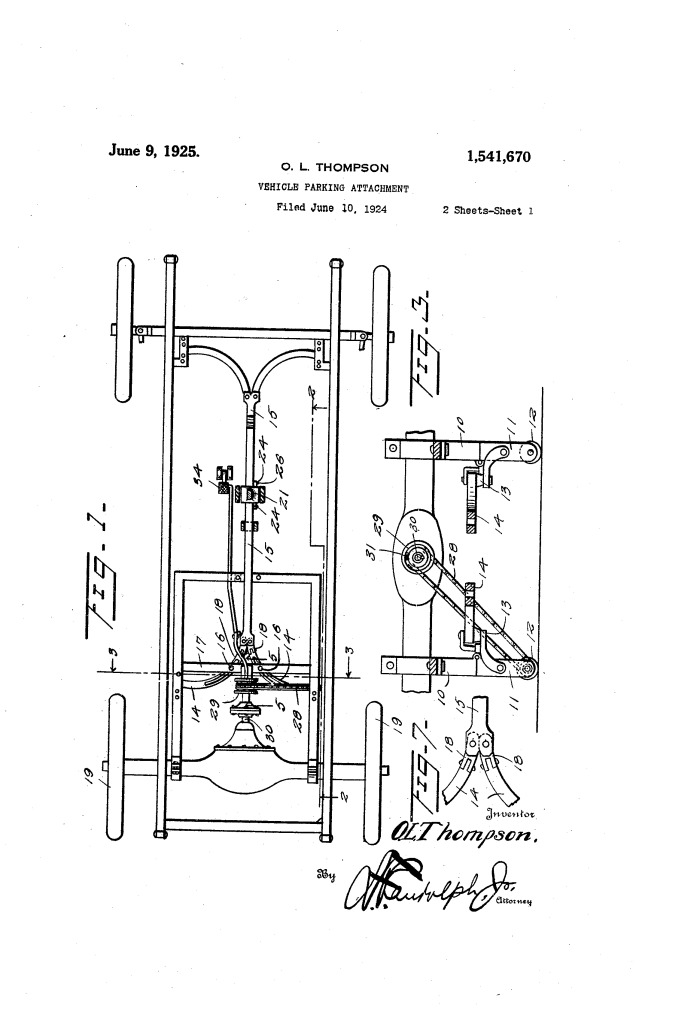
The attachment consists of retractable legs with small wheels that deploy from the chassis to lift the vehicle and propel it sideways.
1. Folding Standards and Lifting Mechanism (10, 11, 12)
- Standards: Two standards are attached to the front and rear axles. Each consists of an upper member (10) clamped to the axle housing and a hinged lower member (11).
- Auxiliary Wheels (12): At the bottom of each standard is a pair of small wheels.
- Deployment: When the driver moves a longitudinal bar (15), the standards swing downward. As they straighten, they act as a jack, lifting the main tires (19) off the ground.
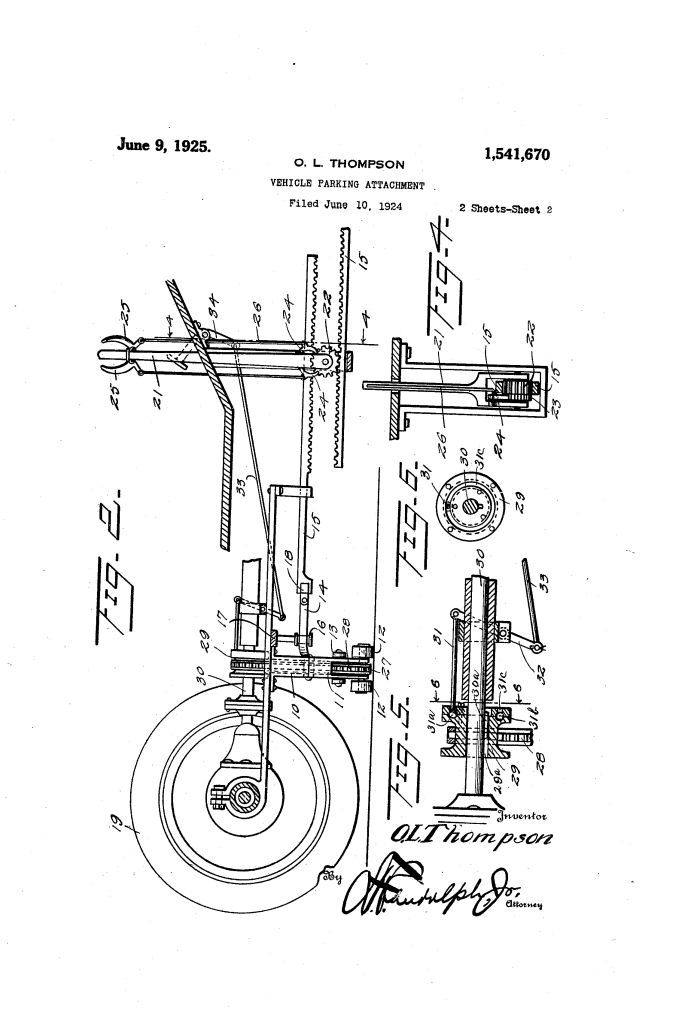
2. The Ratchet Operating Lever (21-26)
To lower or raise the heavy standards, Thompson designed a high-leverage manual system:
- Lever 21: Located in the driver’s compartment, this lever features a spur wheel (22) and ratchet (23).
- Oscillation: By pumping the lever back and forth, the driver moves the main actuating bar (15) intermittently. This provides the mechanical advantage necessary to lift the weight of the entire vehicle manually.
3. Lateral Drive System (27-34)
Once the car is elevated on the auxiliary wheels (12), it must move sideways toward the curb.
- Power Take-off: A sprocket (29) is mounted on the vehicle’s main drive shaft (30).
- Chain Drive (28): A chain connects the drive shaft to the axle of the auxiliary wheels.
- Clutch Control: The driver uses a pedal lever (34) to engage a clutch (31). This transfers the engine’s power from the main transmission to the parking wheels, allowing the car to “crab-walk” into a parking spot.
Engineering Features and Operational Workflow
| Feature | Hazard/Problem Addressed | Thompson’s Engineering Solution |
| Hinged Standards (11) | Ground clearance while driving. | Standards fold upward and inward against the chassis when not in use. |
| Slotted Links (14) | Mechanical jamming. | Longitudinally slotted links allow the lifting bars to move smoothly through an arc without binding. |
| Ratchet & Dogs (23, 24) | Weight of the vehicle. | Allows a human operator to lift several thousand pounds using a “pumping” motion. |
| Pedal-Actuated Clutch (34) | Ease of transition. | Allows the driver to switch from forward driving to lateral parking without leaving the seat. |
Significance to Automotive History
Oliver Thompson’s invention represents a sophisticated understanding of power transmission and mechanical leverage in early 21st-century engineering.
- Lateral Mobility: His patent predates the modern interest in “four-wheel steering” and specialized “omni-directional” wheels by nearly a century.
- Integration of Power: Unlike many contemporary jack systems that were purely manual, Thompson’s ability to “clutch in” the engine to move the car sideways was a major step forward in automotive automation.
- Urban Problem Solving: The invention reflects the specific pressures of the 1920s urban environment—congestion, limited space, and the need for precision maneuvering in the burgeoning “Motordom” era.
