
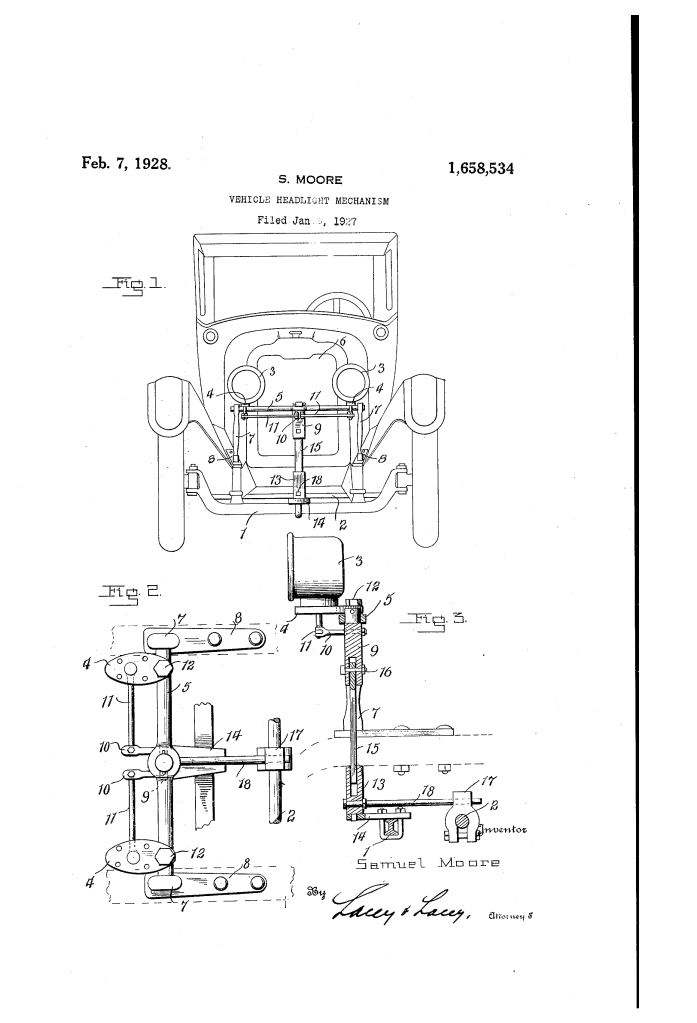
🔦 Vehicle-Headlight Mechanism (Samuel Moore, No. 1,658,534)
The patent by Samuel Moore of Cleveland, Ohio, describes an improved Vehicle-Headlight Mechanism (Patent No. 1,658,534, 1928). This invention is a “dirigible” lighting system designed to automatically pivot automobile headlights in coordination with the steering gear. Moore’s primary objective was to illuminate the path a vehicle is actually about to take during a turn, rather than shining the lights straight ahead into the darkness off-road. His innovation features a telescoping coupling that allows the steering linkage to control the lights while still accommodating the vertical “bounce” of the vehicle’s suspension.
Inventor Background: Samuel Moore
Samuel Moore was a prolific African American inventor and engineer. While he held several patents in West Virginia and Ohio, this 1928 patent represents a significant advancement in automotive safety engineering. During the late 1920s, night driving was exceptionally hazardous due to the lack of street lighting on rural roads. Moore recognized that fixed headlights were a major “pain point” for drivers negotiating curves. His design was specifically engineered to be a “bolt-on” solution, meaning it could be applied to existing automobiles without requiring manufacturers to redesign their steering columns or chassis.
Key Mechanical & Functional Systems
The mechanism translates the horizontal movement of the steering rack into a rotational movement for the headlights.
1. The Supporting Frame (5, 7, 8)
- Structure: The system is built on a cross bar (5) supported by two posts (7).
- Mounting: These posts are attached to strap irons (8), which are bolted directly to the side bars of the vehicle’s chassis.
- Function: This frame provides a stable, independent platform for the headlights (3) to sit forward of the radiator, ensuring they have a clear field of rotation.
2. The Steering-to-Light Linkage (2, 13, 15, 18)
- Drag Link Connection: A rod (18) is secured to the drag link (2) (the part of the steering that moves the wheels) via a stud (17).
- Foot Block (13): This rod pulls or pushes a foot block (13) mounted on the front axle.
- The Coupling (15): A vertical bar (15) connects the foot block to a head block (9) on the upper frame.
- Function: As the driver turns the steering wheel, the drag link moves the rod, which rotates the vertical bar, transferring the “steering command” up to the headlight assembly.
3. The Sliding Coupling (15, 16) (Key Innovation)
- The Problem: Automobiles have springs; the chassis (where the lights are) bounces up and down, while the axle (where the steering is) stays relatively level with the road. A rigid vertical rod would snap or jam the steering.
- The Solution: Moore designed the coupling (15) with a sliding connection.
- Function: The bar is non-circular (so it can still transfer rotation) but can slide up and down within the blocks. This allows the vehicle frame to move vertically incident to the spring suspension without affecting the steering of the headlights.
4. The Pivoting Headlight Plates (4, 10, 11)
- Arms and Links: The upper head block has arms (10) connected by links (11) to the headlight plates (4).
- Pivots (12): The plates are mounted on vertical pivots (12).
- Action: When the central coupling rotates, the arms pull the links, which swings the headlights to the left or right in perfect synchronization with the front wheels.
Improvements Over Standard Fixed Headlights
| Feature | Standard 1920s Headlights | Moore’s Dirigible Mechanism |
| Visibility on Curves | Shine straight ahead, leaving the turn in the dark. | Self-adjusting; throws light exactly where the car is turning. |
| Installation | Required custom factory redesigns. | Ready application; bolts onto existing chassis and axles. |
| Suspension Compatibility | Risk of binding if connected to steering. | Sliding coupling (15) accommodates vehicle “bounce.” |
| Steering Impact | Could add weight or friction to steering. | Loose/sliding rod (18) prevents interference or binding. |
Significance to Engineering and Modern Safety
Samuel Moore’s headlight mechanism influenced the development of adaptive driving systems and dynamic lighting.
- Adaptive Front-lighting Systems (AFS): Moore’s logic—mechanically linking light direction to steering angle—is the direct ancestor of the electronic adaptive headlights found in modern luxury vehicles like BMW and Audi.
- Mechanical Decoupling: The use of a sliding non-circular shaft to transmit rotation while allowing linear movement is a foundational principle in driveshaft and steering column engineering.
- Universal Aftermarket Design: By creating a “supporting frame” that didn’t require “modification in the arrangement of parts,” Moore anticipated the modern aftermarket accessory industry.
- Casualty Reduction: Moore’s focus on illuminating the roadway to “avoid a casualty” shows an early engineering commitment to Active Safety Systems, where the vehicle proactively helps the driver avoid accidents.
