
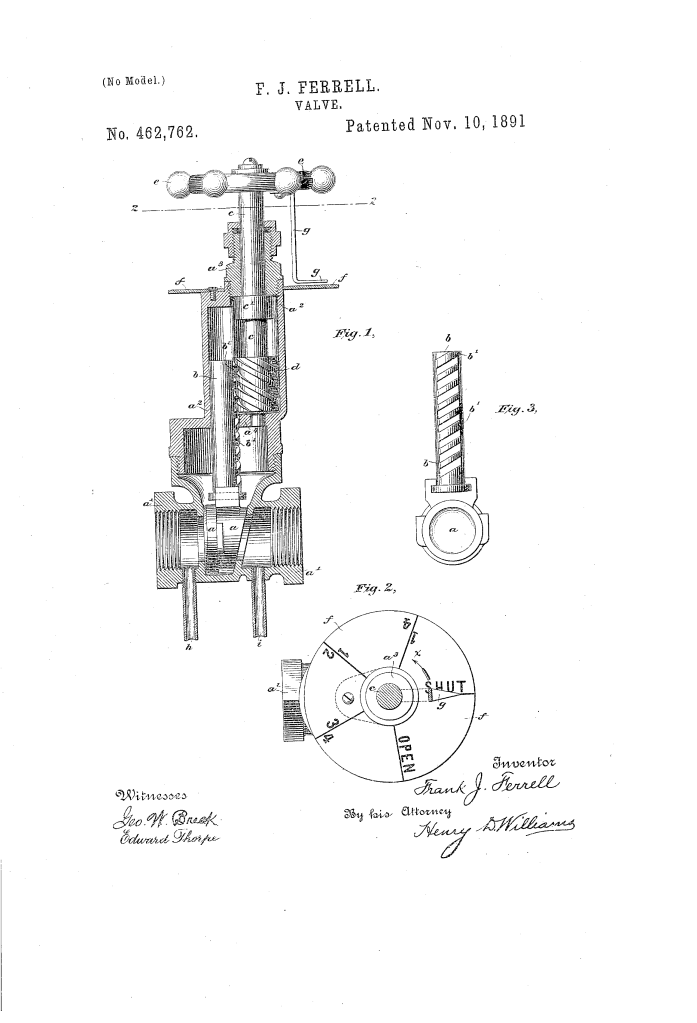
Valve (1891)
U.S. Patent No. 462,762, granted on November 10, 1891, to Frank J. Ferrell, introduces a specialized valve design engineered for durability and ease of maintenance in high-pressure steam and fluid systems. Ferrell, an inventor based in New York City, sought to address the common failure points of late 19th-century plumbing and industrial valves: leakage and the rapid wear of internal seals.
This invention solved a critical mechanical frustration: the difficulty of replacing or repairing valve seats without dismantling entire piping systems. Ferrell’s design focused on a removable and reversible valve seat, ensuring that a single component could last twice as long and be serviced with minimal downtime.
The Innovation: The “Removable Reversible Seat”
In standard valves of the era, the “seat” (the surface the valve closes against) was often cast directly into the metal body. If the seat became pitted or corroded, the entire valve—or the section of pipe—had to be replaced.
Ferrell’s breakthrough was a modular internal architecture that allowed the valve’s most vulnerable parts to be swapped out like modern cartridges.
Why This Design?
- Dual-Life Longevity: The valve seat was designed to be symmetrical. When one side became worn from the friction of steam or water, a technician could simply flip it over to use the fresh, opposite face.
- Leak Prevention: The patent utilized a unique arrangement of flexible packing and a screw-threaded cap, which ensured that the internal pressure of the fluid actually helped tighten the seal rather than forcing it open.
- Toolless Alignment: The internal valve stem was designed to “self-center,” meaning the valve disk would always land perfectly flat against the seat, preventing the uneven wear that leads to “dripping” faucets.
Key Mechanical Components
The valve is a masterpiece of Victorian-era mechanical engineering, utilizing a vertical screw-down mechanism:
| Component | Function |
| Valve Body (A) | The main casing, featuring a horizontal partition that separates the inlet and outlet chambers. |
| Reversible Seat (D) | A separate ring or disk with two identical faces; the “heart” of the patent that can be flipped when worn. |
| Valve Disk (G) | The moving part attached to the stem that presses down onto the seat to stop fluid flow. |
| Screw-Stem (H) | The threaded rod that allows the operator to precisely control the volume of flow by turning the handle. |
| Stuffing-Box (M) | A chamber filled with packing material to prevent water or steam from leaking upward around the handle. |
How the Valve Functions
Ferrell’s valve operates through a specific mechanical sequence designed to handle high-pressure environments:
- Opening: Turning the hand-wheel raises the Valve Disk (G) away from the Reversible Seat (D). The fluid flows upward through the center of the seat and out the discharge port.
- Sealing: To close the valve, the stem is screwed downward. The disk meets the seat with a “crushing” force that creates a watertight seal.
- Maintenance: When the valve begins to leak, the Top Cap (B) is unscrewed. The internal assembly is lifted out, the seat is flipped 180 degrees, and the valve is reassembled in minutes.
Historical and Industrial Impact
Frank J. Ferrell’s valve was a significant contribution to the safety and efficiency of the Gilded Age’s infrastructure.
- Steam Engine Safety: During the 1890s, steam boiler explosions were a constant threat. Valves that could withstand high heat without warping were essential for controlling pressure.
- Urban Infrastructure: As cities like New York began installing complex pressurized water systems in tenement buildings and factories, Ferrell’s “easy-repair” valves reduced the cost of urban maintenance.
- Standardization: This patent moved the industry toward interchangeable parts, a cornerstone of the second Industrial Revolution.
About the Inventor: Frank J. Ferrell
Frank J. Ferrell was a prolific African American inventor active in the late 19th century. Based in New York, he was a member of the American Society of Mechanical Engineers (ASME), a rare distinction for a Black engineer at that time.
- Patents: Ferrell held approximately 10 patents for various improvements to steam engines, valves, and even a “Land-Conveyance” (a type of early bicycle/carriage hybrid).
- Professional Standing: His work was frequently cited in technical journals like Scientific American and The Engineering Record, proving that his designs were respected by the top engineering minds of his day.
- Legacy: Ferrell is remembered as a pioneer who broke racial barriers in the highly technical field of mechanical engineering, demonstrating that innovation was the best tool for professional advancement.
Summary of Claims
The patent explicitly claims:
- A valve body with a removable, reversible seat ring held in place by the pressure of a screw-threaded cap.
- A stem-and-disk assembly where the disk can be replaced independently of the stem.
- The specific use of a concave-convex partition within the valve body to minimize fluid turbulence and noise.
