
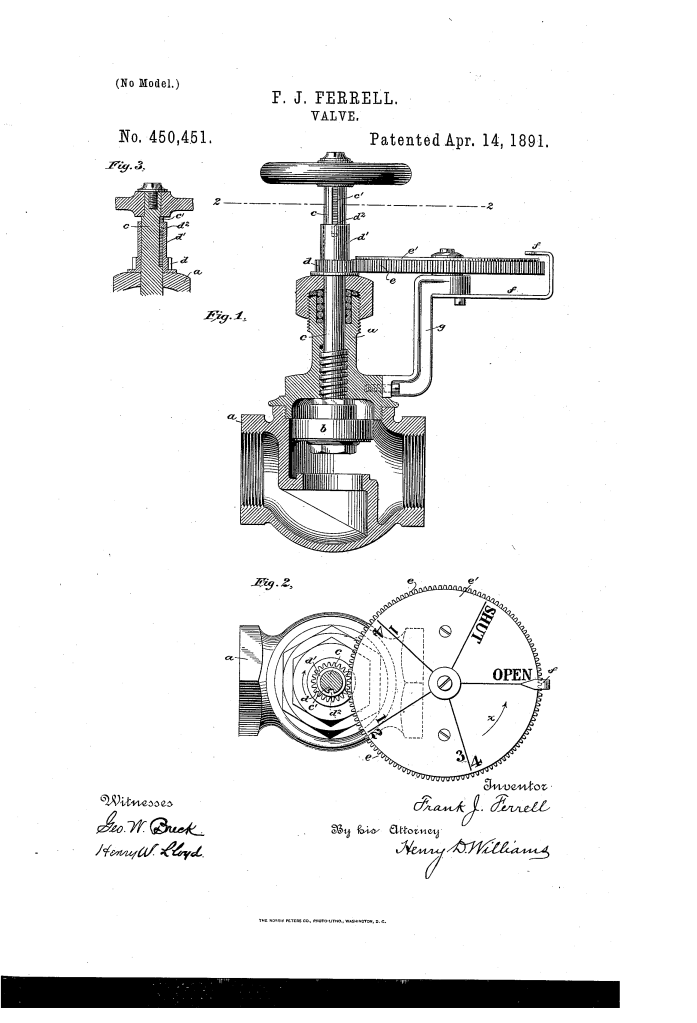
Frank J. Ferrell’s patent for a “Valve,” No. 450,451, is for a simple yet ingenious indicator mechanism that can be added to any standard globe valve. The invention’s purpose was to provide a visual, easy-to-read display of the valve’s position (e.g., open, closed, or partially open).
The system consists of:
- A toothed pinion that fits onto the valve stem but does not move longitudinally with it.
- A longitudinal groove on the valve stem that connects to a stud on the pinion. This allows the valve stem to move up and down while its rotation is transmitted to the pinion.
- A larger gear wheel that meshes with the pinion. As the valve stem is turned, the pinion rotates, which in turn rotates the larger gear wheel.
- The large gear wheel has markings like “Open” and “Closed” and fractional divisions on it, and a fixed index on the casing points to the wheel to show the valve’s exact position.
Societal Impact
Ferrell’s indicator mechanism, like his other valve-related patents, contributed to the efficiency and safety of industrial and plumbing systems in the late 19th century.
Improved Control and Efficiency
Before this invention, an operator had to rely on feel or guess the extent to which a valve was open. With Ferrell’s indicator, the valve’s status could be known at a glance, allowing for more precise and consistent control of the flow of steam, water, or other fluids. This was crucial in industrial settings where exact measurements were needed to optimize performance and prevent waste.
The Inventor’s Legacy
Frank J. Ferrell was a prolific African American inventor and machinist. His patents, which include a variety of steam traps and valve improvements, are a testament to his expertise in industrial engineering. His inventions were not just for show; they solved practical, day-to-day problems in the world of machinery and infrastructure. Ferrell’s work highlights the vital, though often overlooked, contributions of Black innovators to America’s industrial growth, and his patents show how he helped refine the very foundation of modern technology.
