
Valve (1890)
U.S. Patent No. 428,671, granted on May 27, 1890, to Frank J. Ferrell, introduces an advanced double-valve mechanism designed to ensure a leak-proof seal and effortless operation under high pressure and varying temperatures.
Frank Ferrell, an inventor based in New York City, focused his engineering on solving a common industrial headache: the gradual wear and tear of valve seats that lead to “creeping” leaks. His design moved away from simple screw-down plugs toward a balanced, synchronized system that remains “steam-tight” even as the components age.
The Innovation: The Balanced Double-Valve
The primary challenge Ferrell addressed was the physical strain placed on a valve when it has to fight against the pressure of the fluid it is trying to stop. By using two valves on a single stem, he created a system where the fluid pressure is perfectly balanced.
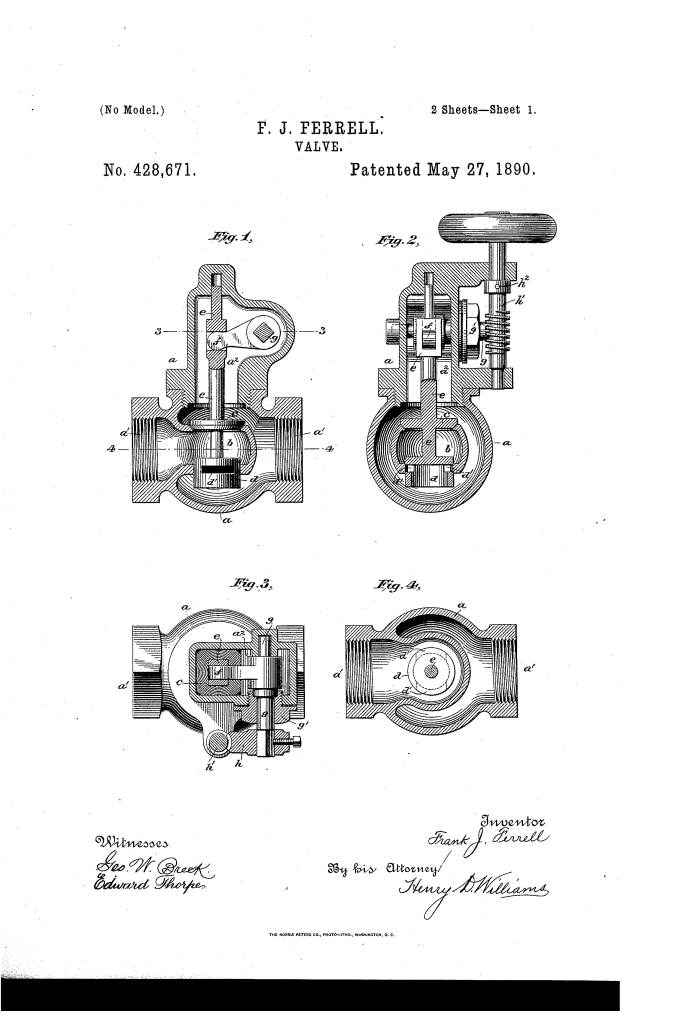
- The Conical and Cylindrical Pair: The system uses an upper conical valve (c) and a lower cylindrical valve (d).
- Pressure Neutralization: The diameter of the lower cylindrical seat is exactly equal to the smallest diameter of the upper conical seat. Because the fluid in the inner chamber pushes up against the top valve and down against the bottom valve with equal force, the pressures are neutralized.
- The Over-Travel Benefit: Unlike standard valves where both parts must hit their seats at the exact same millisecond, Ferrell’s cylindrical valve can slide further into its seat without losing its seal. This allows the conical valve to seat firmly even if the stem length changes slightly due to heat expansion or wear.
The Operating Mechanism: The Rock-Shaft and Worm-Gear
Beyond the valve itself, Ferrell revolutionized how the valve is opened. Instead of a standard rising stem that requires multiple turns of a handle, he implemented a high-leverage gear system:
- Rock-Shaft (g): An internal arm connects the valve stem to a horizontal shaft that exits the casing.
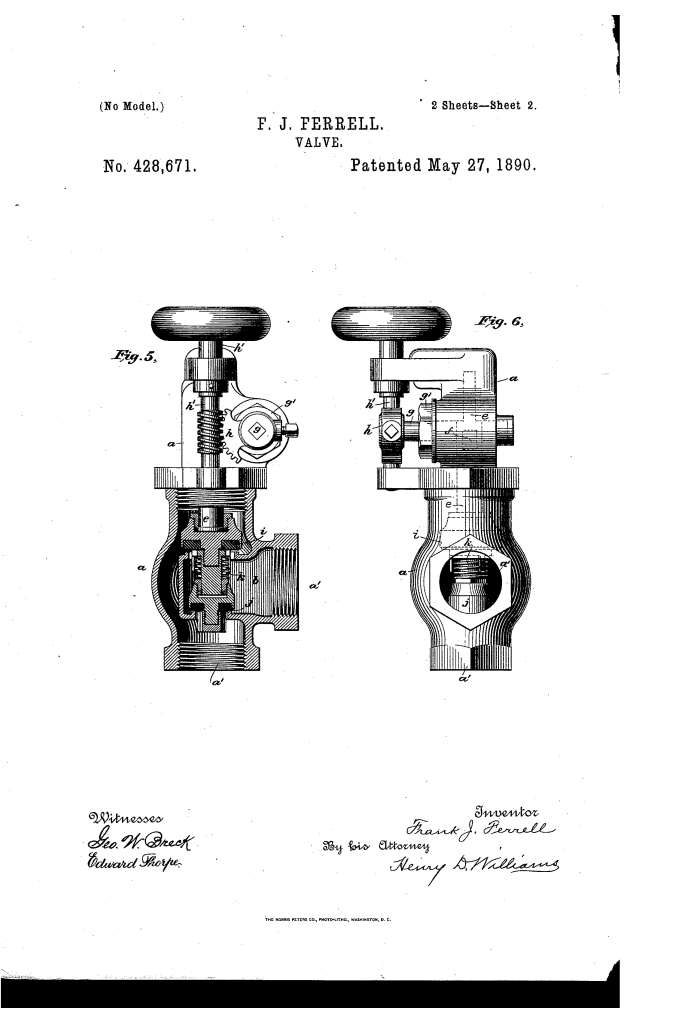
- Worm-Toothed Sector (h): On the outside of the casing, the shaft is attached to a geared arc.
- Worm-Shaft (h¹): A hand-wheel turns a screw (worm) that meshes with the geared arc.
This setup allows the operator to completely open or close the valve with a single revolution of the hand-wheel, providing both speed and immense mechanical advantage.
Key Technical Components
The assembly is housed in a globe-shaped casing designed for industrial piping:
| Component | Function |
| Inner Chamber (b) | The high-pressure zone where fluid enters before being regulated. |
| Valve Stem (e) | The central rod that carries both valves; it is guided at both the top and bottom for perfect alignment. |
| Cylindrical Ports (d¹) | Openings in the lower valve that gradually expose the fluid path as the stem is raised. |
| Metallic Joint (g¹) | A specialized threaded sleeve that creates a steam-tight seal for the rock-shaft without needing traditional packing or stuffing boxes. |
Performance: Precision and Speed
Ferrell’s design offered two distinct advantages for 19th-century steam and fluid systems:
- Visual Indication: Because the hand-wheel only rotates once, a pin or mark on the wheel tells the operator exactly how far open the valve is at a glance.
- Durability: By using a “spring-loaded” variation (seen in his modified disk-valve version), the valve accommodates the “settling” of metal parts over time, ensuring the seal remains absolute regardless of temperature swings.
About the Inventor: Frank J. Ferrell
Frank J. Ferrell was a prolific African American inventor living and working in New York during the late 19th century.
- Patents: Ferrell held several patents for valve improvements and steam engine components (including U.S. Patent No. 420,936 and 428,672), demonstrating a high level of expertise in thermodynamics and mechanical engineering.
- Legacy: At a time when steam power drove the world’s factories and ships, Ferrell’s inventions contributed to the safety and efficiency of high-pressure systems. His work is often cited alongside other great Black engineers of the era who pioneered the “Age of Invention.”
Summary of Claims
The patent explicitly claims:
- A longitudinally moving stem combined with an internal rock-shaft and an external worm-gear for rapid operation.
- A double-valve construction featuring one conical seat and one cylindrical seat to ensure a balanced pressure state.
- A design where one valve has a fixed point of closure while the other allows for continued movement, ensuring both stay tight despite physical wear.
