
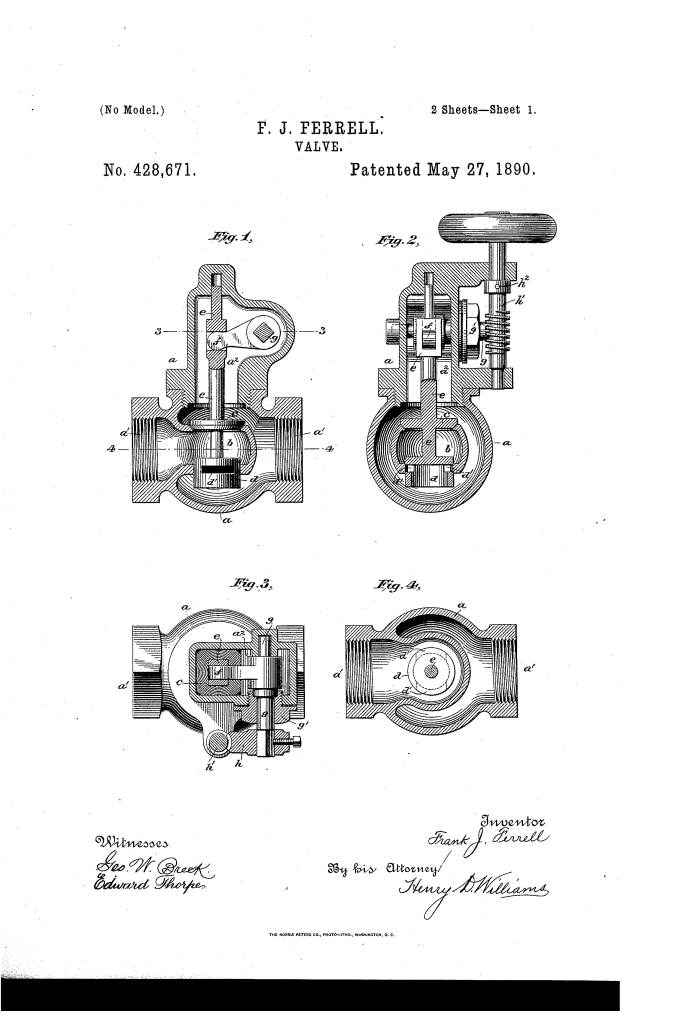
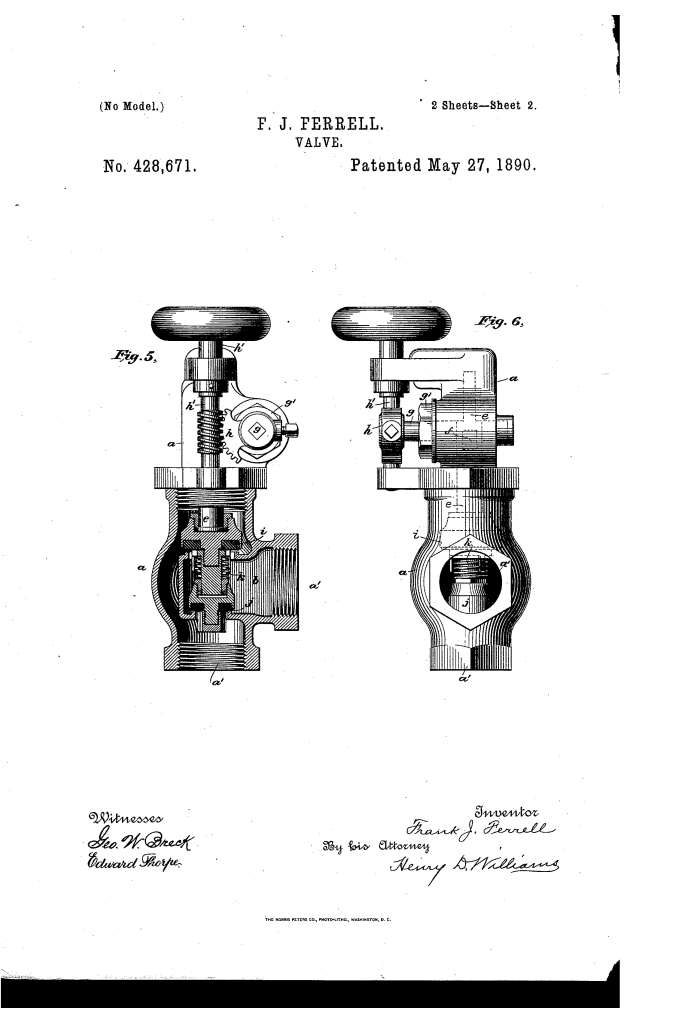
Frank J. Ferrell’s patent for a “Valve,” number 428,671, describes a specialized valve designed to be exceptionally tight and durable. The primary innovation was its balanced double-valve system. The valve featured a conical valve and a cylindrical piston-like valve on the same stem. This design ensured that pressure on the top and bottom of the valve was equal, making it “perfectly balanced.” The cylindrical valve was also designed to seal tightly, even if the conical valve showed signs of wear. Additionally, the patent detailed a unique worm-gear mechanism for operating the valve, allowing for precise control with a simple rotation of a hand-wheel.
Societal Impact
Ferrell’s valve patent, while not a household name, was part of the critical infrastructure that enabled the late 19th-century industrial revolution. Better valves were essential for the safe and efficient operation of a wide range of technologies.
- Industrial Efficiency and Safety: Reliable valves were fundamental to steam engines, heating systems, and other industrial machinery. A leak-proof, balanced valve like Ferrell’s reduced the waste of costly steam and other fluids, improving efficiency. More importantly, it increased the safety of high-pressure systems by preventing leaks and failures that could lead to dangerous accidents.
- Plumbing and Urbanization: As cities grew and plumbing became more complex, dependable valves were needed to control the flow of water and gas in homes and businesses. Ferrell’s invention contributed to the development of better, more reliable plumbing components that supported urban growth and improved public sanitation.
- The Inventor’s Legacy: Frank J. Ferrell was an African American inventor who filed multiple patents, including one for a snow-melting apparatus. His work as an inventor and his position as a machinist in New York City’s industrial landscape demonstrate the vital, though often unheralded, role that Black inventors played in building the technological foundation of modern America. His valve patent is a testament to the kind of specialized, practical ingenuity that drove the industrial progress of the era.
