
Vacuum Heating System, David N. Crosthwait, Jr., Patent No. 1,986,391
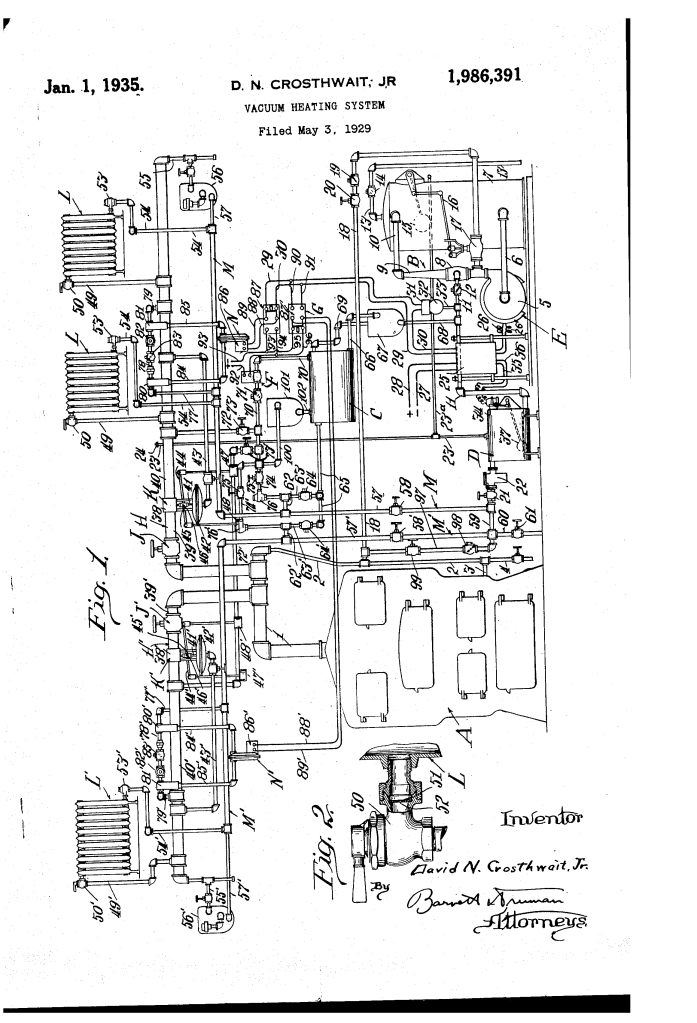
The patent by David N. Crosthwait, Jr. of Marshalltown, Iowa, describes a Vacuum Heating System (Patent No. 1,986,391), granted on January 1, 1935. This invention is a multi-zone thermal energy recovery system designed to heat different sections of a building at varying sub-atmospheric pressures while utilizing a single exhausting mechanism and “flashing” condensate into steam for reuse.
The “Why”
Crosthwait identified a major inefficiency in early 20th-century architecture: asymmetric weather loads. A building’s north side might be battered by freezing winds while the south side remains mild. Standard systems either overheated the south to keep the north warm or required expensive, duplicated machinery for different zones. Crosthwait sought to solve this with a system that could run different zones at different “vacuums” (pressures) from a single boiler, while recycling heat from the high-pressure zone to help heat the low-pressure zone.
Inventor Section: David N. Crosthwait, Jr.
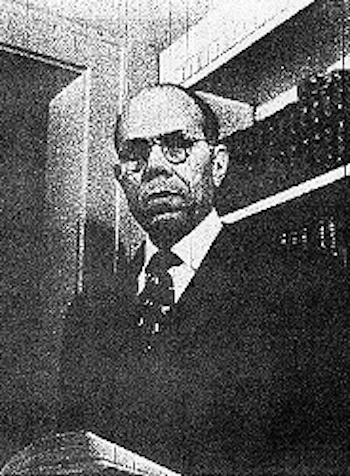
David Crosthwait’s engineering philosophy was centered on resource conservation through synchronization. He viewed a building not as a collection of rooms, but as a singular thermodynamic organism. Despite the social barriers of the 1930s, Crosthwait became the first Black person to be a member of the American Society of Heating and Ventilating Engineers. This patent showcases his ability to simplify complex mechanical problems using electrical control logic, a precursor to modern integrated building circuits.
Key Systems Section
1. The Flash Tank (Energy Recovery Unit)
- Function: Revaporizes hot condensate from the “warm” zone into steam for the “cool” zone.
- Modern Translation: Flash Steam Heat Exchanger.
- When high-pressure condensate enters the lower-pressure flash tank, it “flashes” into steam. This $1^{st}$-stage waste heat is then piped into the supply side of the lower-pressure system, ensuring no BTU is wasted.
2. Zone-Specific Differential Controllers
- Function: Manages the specific “comfort level” of different building wings.
- Modern Translation: Zone Control Actuators.
- Each zone has its own controller (N and N) that monitors its local pressure differential. They communicate electrically to either start the main vacuum pump or open the local Solenoid Cut-off Valve (F).
3. Reversible Electrical Control Switch (G)
- Function: Allows the operator to flip which zone is “High” or “Low” pressure without repiping.
- Modern Translation: Software-Defined Logic (Physical Switch).
- By using double-throw switches, the building manager could adapt to changing winds (e.g., switching the “priority” from the North wing to the West wing) simply by toggling electrical circuits.
4. Centrifugal Ejector Exhaust (Pump B)
- Function: Creates the system-wide vacuum and returns water to the boiler.
- Modern Translation: Liquid Ring Vacuum Pump.
- This central “heart” pulls air and water from all return mains. It uses a float mechanism (15) to automatically inject water back into the generator (A) only when needed, maintaining the system’s mass balance.
Comparison Table
| Feature | Conventional Multi-Zone Systems | Crosthwait’s Vacuum System |
| Machinery | Requires multiple pumps/generators. | Single source and single exhaust pump. |
| Waste Heat | Condensate heat is lost in return lines. | Revaporized in flash tank for reuse. |
| Adaptability | Fixed piping determines zone priority. | Electrical switching allows zone reversal. |
| Precision | Difficult to maintain stable low-vacuum. | Differential controllers maintain exact $\Delta P$. |
Significance Section
- Energy Recycling: By capturing “flash steam,” Crosthwait decreased the total load on the boiler, a direct precursor to modern heat recovery steam generators (HRSG).
- Micro-Climate Control: This was one of the first systems to acknowledge that a single building contains multiple climates based on orientation.
- Circuit Integration: The use of electrical solenoids (F) to manage steam flow moved HVAC away from purely mechanical “weights and levers” toward the electronic age.
- Thermodynamic Efficiency: The system maximizes the use of latent heat (L) by facilitating phase changes (liquid to gas) within the return side of the system.
