
Universal Joint (1956)
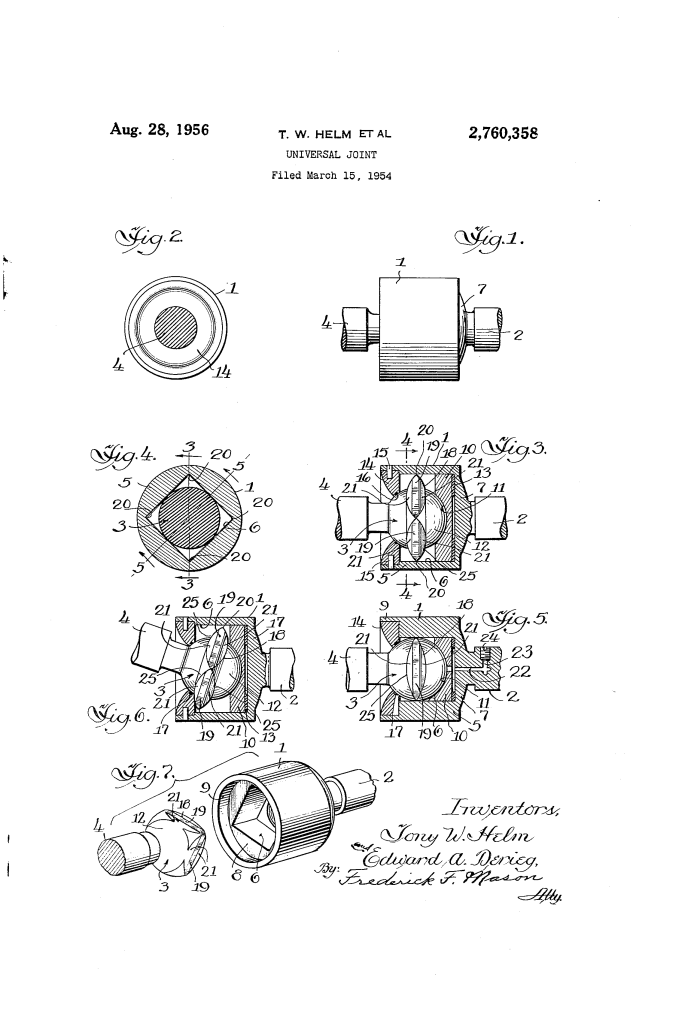
U.S. Patent No. 2,760,358, granted on August 28, 1956, to Tony W. Helm and Edward A. Derieg, introduces an improved universal joint designed for higher durability and more efficient power transmission. Specifically, this invention targeted the weaknesses of traditional joints that relied on pins—components prone to shearing, loosening, and a short service life.
Helm and Derieg’s design is particularly suited for mechanical tools used in difficultly accessible or highly angular positions, such as applying torque to nuts where the driving and receiving shafts cannot be perfectly aligned.
The Innovation: The Pinless “Square-in-Socket” Design
Traditional universal joints often failed under high stress because the small pins used to transmit rotational force would snap. The Helm-Derieg joint eliminated these pins entirely, instead using a male ball member with integrated “widened faces” that fit into a square female socket.
1. The Male Member (Ball 12)
The heart of the joint is a hardened steel ball. Unlike a perfectly smooth sphere, this ball features four widened faces (18).
- The Flat Portions (19): At the equator of the ball, these faces are flat and sit just one-thousandth of an inch away from the socket walls.
- The Sharp Corners (20): These faces meet at sharp points that ride in the corners of the square socket, providing maximum contact area for power transmission.
2. The Female Socket (6)
The female portion consists of a sturdy metal body with a square longitudinal opening. Because the walls are flat, they provide a large surface area for the ball’s widened faces to push against, spreading the rotational load and preventing the metal-on-metal “bite” that destroys lesser joints.
How the Apparatus Functions
The joint maintains a constant connection even as the angle between the two shafts changes:
- Axial Alignment: When the shafts are straight, the ball’s square profile fits snugly within the socket’s square profile.
- Angular Movement: As the shaft tilts, the ball rotates within the socket. The “sharp corners” of the ball travel in a curved path along the interior grooves of the square socket.
- Torque Transmission: Even at an angle, the widened faces of the ball maintain driving engagement with the flat side walls of the socket, ensuring that rotation is “positively transmitted” without slipping.
Key Technical Components
The assembly is built to withstand heavy industrial “push and pull” forces:
| Component | Function |
| Bearing Plate (10) | Sits at the back of the socket with a spherical depression to hold the ball in place. |
| Spring Washer (13) | Constantly urges the bearing plate against the ball to maintain a tight, sliding contact. |
| Retaining Ring (14) | Secured by pins at the mouth of the socket to prevent the ball from falling out. |
| Glycerin/Grease Port (22-23) | A dedicated passageway for lubrication to ensure smooth movement under high friction. |
Performance: Durability and Efficiency
The primary advantage of this 1956 patent was the shift from point-load (pins) to surface-load (flat faces).
- Anti-Shearing: By removing pins, the inventors removed the most common point of mechanical failure.
- Angular Power: The design allows for a “substantial amount” of angular movement while still delivering maximum rotational power.
- Reduced Friction: The slight inward curvature or “inclination” of the faces (at 21) prevents the ball from binding or cramping against the socket walls when the joint is operating at a sharp angle.
About the Inventors: Tony W. Helm and Edward A. Derieg
Based in Chicago, Illinois, Tony Helm and Edward Derieg were innovators in mechanical engineering during the post-war industrial boom. Their work on this universal joint contributed to the evolution of high-torque hand tools and automotive drivetrains. By focusing on the geometry of the contact surfaces rather than the strength of a single pin, they provided a blueprint for more “bulletproof” mechanical couplings that could survive the rigors of heavy-duty industrial use.
Summary of Claims
The patent explicitly claims:
- A square socket female member with right-angle corners.
- A male ball member with four radially extended portions forming a square profile.
- A spring-loaded bearing system that maintains constant pressure between the ball and the socket for “slip-free” operation.
- The specific use of tapered sharp points on the ball faces to allow longitudinal swinging within the socket corners.
