
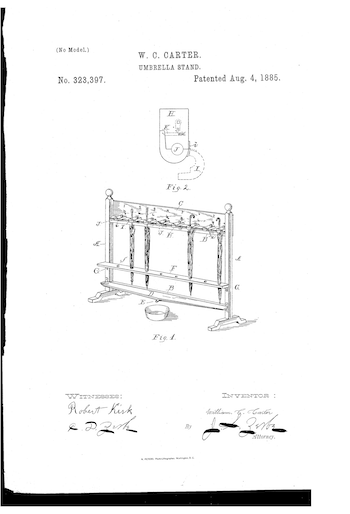
William C. Carter’s 1885 patent (#323,397) for an “Umbrella Stand” was a simple yet innovative design that improved upon existing umbrella holders by incorporating a separate, removable drip pan. This made it easier to clean and manage the water from wet umbrellas.
Details of the Patent
Carter’s patent addressed a common problem with traditional umbrella stands: the accumulation of water, which could lead to rust, rot, and a general mess.
- The Invention: The design featured a stand with a bottom section for holding the umbrella, but instead of the usual solid base, it had a removable, shallow pan.
- Key Features: This removable pan was the core of the invention. It could be easily lifted out to empty the collected water, making the stand more hygienic and preventing damage to the floor underneath.
- Problem Solved: By separating the water collection from the main stand, the design made it easy to maintain cleanliness and prevent water from sitting in the base, which was a frequent issue with older designs.
Significance of the Invention and Inventor
While Carter’s invention may seem minor compared to others, its significance lies in its practicality and the context of the inventor himself.
- Solving a Mundane Problem: Carter’s patent is a great example of an inventor identifying and solving a common, everyday problem. It highlights the fact that innovation isn’t limited to complex machinery but can also be found in simple, domestic objects that improve daily life.
- Legacy as an Inventor: William C. Carter was an African-American inventor from New York. Like many African-American inventors of his time, he faced significant barriers to having his work recognized and patented. His successful patent for the umbrella stand, along with another patent for an “Insect-destroyer” in 1883, demonstrates his ingenuity and perseverance in the face of systemic adversity. His work contributes to the rich history of African-American innovators who, despite limited resources and opportunities, made valuable contributions to society.
