
Type-Writing Machine (Lee S. Burridge & Newman R. Marshman, No. 315,386)
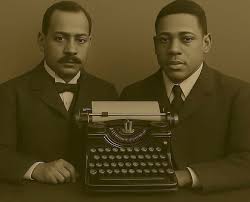
The patent by Lee S. Burridge and Newman R. Marshman of New York, N.Y., describes certain new and useful Improvements in Type-Writers (Patent No. 315,386, 1885). The object of the invention was to provide an inexpensive and yet complete type-writer of few parts, requiring minimal movement for operation, and capable of printing on paper of any length.
Inventor Background: Lee S. Burridge & Newman R. Marshman
Lee S. Burridge and Newman R. Marshman were key inventors associated with early typewriter development, particularly for non-keyboard machines. This patent is for the original mechanism of the Sun Index Typewriter, which was characterized by its simplicity and low cost compared to the expensive, complex keyboard machines of the time. They later continued to patent improvements, often focusing on inking and type-bar mechanisms, demonstrating a long commitment to improving typewriting technology.
Invention and Mechanism (Simplified)
The machine is a hand-operated index typewriter, where the user selects a character with a stylus before printing it. The design incorporates features for precise alignment and efficient inking.
1. Indexing and Printing Mechanism (Index Typewriter)
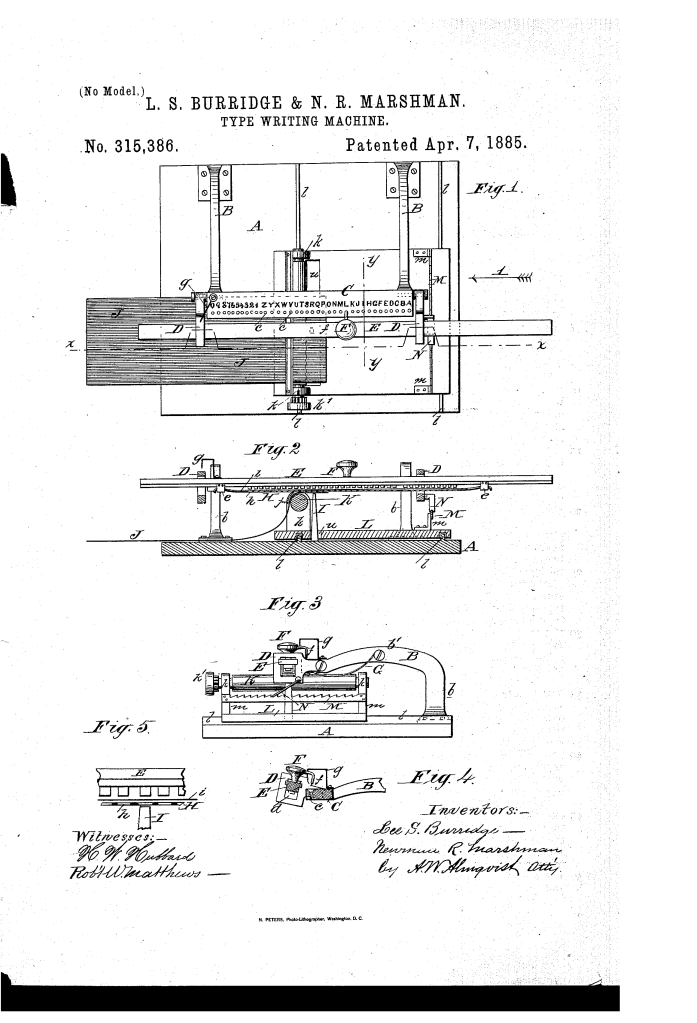
- Stationary Letter-Plate (C) & Sliding Type-Plate (E): The machine features a fixed Letter-Plate (C) that lists all the available characters, and a Type-Plate (E) that slides parallel to it, carrying the actual type.
- Stylus (F) & Tapering Holes ($c$): A Stylus (F) is rigidly attached to the Type-Plate. To select a letter, the user moves the stylus to the corresponding tapering hole ($c$) on the Letter-Plate.
- Function: Depressing the stylus forces the tapered point into the hole, which guides the type-plate to a precise alignment before the type face hits the paper, ensuring perfect registration.
2. Impression and Inking System (Key Innovation)
- Perforated Plate (H) & Ink-Ribbon ($i$): Underneath the type-plate is a strip of metal called the Perforated Plate (H). A small perforation ($h$) is positioned opposite each type face. The Ink-Ribbon ($i$) is interposed between the type-face and this perforated plate .
- Function: The type only passes through the small perforation ($h$) to make contact, meaning the ribbon only supplies ink to the type directly opposite to it. This prevents the entire ribbon from sliding, thereby extending the ribbon’s life and ensuring the ink is used efficiently. The plate (H) protects the paper from unintentional ribbon contact.
- Impression Stud (I): A stationary impression stud (I) is fixed on the base-plate, providing the hard surface against which the type presses the paper.
3. Paper Feed and Spacing
- Automatic Letter Spacing: The paper is held on a sliding frame (L), which has a toothed rack (M). A pawl (N) is pivoted to the arms supporting the type-plate.
- Function: Each time the user depresses the stylus (F) to print, the pawl engages the rack and slides the paper forward the space of one tooth (the width of one letter). This automatically spaces the letters correctly.
- Unlimited Paper Length: The supports (B) for the Letter-Plate are designed as overhanging arms to ensure free space at both ends of the machine.
- Function: This construction allows the machine to print on paper of any length without the necessity of coiling or folding the paper.
Concepts Influenced by This Invention
The Sun Typewriter’s mechanisms were significant in advancing the design of low-cost, high-precision indexing devices.
- Precision Indexing through Tapered Guides: The use of a tapered stylus and hole system to achieve final, micrometer-level type alignment before impact became a core concept in various indexing and alignment mechanisms, ensuring accuracy despite the manual sliding motion.
- Localized Inking for Efficiency: The key innovation of the perforated plate and stationary ribbon influenced inking systems by maximizing the use of ink through targeted contact, a principle applied in various non-impact and dot-matrix printing mechanisms.
- Integrated Actuation and Spacing: The design that links the vertical printing stroke (stylus depression) directly to the horizontal spacing motion (pawl and rack) is an elegant solution in mechanical computing, ensuring that the two essential functions of typing are synchronized by a single user action.
- Low-Cost Personal Computing: The success of the Sun Typewriter demonstrated that essential office functions could be achieved with simplified, non-keyboard mechanisms, contributing to the decentralization and increased accessibility of writing technology.
