
The Two-Cycle Gas Engine, Frederick M. Jones (1945)
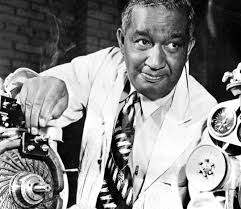
This patent (U.S. Patent No. 2,376,963) represents a significant mechanical innovation by Frederick McKinley Jones, the self-taught engineering genius behind Thermo King. While Jones is best known for refrigeration, his expertise in internal combustion was the foundation of his career.
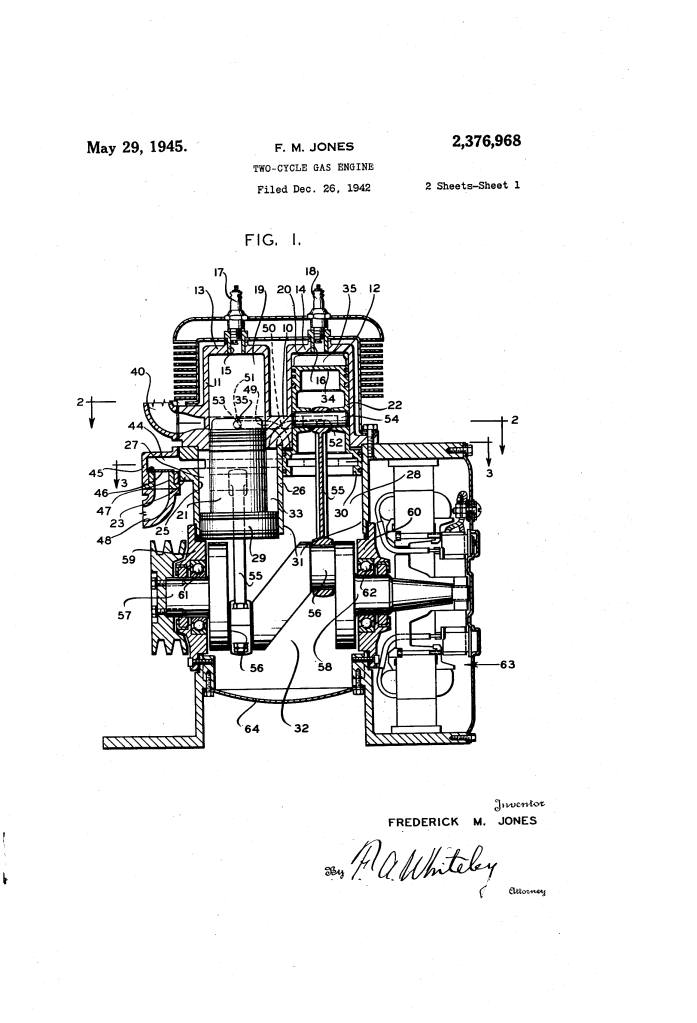
In this 1945 patent, Jones re-engineered the standard two-cycle (two-stroke) engine to solve its most persistent flaws: poor lubrication, inefficient fuel charging, and excessive vibration. His solution was a “cross-charging” twin-cylinder design that used one piston to act as a supercharger for the other, all while sharing a single, simplified crankcase.
The “Why”
Standard two-cycle engines of the 1940s were notorious for being “dirty” and inefficient. They typically used the crankcase itself to compress the fuel-air mixture, which meant the lubricating oil had to be mixed with the gasoline. This led to heavy carbon deposits and unreliable cooling. Jones wanted an engine that had the power-to-weight advantage of a two-cycle but the balanced, clean operation of a four-cycle engine—essential for the long-running, unattended operation required by his mobile refrigeration units.
Inventor Section: Engineering Philosophy
Frederick Jones’s philosophy was Symmetrical Interdependence. He didn’t view two cylinders as two separate power sources; he viewed them as a single, reciprocating system where the “waste” energy of one stroke (displacement) became the “input” energy of the other. By physically linking the intake of one cylinder to the compression of the other, he created a self-balancing “breathing” apparatus that eliminated the need for complex external blowers or separate crankcase compartments.
Key Systems Section
1. The “Stepped” Double Piston
The heart of the invention is the unique shape of the pistons (21, 22).
- The Power Section: The top part of the piston is a standard diameter, operating in the explosion chamber (19, 20).
- The Charging Section: The bottom of the piston (29, 30) is significantly wider, operating in an enlarged lower cylinder (27, 28).
- The Result: As the piston moves down after an explosion, this larger “step” acts like a bicycle pump, drawing in a massive volume of fresh fuel-air mixture into an annular chamber (33).
2. The Cross-Charging Manifold
This is the “brain” of the engine’s airflow. Jones discarded the traditional method of a cylinder charging itself.
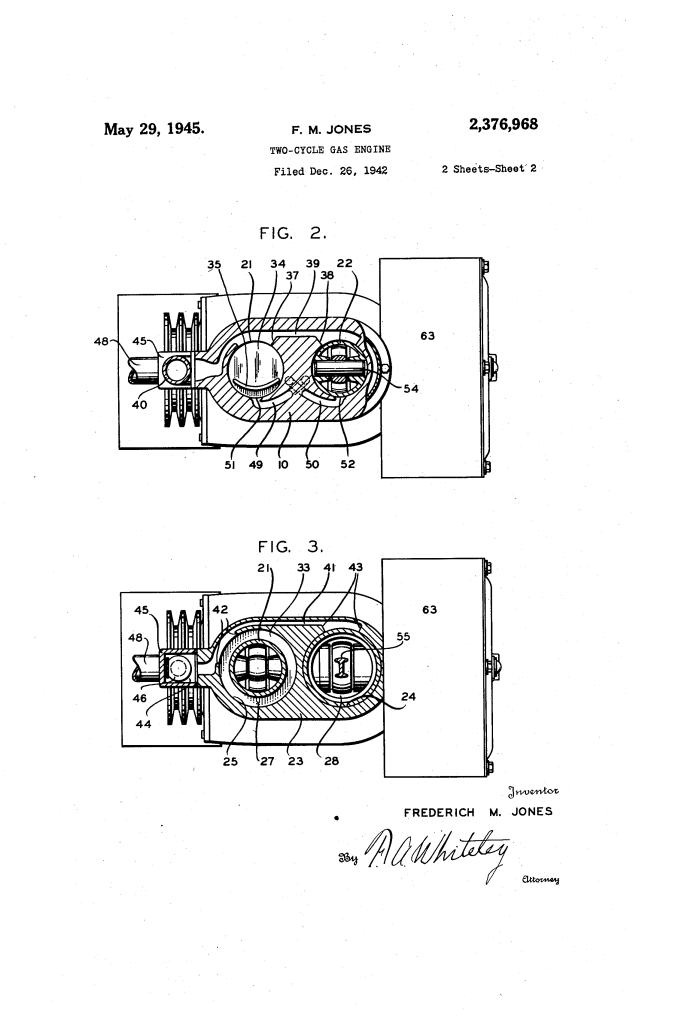
- The Path: Instead of the fuel moving straight up, the compressed gas from the left cylinder’s annular chamber is forced through a passage ($50$) into the right power cylinder.
- The Advantage: This “cross-flow” ensures that the fuel is delivered at peak pressure precisely when the opposite cylinder is ready to be “scavenged” (cleared of exhaust).
3. Simultaneous Scavenging and Charging
Jones utilized a baffle (35) on the piston head to manage the chaotic environment inside the cylinder during the split second when exhaust leaves and fresh fuel enters.
- The Action: The fresh charge of gas hits the baffle and is deflected upward to the top of the cylinder.
- The Result: This “loop” of fresh air pushes the old, burnt exhaust gases out through the exhaust port (37, 38) on the opposite side. This ensures the new explosion is as “clean” as possible, maximizing power.
4. The Common Crankcase Chamber
In most twin-cylinder two-cycles of the era, the crankcase had to be divided into airtight sections.
- Jones’s Innovation: Because his “charging” happened in the enlarged cylinders above the crankcase, the crankcase (32) could be a single, open chamber.
- Benefit: This allowed for much better oil circulation (lubrication) and simplified the manufacturing process, making the engine more durable for the high-vibration environment of a moving truck.
Comparison Table: Standard 2-Cycle vs. Jones’s Design
| Feature | Standard 1940s 2-Cycle | Jones’s Two-Cycle Engine |
| Intake Method | Crankcase suction. | Stepped-piston compression. |
| Charging Logic | Self-charging. | Cross-charging (Cyl A feeds Cyl B). |
| Lubrication | Oil mixed with gas (Dirty). | Open crankcase (Cleaner/Simplified). |
| Efficiency | High fuel waste (Short-circuiting). | High scavenging efficiency via baffle. |
| Vibration | High (Independent pulses). | Smooth/Balanced (Opposing forces). |
Significance
This engine was a masterclass in Mechanical Logic:
- Reliability for Refrigeration: By separating the fuel-charging from the crankcase, Jones created an engine that could run for hundreds of hours without the “plug fouling” common in other two-strokes.
- Compact Power: The design provided the high torque needed to start heavy refrigeration compressors while remaining small enough to fit in the limited space of a truck’s nose.
- Legacy: While the industry eventually moved toward four-cycle diesels, Jones’s innovations in port timing and cross-cylinder charging influenced small-engine design for decades, particularly in industrial and agricultural equipment.
Final Insight: Frederick Jones held over 60 patents, but he considered his engine designs among his most important. He often said he could “hear” what was wrong with an engine just by standing near it. This patent is the visual proof of that mechanical intuition.
