
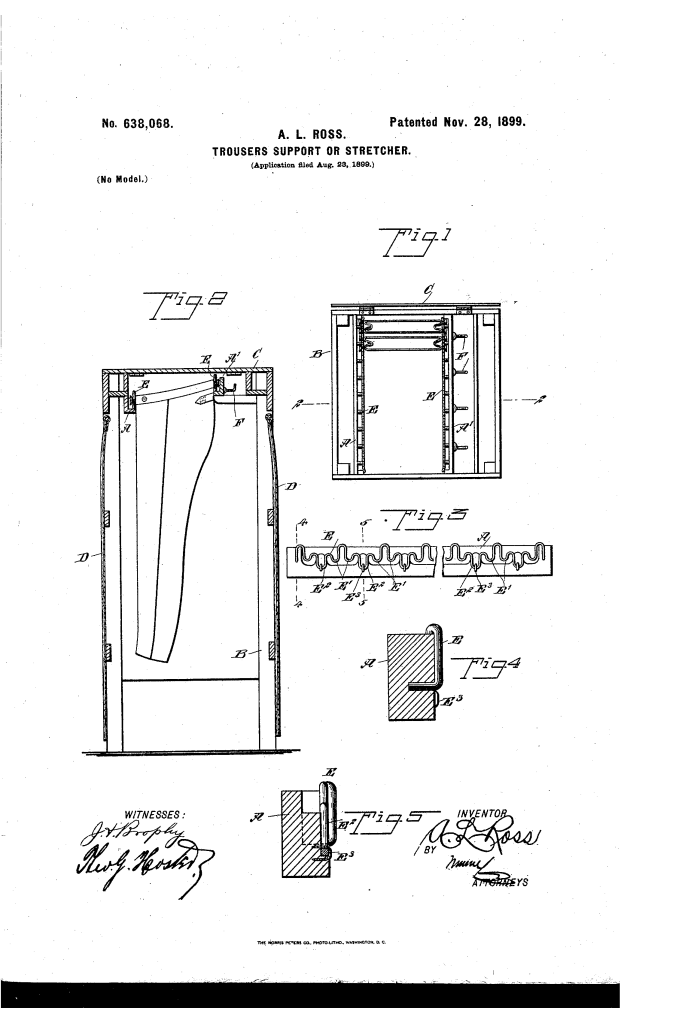
Trousers Support or Stretcher (1899)
U.S. Patent No. 638,068, granted on November 28, 1899, to Archia L. Ross, describes an innovative garment hanging and shaping apparatus designed for wardrobes, closets, and storage cabinets. Archia L. Ross, an inventor based in Port Chester, New York, developed the system to solve a common domestic issue of the late 19th century: keeping multiple pairs of men’s trousers pressed, wrinkle-free, and properly supported without consuming excessive closet space.
Traditional storage methods often resulted in creasing, fabric sagging, or rumpled waistbands. Ross’s design provided a high-density, dual-point suspension system that utilized the garment’s own waistband buttons to maintain natural tension and preserve the trousers’ tailored shape while hanging.
The Innovation: The Continuous-Wire Stretching Bar
The core mechanical breakthrough of Ross’s patent lies in the design of the stretching bars (E), which are mounted in parallel across the interior of a specialized cabinet structure (B).
Rather than using complex clamps, moving springs, or bulky wooden dowels, Ross formed each stretching bar from a single, continuous piece of resilient bent wire. The wire was shaped into alternating series of functional loops that simultaneously acted as mounting anchors and button-securing hooks:
- Upward-Extending Loop Pairs (E’)Arranged in precise pairs along the length of each bar, these loops serve as direct receivers for a pair of buttons situated on the waistband of folded trousers.
- Downward-Extending Anchoring Loops (E2)Alternating between each button-receiving pair, these loops extend downward below the bar line. Each lower bend is secured tightly to the wooden frame via a staple (E3) or fastener, creating rigid, evenly distributed support along the entire span.
- Clearance and Hang GeometryTo ensure buttons could easily slide into the wire loops without binding against the wood, Ross notched the transverse wooden supports (A, A’) so they feature an L-shaped cross-section directly behind the loops. Furthermore, supports A and A’ are installed at staggered, different height levels, providing the natural incline necessary for folded trousers to hang cleanly without bunching.
Key Structural Components
| Component | Function |
| Supporting Structure (B) | The outer cabinet framework, fitted with a hinged top cover (C) and curtained sides (D) for dust protection and easy ventilation. |
| Transverse Supports (A, A’) | Parallel wooden framing beams cut with an L-shaped cross-section to create clearance behind the button slots. |
| Wire Stretching-Bars (E) | Continuous-wire racks formed with integrated upward button loops and downward anchoring loops. |
| Upward Button Loops (E’) | Paired wire loops that hold the trousers’ suspender or waistband buttons securely. |
| Anchoring Loops and Staples (E2, E3) | Downward wire extensions driven into or fastened to the face of the wooden supports for stability. |
| Auxiliary Hooks (F) | Secondary storage hooks mounted on the rear support beam (A’) for hanging belts, suspenders, or additional garments. |
How the Apparatus Functions
The support operates via a direct, four-point waistband suspension:
- Folding the Garment: The trousers are folded lengthwise along their natural creases so the waistband buttons line up on opposing sides.
- First-Side Engagement: The user slides a pair of waistband buttons on one side of the trousers into a corresponding pair of upward wire loops (E’) on the first support bar (A).
- Second-Side Engagement: The opposing waistband buttons on the opposite side of the trousers are engaged into the matching pair of loops on the parallel bar (A’).
- Suspended Tension: Spanning the gap between the two staggered parallel bars draws the waistband taut across its width. The legs hang freely downward inside cabinet B, utilizing gravity and horizontal tension to pull out wrinkles and retain the garment’s press.
Historical and Practical Impact
Archia L. Ross’s trousers support addressed key lifestyle and garment-care needs at the close of the 19th century:
- High-Density Storage: The alternating loop configuration allowed dozens of trousers to hang in parallel within a compact footprint, with every pair independently accessible without disturbing adjacent garments.
- Fabric Preservation: By eliminating horizontal crossbars (which produce sharp transverse creases across trouser legs) and mechanical friction clamps (which mark delicate woolens), the button-suspension design preserved the fabric’s integrity.
- Simplicity of Manufacture: Fabricating the primary support out of a single continuous piece of bent wire eliminated multi-part assembly, hinges, and mechanical wear points, making it durable and inexpensive to produce.
About the Inventor: Archia L. Ross
Archia L. Ross was an active inventor residing in Port Chester, Westchester County, New York, during the turn of the 20th century. His practical mechanical designs focused on everyday consumer and domestic improvements, leveraging clever structural geometry and resilient wire-forming techniques to streamline garment maintenance and personal storage systems.
Summary of Claims
The patent explicitly claims:
- A trousers support or stretcher comprising a supporting structure combined with spaced, parallel stretching-bars.
- Stretching-bars each formed of a single continuous piece of wire featuring upwardly extending loops arranged in pairs to receive pairs of trousers buttons.
- Downwardly extending loops alternating with the upwardly extending loops and projecting below them, with the lower bends firmly fastened to the supporting frame.
