
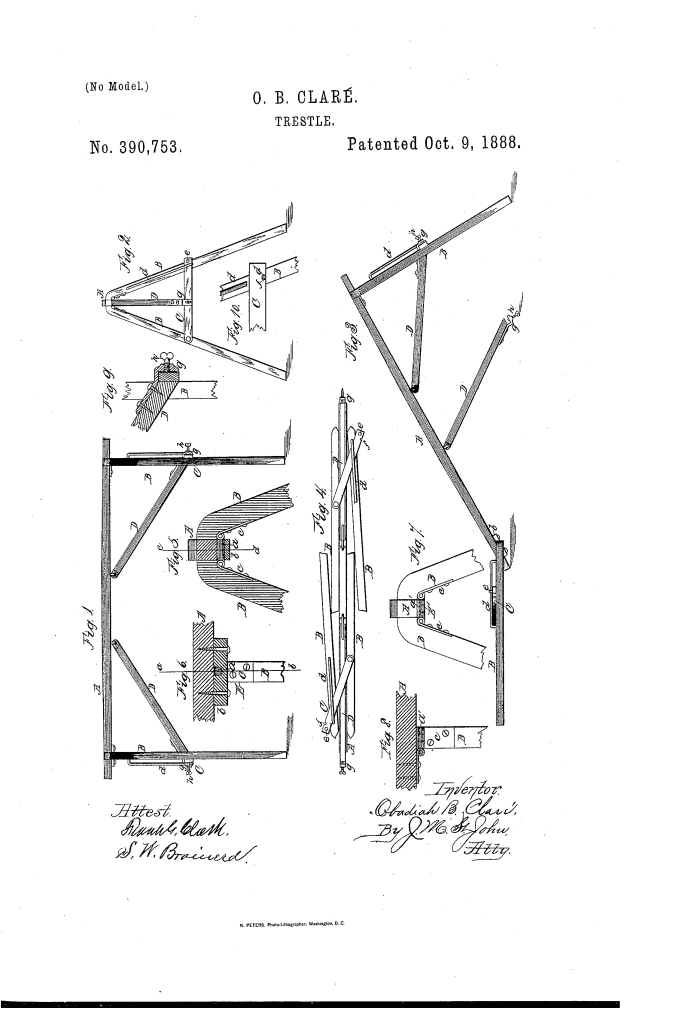
Folding Trestle (Obadiah B. Clare, No. 390,753)
The patent by Obadiah B. Clare of Cedar Rapids, Iowa, describes an improved Trestle (Patent No. 390,753, 1888). This invention is a large-scale, portable support structure designed specifically for household and industrial tasks like carpet beating. Clare’s primary objective was to create a trestle that was exceptionally large—approximately sixteen feet long and ten feet high—yet light enough to be transported and capable of folding into a compact form. His innovation features a specialized asymmetrical hinge system and a locking cross-bar mechanism that allows the trestle to be set up by a single person.
Inventor Background: Obadiah B. Clare
Obadiah B. Clare was an African American inventor based in Iowa during the late 19th century. His 1888 patent addressed a common logistical problem of the era: the maintenance of large, heavy textiles like carpets, which were difficult to clean without a sturdy, elevated support. Clare’s design demonstrates a sophisticated understanding of mechanical leverage and structural portability. By utilizing light woods like pine or spruce and designing complex multi-jointed hinges, Clare provided a professional-grade tool that could be used by carpet cleaners or homeowners and then tucked away, highlighting the engineering ingenuity within the post-Civil War Black community.
Key Mechanical & Structural Systems
The trestle functions through a series of interlocking wooden components and unique metal hinges that manage the weight of large objects.
1. The Asymmetrical Hinge System (E, E’)
A critical feature of the trestle is that the two ends behave differently to facilitate loading.
- Hinge E (Dual-Directional): The legs on one end can swing both inwardly and outwardly. This allow one end of the trestle to lie flat on the ground.
- Hinge E’ (Inward-Only Lock): The central portion (a’) of this hinge only turns inwardly, forming a “lock” against the rail (A) when the legs reach a right angle.
- Function: This allows the user to rest one end of the 16-foot rail on the ground (Fig. 3) to slide a heavy carpet on easily. Once loaded, the user lifts the depressed end, and the legs at Hinge E’ naturally fall into a locked, stable position to support the weight.
2. The Rail and Flaring Legs (A, B)
- Variable-Thickness Rail (A): The main horizontal bar is thicker in the middle than at the ends.
- Function: This engineering choice provides maximum strength where the “sag” from a heavy carpet is greatest while reducing unnecessary weight at the ends, making the 16-foot beam easier to carry.
3. The Locking Cross-Bars and Stirrup-Irons (C, d, f)
- Pivoted Cross-Bar (C): Each pair of legs is connected by a cross-bar pivoted to one leg.
- Stirrup-Iron (d): The opposite leg features a metal guide or “stirrup.”
- Locking Notch (f): A notch on the underside of the bar engages the bottom of the stirrup.
- Action: As the legs are spread apart, the bar drops into the stirrup and the notch “clicks” into place. This prevents the legs from spreading too far under a heavy load, providing a rigid triangular base.
4. The Angular Braces and Hooks (D, g, h)
- Diagonal Braces (D): These are hinged to the underside of the rail and extend to the cross-bars.
- Set-Screws (h): The braces terminate in angular hooks (g) that are tightened with thumb screws.
- Function: These braces prevent the trestle from “racking” or swaying lengthwise. The use of thumb screws allows for quick assembly and disassembly without the need for additional tools.
Improvements Over Standard Fixed Trestles
| Feature | Standard Industrial Trestles | Clare’s Folding Trestle |
| Portability | Heavy and fixed; required wagons. | Foldable (Fig. 4); easily carried by one person. |
| Loading | Required lifting heavy carpets 10ft high. | Inclined loading; one end rests on the ground. |
| Stability | Prone to collapsing or swaying. | Stirrup locks and braces provide a rigid frame. |
| Storage | Occupied large amounts of floor space. | Compact folding alongside the main rail. |
Significance to Engineering and Household Utility
Obadiah B. Clare’s trestle influenced the development of portable scaffolding and collapsible furniture.
- The Foundations of Tilting Loaders: Clare’s realization that a structure should “kneel” to receive a load is a precursor to the tilting trailers and loading ramps used in modern transport.
- Weight-to-Strength Optimization: By tapering the main rail and using pine/spruce, he practiced early structural optimization, a core principle in modern aerospace and civil engineering.
- Modular Safety Interlocks: The use of notches and set-screws to provide secondary stability anticipated the locking pins and tensioners found in modern ladder and easel designs.
- Ventilation Design: Clare specifically noted that the flaring legs helped spread the carpet ends apart, allowing air to pass through for better dust removal—an early example of functional ergonomics in cleaning technology.
