
Automatic Gear-Shift Transmission: Richard B. Spikes (Patent No. 1,936,996)
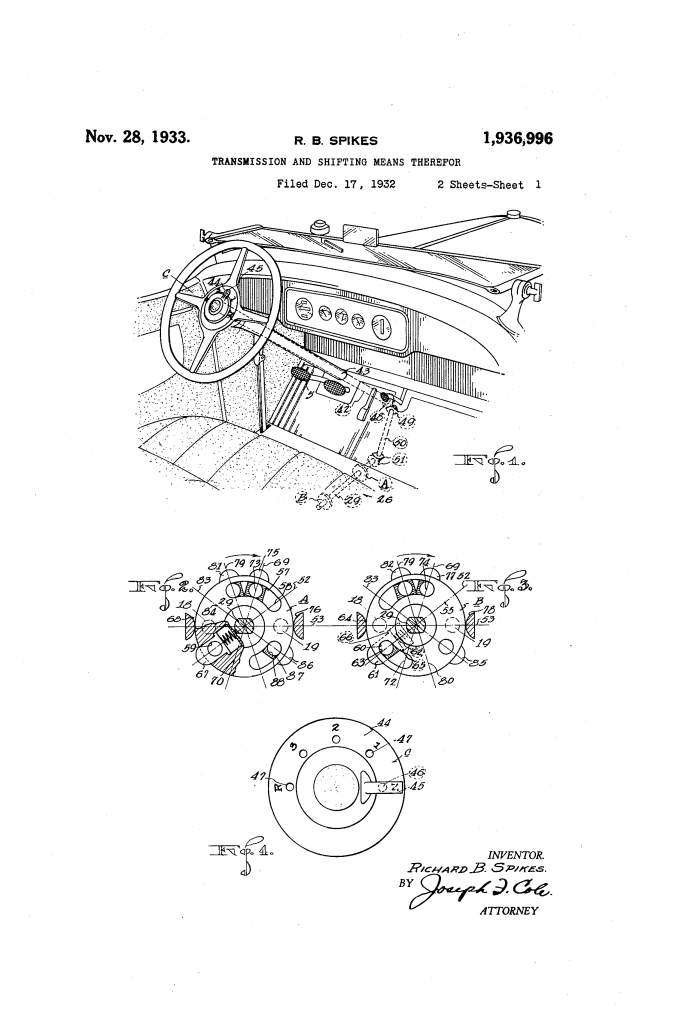
The patent by Richard B. Spikes of San Francisco, California describes a Transmission and Shifting Means Therefor (Patent No. 1,936,996), issued on November 28, 1933. This invention is a sophisticated mechanical gear selector and automatic shifting system designed to simplify automotive operation by allowing a driver to pre-select a gear and execute the shift entirely through the movement of the clutch pedal.
The “Why”
In the early 1930s, driving a car was a physically demanding task. Standard transmissions required precise manual coordination between the floor-mounted gear lever and the clutch pedal. Misaligned shifts often led to “grinding gears,” and the presence of the large shift lever obstructed the driver’s compartment. Spikes aimed to solve these “pain points” by creating a pre-selective system. He wanted to remove the clutter of the gear shift lever and ensure that the complex sequence of shifting—dropping to neutral, then engaging the new gear—happened automatically and flawlessly in one motion.
Inventor Section: Richard B. Spikes
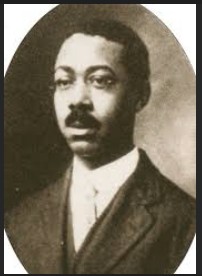
Richard B. Spikes was a prolific Black engineer and master mechanic whose inventions fundamentally shaped 20th-century transportation. His engineering philosophy focused on human-centric automation—making machines safer and easier for the general public to use. Despite the systemic barriers of the era, Spikes secured patents for the directional turn signal, the automatic brake safety system, and improved beer keg taps. His work on this transmission reflects a high degree of mathematical precision and a visionary approach to what we now recognize as the precursor to semi-automatic driving.
Key Systems Section
1. The Selector Indicator (User Interface)
Located on the steering column, this interface (C) allowed the driver to move a finger-grasping dial (45) to a desired gear (Low, Second, Third, or Reverse) at any time before the actual shift.
- Modern Translation: A pre-selector dial or electronic gear selector.
- Function: It mechanically rotates a shaft (29) that “primes” the internal shifting discs to the correct angle, though nothing happens to the gears until the clutch is depressed.
2. The Companion Selector Discs (A & B)
The heart of the invention consists of two confronting discs (A and B) mounted on a central shaft. These discs feature a complex pattern of slots and solid wall portions.
- Modern Translation: A mechanical logic gate system.
- Function: Depending on the rotation of the discs, they either “telescope” (pass over) a shifting rod or “abut” (push) it. This determines which gear rod (18 or 19) is moved when the discs are drawn together.
3. Cam-Operated “Gates” (Neutral Return System)
Small sliding gates (61, 67) are built into the selector discs, controlled by fixed cams (64, 68).
- Modern Translation: An automatic neutral-return interlock.
- Function: As the discs move axially, these gates ensure that if a gear is already engaged, it is first pushed back to the Neutral position before the new gear is permitted to engage. This prevents the transmission from trying to hold two gears at once, which would cause a catastrophic failure.
Comparison Table
| Feature | Standard Manual Transmission (1932) | Spikes’ Automatic Shifting Means |
| Shift Actuation | Manual floor lever moved in an “H” pattern. | Single-stroke clutch pedal operation. |
| Timing | Driver must manually find neutral between gears. | Automatic neutral synchronization via cam-gates. |
| Cab Ergonomics | Obstructed by large floor levers. | Unobstructed floor; selector on steering column. |
| Human Error | High risk of gear grinding or missed shifts. | Mechanical pre-selection ensures the gear is locked in before the shift occurs. |
Significance Section
- Foundation of Semi-Automatic Driving: Spikes’ logic of separating the “selection” of the gear from the “actuation” is the fundamental principle behind modern paddle-shifters.
- Safety Integration: By linking the shift to the clutch pedal stroke, he ensured the engine was always disengaged during gear changes, protecting the transmission longevity.
- Space Optimization: Moving the gear selection to the steering column cleared the way for the “bench seating” and modern interior layouts of the mid-20th century.
