
Automatic Car-Coupler (1897)
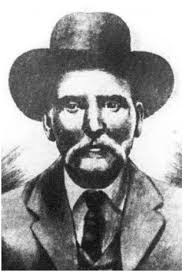
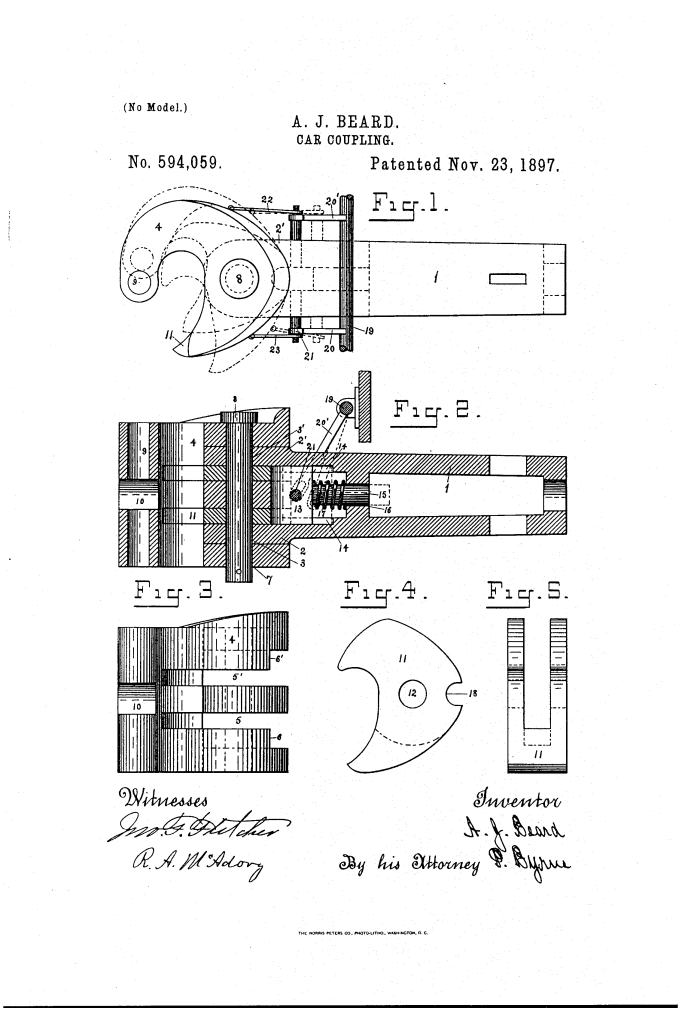
U.S. Patent No. 594,059, granted on November 23, 1897, to Andrew Jackson Beard, details a modular, automatic railway car coupler designed to improve safety, ease of maintenance, and mechanical reliability. Andrew J. Beard, an extraordinarily inventive mind working out of Eastlake, Alabama, introduced this design—commonly referred to as the “Jenny Coupler”—to help eliminate the lethal hazards associated with early railroad coupling systems.
Prior to automatic couplers, rail workers were forced to stand manually between moving train cars to drop a iron pin into a link as the cars slammed together. This manual “link-and-pin” method was responsible for thousands of severe injuries, crushed limbs, and deaths among rail workers every year. Beard’s invention provided a completely automatic jaw-coupling system that coupled on impact and could be safely uncoupled from the exterior of the train.
The Innovation: Modular Interlocking Jaws
Beard’s design introduced a double-pivoting, horizontal jaw arrangement that opens and closes in opposite directions to join two cars. Rather than manufacturing the draw-head as a single, rigid piece of cast metal, Beard engineered a modular three-part assembly consisting of a shank (1), a head (4), and a movable jaw (11)—all secured together by a single central pivot pin (8).
Why the Modular Three-Part Design?
- Ease of Repair: Railroad equipment takes immense mechanical impact. By isolating the shank, head, and jaw into separate components connected by a single pin (8), any broken section could be easily swapped out on the line without discarding the whole coupler.
- Opposing Dual Action: The head (4) and the side jaw (11) pivot on the same vertical axis, allowing them to swing open and shut in opposite directions. This dual action gives the coupler a wider capture zone during car contact.
- Fail-Safe Automatic Locking: A spring-loaded internal lock secures the jaws instantly upon impact, eliminating any need for a worker to step between the cars.
Key Technical Components
The system relies on a tightly integrated set of mechanical links and locking mechanisms:
| Component | Function |
| Draw-Head Shank (1) | The heavy steel body mounted to the car frame; features forward-projecting lugs (2, 2′) with pin-holes to anchor the head and jaw. |
| Head (4) | The primary outer coupling shell containing internal slots (5, 5′) that house the jaw tail-wings, alongside a recess (18) for the lock. |
| Side Jaw (11) | The pivoting metallic arm featuring tail-wings that fit inside the head’s slots; swings outward to open and inward to catch an opposing coupler. |
| Head-Lock (13) | A sliding spring-loaded block equipped with a tail-pin (15) and coiled spring (17); automatically drops into recesses (18) to freeze the head and jaw in a locked position. |
| Operating-Rod Assembly (19, 20, 20′) | A cross-car rod with levers extending downward, connected via a transverse bar (21) and control rods (22, 23) directly to the lock and jaws. |
How the Apparatus Functions
The coupler transitions seamlessly between automatic coupling and safe manual release through a simple sequence:
- Automatic Coupling: As two cars move together, the extended jaws bump into each other, forcing the head (4) and side jaw (11) to pivot inward toward their closed orientation.
- Spring Engagement: The internal coiled spring (17) drives the sliding head-lock (13) forward into the concave recesses (18) of the head and jaw, instantly locking them together.
- Manual Uncoupling: To disconnect cars, a rail worker turns the external operating-rod (19) mounted safely at the outer edge of the car frame.
- Linkage Activation: Rotating the rod causes the downward levers (20, 20′) to pull back the transverse bar (21) and sliding lock (13), while connecting rods (22, 23) simultaneously pull the head and jaw wide open.
Historical and Industrial Impact
Andrew Jackson Beard’s patent came at a critical turning point in American industrial history, arriving shortly after Congress passed the Railroad Safety Appliance Act of 1893 (which mandated automatic couplers on interstate rail cars).
- Life-Saving Safety: By removing the requirement for workers to stand between moving freight cars to drop coupling pins, Beard’s style of automatic coupler prevented thousands of amputations and fatalities across the rail network.
- Commercial Value: Beard reportedly sold the rights to his car coupler patent for $50,000 in late 1890s money—an enormous fortune at the time that reflected the immediate commercial utility of his design.
- Interoperability: To maintain flexibility during the industry’s transition period, Beard included standard link slots (10) and pin-holes (9) in the front of his head (4), allowing his modern coupler to connect to older link-and-pin equipment when necessary.
About the Inventor: Andrew Jackson Beard
Andrew Jackson Beard (c. 1849–1921) was an extraordinarily prolific African American inventor and entrepreneur who rose from severe post-Reconstruction hardships to change industrial mechanics.
- Self-Taught Engineering: Born into slavery in Alabama, Beard gained his freedom following the Civil War. Despite having no formal training in mechanical engineering, he taught himself design through practical agricultural work and mill operation.
- Patent Portfolio: Before his revolutionary car coupler, Beard patented an improved rotary plow (1881), a double plow design (1887), and a steam engine design (1892).
- National Recognition: In 2006, Andrew Jackson Beard was posthumously inducted into the National Inventors Hall of Fame in recognition of his transformative impact on railway safety and mechanical engineering.
Summary of Claims
The patent explicitly claims:
- A draw-head combination featuring a shank with forward-projecting lugs, a slotted head, an interlocking jaw, and a central pin pivotally connecting all three core elements together alongside a sliding lock.
- An external operating rod configured with downward arms attached to a transverse bar to manipulate the internal locking mechanism from the side of a train car.
- Connecting rods attached between the lock-bar, head, and side jaw that pull the jaws fully open when the lock is retracted.
