
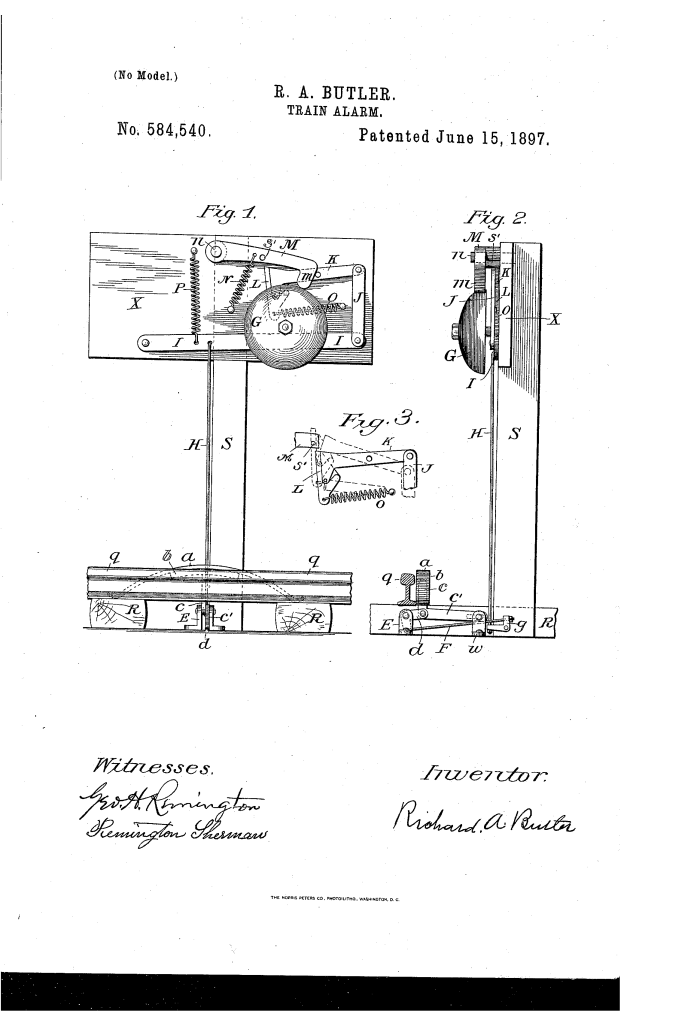
The patent by Richard A. Butler of Pawtucket, Rhode Island, describes an improvement in a Train-Alarm (Patent No. 584,540, 1897). The objective is to provide an alarm-signal for the benefit of trainmen when approaching an overhead bridge or other low-clearance hazard.
Inventor Background: Richard A. Butler
Richard A. Butler was an inventor contributing to railway safety devices in the late 19th century. His invention addresses a specific and dangerous operational hazard of the time: the risk of trainmen (who had to walk or stand on top of freight cars) being struck by low-hanging structures. Butler’s system provided a simple, track-actuated warning mechanism.
Invention and Mechanism
The apparatus is a completely mechanical system that uses the weight of the passing train wheels to actuate a gong located near the top of the cars.
1. Track-Side Actuation (The Trigger)
- Spring-Shoe (): A strip of spring-steel secured above the rail and outside of it, so that the tread of passing car wheels will impinge upon it and force it down.
- Plunger and Bell-Crank (): The spring-shoe (
) rests on a cushion (
) and a plunger (), which in turn presses upon a bell-crank lever () fulcrumed in a double post (E).
- Function: As the train wheel rolls over the spring-shoe, the downward force translates into a mechanical pull on the connected system of wires.
2. Mechanical Linkage and Amplification
- Wire and Lever System (F, H, I, J, K): A series of wires (F, H) and levers (g, I, J, K) transmit the motion from the track to the post (S) where the alarm is located.
- Reciprocating Rod: The system is designed to convert the small initial depression of the spring-shoe into a significant upward movement necessary to cock the hammer.
3. Alarm Mechanism (The Striker)
- Hammer (m) and Gong (G): A gong (G) is mounted on a post (S) raised to about the height of the top of a freight-car. A lever (M) terminates in the hammer (
).
- Trip-Toe Lock (L): The end of the final lever (K) has a loosely secured trip-toe (L).
- Hammer Shaft (5): This shaft is connected to the hammer lever (M). When the trip-toe (L) is raised by the linkage, it catches against and lifts the shaft (5), raising the hammer ().
- Spring Release: A strong spiral spring (N) is secured to the frame (X) and the hammer lever (M). When the trip-toe (L) releases the shaft (5), the spring (N) snaps the hammer (
) down against the gong (G), sounding the alarm.
Historical Significance and the Inventor
Butler’s invention addressed a severe safety hazard in 19th-century rail operations by providing a simple, reliable warning system.
- Overhead Bridge Danger: Before clearance standards were universal, low overhead bridges and tunnels were lethal hazards for trainmen working on top of freight cars. Manual warning signals (often ropes or “tell-tales”) were unreliable, especially at night or in bad weather.
- The Audible/Physical Warning: Butler’s system provided an automatic, clear audible warning placed at the elevation where the trainmen were located, serving as a non-electronic safeguard.
- Mechanical Simplicity: The system is completely mechanical and non-electric, relying entirely on levers, wires, and springs. This made it cheaper to manufacture, easier to maintain in remote areas, and immune to weather-related electrical failures.
Concepts Influenced by This Invention
Butler’s design influenced subsequent mechanical signaling and trip systems used in harsh, remote environments.
- Track-Actuated Trip Switches: The concept of using a wheel-depressed shoe/plunger to initiate a safety sequence is a foundational principle of track-side automation. This influenced later mechanical systems for counting cars, setting crossing gates, and activating signals where movement is controlled by physical interaction with the wheel flange or tread.
- Mechanical Motion Amplification: The design uses a series of lever and wire linkages (F, H) to transmit a tiny vertical displacement at the track (plunger
) over a long distance and convert it into the final, rapid vertical snap of the hammer (
). This influenced the design of mechanical systems requiring force or motion amplification in remote control or signaling applications.
- Trip-and-Release Alarm: The use of a trip-toe (L) and a spring-driven hammer (N) to create a loud, momentary alarm is a classic, robust design. This mechanism is still used conceptually in various mechanical alarms and trip mechanisms (like emergency stop buttons that mechanically latch until reset).
