
Traffic Signal for Automobiles (Hassel D. Robinson, No. 1,580,218)
The patent by Hassel D. Robinson of Washington, D.C., describes an advanced Traffic Signal for Automobiles (Patent No. 1,580,218, 1926). This invention is an early, comprehensive signaling system designed to allow drivers to communicate their intentions to stop, turn, or reverse to both pedestrians and other motorists. Robinson’s primary objective was to replace the ambiguous hand signals of the era with a clear, illuminated, and color-coded dashboard-controlled device. His innovation resides in a multi-compartment casing that organizes various signals—including turn arrows, a stop cross, and a tail-light—into a single, compact unit.
Inventor Background: Hassel D. Robinson
Hassel D. Robinson was an African American inventor based in the District of Columbia during the mid-1920s. This was a critical period in automotive history; as car ownership surged, the lack of standardized signaling led to increasing road accidents. Robinson, along with several family members who held stakes in the patent, sought to solve this “chaos of the road.” His design is a testament to early automotive safety engineering, emphasizing high visibility and intuitive iconography (like arrows and crosses) that remain the global standard for traffic communication today.
Key Mechanical & Electrical Systems
The signal is a modular box containing five distinct light chambers, designed to be mounted on both the front and rear of a vehicle.
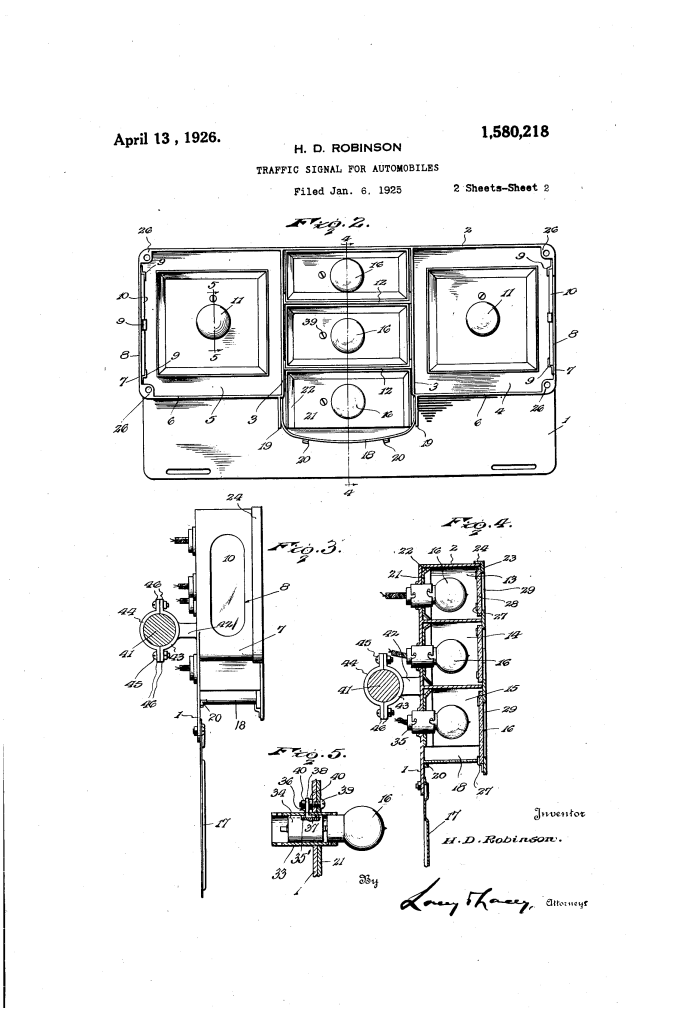
1. The Multi-Compartment Casing (1, 3, 12)
- Structural Layout: The device features a back plate (1) with integral vertical partitions (3) and horizontal partitions (12).
- Functional Zoning: These partitions divide the box into five light-tight compartments (4, 5, 13, 14, 15), ensuring that when one signal is lit, it does not “bleed” light into the others.
- Function: This allows for precise signaling. The side compartments (4, 5) house turn signals, while the center stack houses reverse, stop, and tail-lights.
2. Iconic Sight Openings and Color Coding (29, 30, 31, 32)
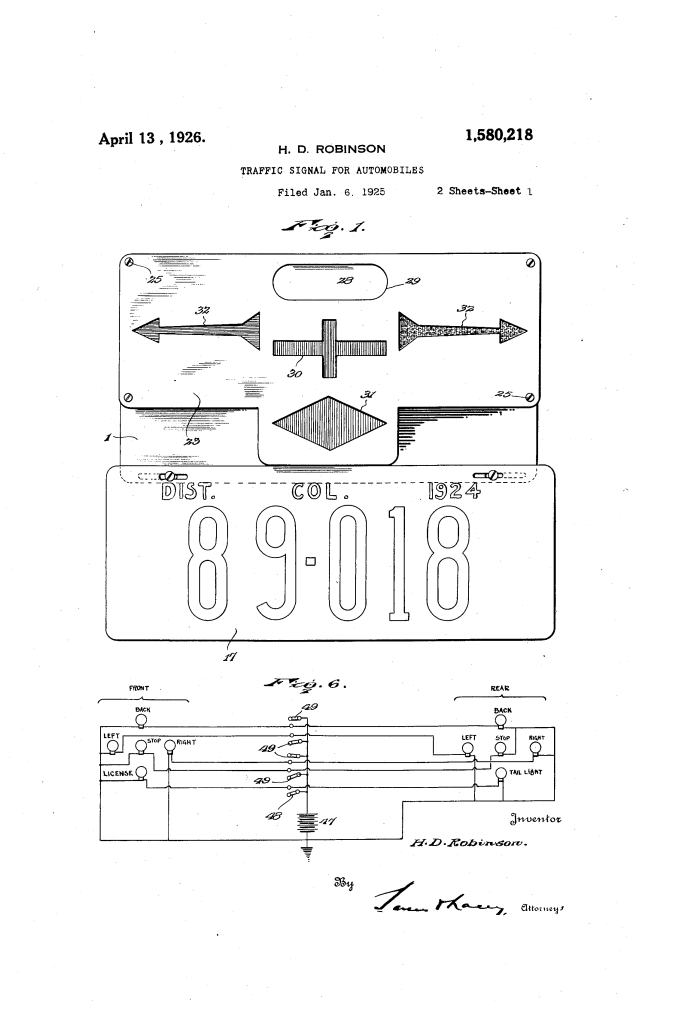
The face plate (23) features cut-outs with distinctive shapes and colored glass panes (28).
- Directional Arrows (32): Located on the left and right to indicate turns.
- The Stop Cross (30): A red cross in the center compartment (14) signals a full stop.
- The Reverse Ellipse: An oblong opening over compartment (13) with clear glass to signal backing up.
- The Tail-Light Diamond (31): A red diamond over the bottom compartment (15) for night driving and parking.
3. Integrated Tail-Light and License Illuminator (15, 17, 18) (Key Innovation)
- Open-Bottom Design: The lowermost compartment (15) is open at the bottom.
- License Plate (17): The license plate is mounted directly beneath the signal box.
- Transparent Cover (18): A flexible celluloid strip protects the lamp from dust while allowing light to shine downward.
- Function: This dual-purpose design allows the red rear light to serve as a safety marker while simultaneously providing the legal illumination required for the license plate.
4. The Circuit and Mounting System (41, 47, 49)
- Series Connection: Robinson’s electrical diagram (Fig. 6) shows that the front and rear signals are connected in series.
- Function: When the driver flips a switch (49) on the dashboard, the turn signal flashes at both the front and rear of the car simultaneously, ensuring 360-degree communication.
- Universal Mounting: The device uses a bracket (42) and collar (43) system to clamp onto the cross-bars or fenders found on most 1920s automobiles.
Improvements Over Standard 1920s Signaling
| Feature | Standard Hand/Early Signals | Robinson’s Traffic Signal |
| Visibility | Hard to see at night or in bad weather. | Reflector-backed (21) electric lamps in color-coded compartments. |
| Clarity | Hand signals varied by region/driver. | Iconic shapes (Arrows, Crosses, Diamonds) for instant recognition. |
| Automation | Required driver to take hand off the wheel. | Controlled by dashboard switches (49). |
| Integration | Separate lights for tail, stop, and license. | All-in-one unit with integrated license plate illumination. |
Significance to Automotive Engineering
Hassel D. Robinson’s traffic signal influenced the development of modern vehicle lighting clusters and standardized road communication.
- The Turn Signal Standard: Robinson was among the first to use the arrow shape for automotive turns, a design choice that is now universally mandated for vehicle safety.
- Block Compartmentalization: His use of internal partitions to prevent “light bleed” is a foundational principle in the design of modern LED tail-light housings, where stop, turn, and reverse lights must be strictly separated.
- Simultaneous Front/Rear Signaling: By wiring the front and rear units in series, he established the logic for vehicle-wide signal synchronization, ensuring the driver’s intent is visible from all angles.
- Modular Safety Clusters: The concept of an “all-in-one” safety box (tail, stop, reverse) anticipated the rear combination lamps (RCL) found on every car manufactured today.
