
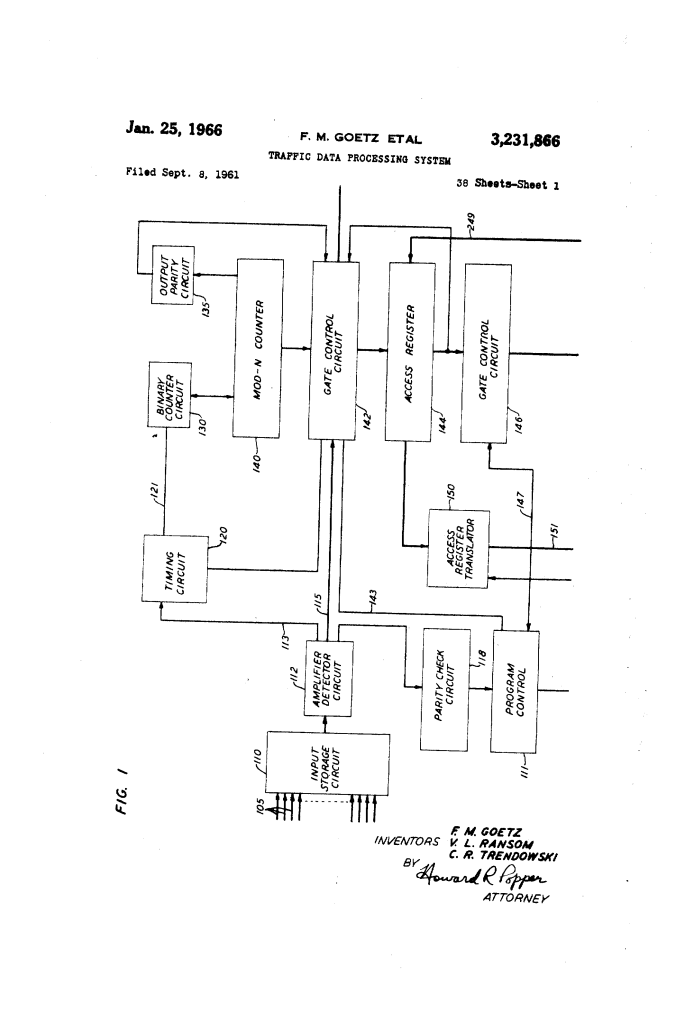
Traffic Data Processing System (1966)
U.S. Patent No. 3,231,866, granted on January 25, 1966, to Frank M. Goetz, Vance L. Ransom, and Casimir R. Trendowski (assigned to Bell Telephone Laboratories, Incorporated), describes an automated, high-speed electronic data processing system tailored for telephone switching networks.
During the rapid postwar expansion of national telephone infrastructure, managing central office traffic was a critical operational bottleneck. Network administrators had to monitor call volume, hold times, and circuit loads across thousands of switching trunks to avoid congestion and route traffic efficiently. Previously, gathering this data relied on mechanical peg-count meters, electromechanical step counters, or manual photographic readings. The Goetz system introduced a solid-state, centralized digital framework that continuously sampled, stored, and compiled live trunk data into standardized machine-readable formats.
The Innovation: Solid-State Traffic Scanning and Core Accumulation
The primary challenge of electromechanical telephone exchanges was the mismatch between continuous, real-time circuit traffic and slow mechanical recording devices. If an exchange experienced sudden spikes, electromechanical recorders suffered wear, missed counts, or clogged physical tally registers.
The Goetz-Ransom-Trendowski system replaced mechanical tallying with a high-speed electronic scanner coupled directly to magnetic core memory storage. By scanning status leads at microsecond intervals, the system converted instantaneous trunk conditions (busy vs. idle) into structured digital binary words without disrupting ongoing customer telephone connections.
Core Functional Blocks
| Block / Unit | Core Function |
| Electronic Scanner Matrix | Rapidly scans thousands of individual trunk terminals and switching circuits in a sequential matrix cycle to detect busy or idle states. |
| Data Selector Circuit | Gates and routes sampled signals from selected trunk groups into the central processor logic based on program timing. |
| Counter Mod-N & Mod-M Stages | Dual-tier electronic modulo counter chains that divide clock frequencies and track word intervals, frame cycles, and scan addresses. |
| Magnetic Core Memory Matrix | High-density magnetic storage providing dedicated memory addresses that accumulate and tally total usage counts for each trunk group. |
| Output Parity & Formatting Logic | Performs automated parity checking on output words and converts internal data into standard binary format for transmission or tape recording. |
| Word Alternator | Regulates reading, modifying, and rewriting operations during each memory access cycle to prevent data collisions. |
System Operation and Flow
The system executes continuous cycles of interrogation and data logging to keep network traffic counts updated in real time:
| Phase | Action | Operational Purpose |
| 1. Sampling | Scanner sweeps groups of trunk status leads. | Senses the binary electrical condition (conducting/open) of circuits without interfering with live voice lines. |
| 2. Selection | Data Selector isolates incoming status bits. | Translates raw physical wire conditions into synchronized logic-level pulses. |
| 3. Memory Lookup | System fetches the stored accumulator word for the scanned trunk. | Retrieves the existing tally from the magnetic core matrix via Mod-N and Mod-M address lines. |
| 4. Accumulation | Arithmetic adder updates the count if the line is active. | Increments total usage (CCS / Hundred Call-Seconds) directly inside the electronic register. |
| 5. Verification & Output | Parity check is applied; output is buffered. | Guarantees data integrity before committing records to teletypewriters, paper tape punches, or magnetic tape drives. |
Technical and Network Impact
The Goetz data processing system marked a pivotal transition in central office operations:
- Real-Time Network Load Balancing: Central office engineers could detect overloaded crossbar groups instantly rather than waiting for day-end manual meter tallies.
- Elimination of Mechanical Drift: Solid-state digital counters removed the physical wear, coil burnouts, and mechanical latency inherent in traditional electromechanical registers.
- Direct Computer Integration: By formatting collected metrics into synchronized digital words with built-in parity, traffic data could be fed straight into mainframe data processing pipelines for billing and network optimization.
About the Inventors
- Frank M. Goetz: A research engineer at Bell Telephone Laboratories, Goetz contributed extensively to electronic switching system (ESS) development, digital memory interfaces, and automated diagnostic architectures.
- Vance L. Ransom: An electrical engineer with Bell Laboratories who specialized in telecommunications network traffic theory, pulse-code manipulation, and automated trunk routing systems.
- Casimir R. Trendowski: A systems and hardware design engineer at Bell Labs focused on solid-state digital circuits, scanner timing arrays, and peripheral control units for central switching offices.
Summary of Claims
The patent explicitly claims:
- An electronic data processing architecture combining an electronic scanner, a multi-address magnetic memory store, and automated accumulator logic for monitoring telecommunication links.
- A coordinated counter system comprising Mod-N and Mod-M timing chains to address distinct memory segments sequentially in synchronism with network line scanning.
- An integrated parity-checking and word-alternating output circuit that validates gathered traffic words before permanent recording.
