
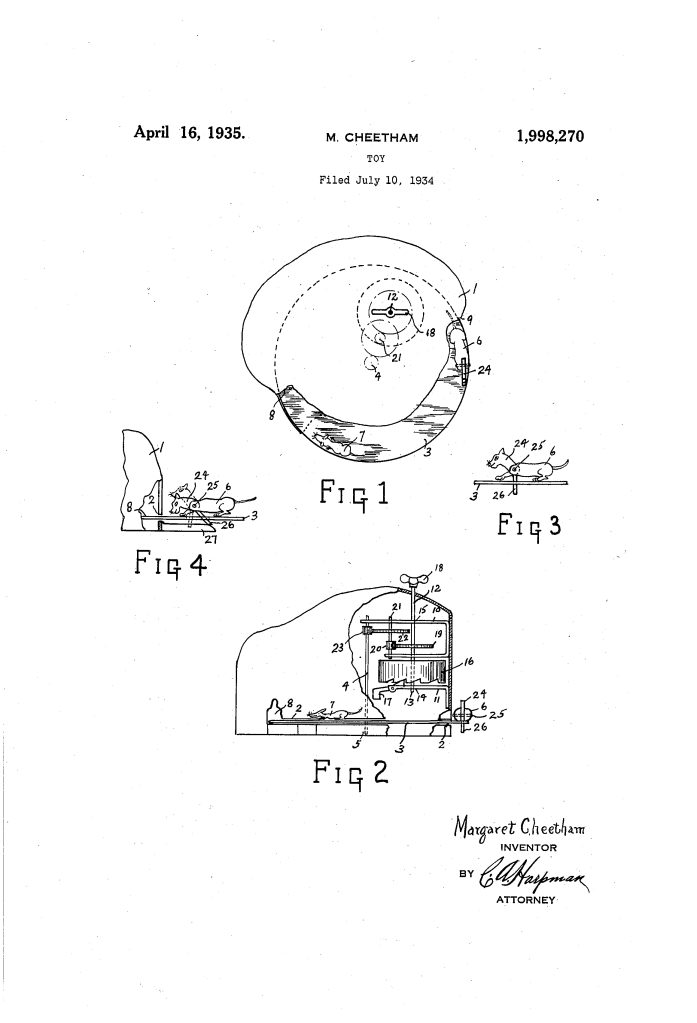
Animated Pursuit Toy, Margaret Cheetham, Patent No. 1,996,270
The patent by Margaret Cheetham of Youngstown, Ohio, describes an Animated Pursuit Toy (Patent No. 1,996,270), granted on April 16, 1935. This invention is a mechanical clockwork novelty featuring a kinetic “chase” sequence where figures—specifically a cat and a rat—disappear into and emerge from a hollow mound, enhanced by a gravity-defying head-drop mechanism.
The “Why”
In the mid-1930s, the toy market was evolving from static figurines to “action” toys that told a story. The primary “pain point” Cheetham addressed was the lack of realistic interaction in simple rotational toys. By offsetting the axis of the rotation, she created an “in-and-out” motion that simulated a hunt, and by adding a mechanical pivot, she overcame the clearance issues of a tall figure entering a small opening, adding a touch of whimsical realism.
Inventor Section: Margaret Cheetham
Margaret Cheetham’s engineering philosophy was centered on eccentric geometry and character-driven mechanics. Patenting a mechanical device as a woman in 1934 was a significant feat, as women inventors often faced skepticism in the male-dominated field of toy engineering. Her design shows a sophisticated understanding of spatial offsets and moment arms. She didn’t just want a wheel that turned; she wanted a staged performance that utilized the “unseen” interior of the toy to create suspense for the child.
Key Systems Section
1. Eccentric Drive System (Off-Center Rotation)
- Function: Creates the “appearing and disappearing” effect of the figures.
- Modern Translation: Eccentric Axis Rotation.
- The vertical shaft ($4$) is positioned away from the center of the mound ($1$). This ensures that as the disk ($3$) rotates, the figures travel in a wide arc that takes them outside the mound’s footprint and then “hunts” them back through the internal hollow.
2. Gravity-Weighted Pivot (Head Movement)
- Function: Lowers the cat’s head so it can fit into the “mouse hole” without hitting the roof.
- Modern Translation: Mechanical Cam-Actuated Pivot.
- The cat’s head ($24$) is balanced by a weighted arm ($26$). Normally, gravity keeps the head up. However, as the cat approaches the tunnel, the arm hits a stationary lug ($27$), which physically pulls the head down into a “stalking” position.
3. Spring-Driven Transmission (Clockwork)
- Function: Provides the energy for the continuous pursuit.
- Modern Translation: Mainspring and Gear Train.
- A thumb nut ($18$) winds a spring-contained ratchet drum ($16$). This potential energy is released through a series of increasing cog wheels ($19, 20, 22, 23$) to convert the spring’s torque into the steady, high-speed rotation required for the chase.
4. Slot-and-Opening Architecture
- Function: Manages the physical boundaries of the “stage.”
- Modern Translation: Housing Clearances / Guide Slots.
- A horizontal slot ($2$) near the base allows the disk to pass through the sheet metal mound. This creates a clean visual break where the “outside world” meets the “cat’s den.”
Comparison Table
| Feature | Standard 1930s Rotating Toys | Cheetham’s pursuit Toy |
| Motion Path | Simple circle (always visible). | Eccentric path (disappears into the mound). |
| Character Interaction | Static figures. | Dynamic head-drop for clearance and realism. |
| Power Source | Often hand-pushed. | Internal clockwork with ratchet tensioning. |
| Spatial Utility | Flat play surface. | 3D Mound utilized for “hide-and-seek” play. |
Significance Section
- Precursor to Modern “Pop-Up” Toys: The use of a rotating disk to move objects in and out of a hidden space is the mechanical foundation for many modern nursery toys.
- Mechanical Animation: This design is an early example of using interference-driven motion (the lug hitting the weight) to create a secondary animation without a separate motor.
- Geometry in Play: The use of an off-center vertical shaft demonstrates a clever application of circular geometry to create non-concentric motion paths.
- Durability in Design: By choosing sheet metal and a simple geared movement, Cheetham designed a toy that could withstand the high-torque stresses of a child’s winding.
