
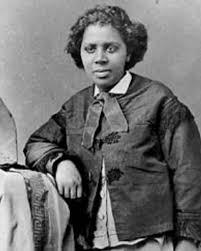
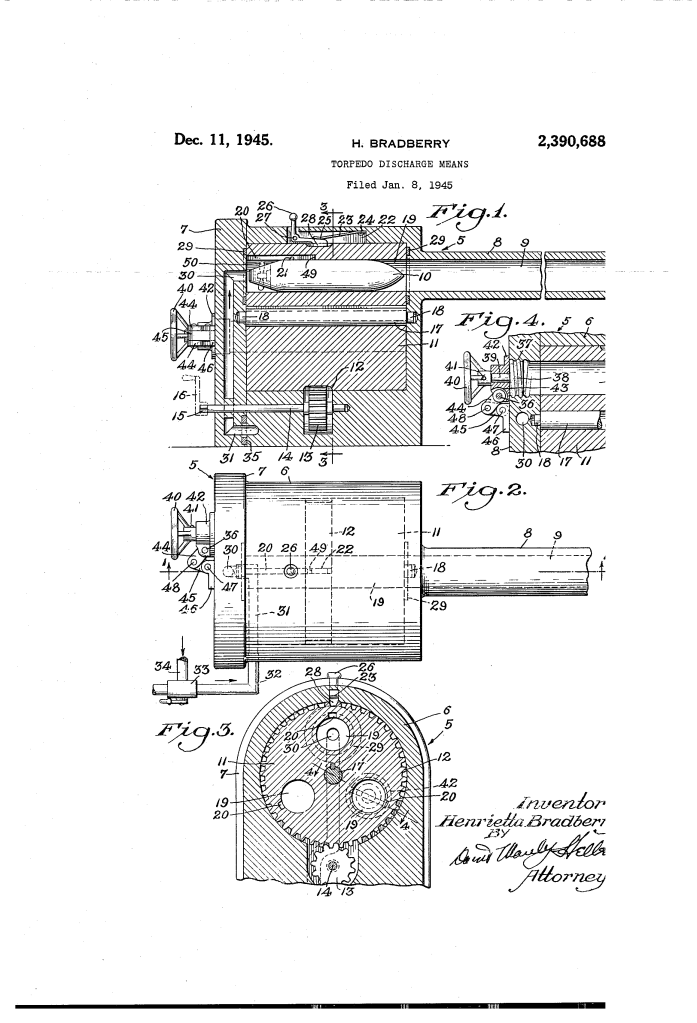
Torpedo Discharge Means, Henrietta Bradberry (1945)
Patented in December 1945, this invention by Henrietta Bradberry of Chicago (U.S. Patent No. 2,389,617) represents a specialized advancement in naval and defensive weaponry. Bradberry, an African American inventor who also developed subterranean fortification systems, designed this mechanism to solve a specific problem in underwater combat: how to rapidly and reliably fire multiple torpedoes from a fixed position (like a submarine or a sub-terranian fort) without letting water pressure flood the firing mechanism.
Bradberry’s Torpedo Discharge Means is essentially a “revolving door” for explosives. By utilizing a rotating drum magazine and a clever pneumatic firing system, she created a weapon that could be reloaded and fired while submerged, keeping the internal chambers bone-dry and the torpedoes ready for action.
The “Why”
In the 1940s, firing a torpedo from a submarine was a delicate process. Opening the outer doors of a torpedo tube exposed the interior to immense water pressure. If the seals failed, the vessel could flood. Furthermore, manually “arming” a torpedo before firing was dangerous and slow. Bradberry sought to create a sealed, multi-chambered magazine that could index torpedoes into position and automatically activate their engines as they were being launched.
Inventor Section: Engineering Philosophy
Henrietta Bradberry’s philosophy was Mechanical Isolation. She realized that the firing chamber should never be “open” to both the interior of the ship and the exterior ocean at the same time. Her design uses a Rotating Drum (11) as a pressure lock. By isolating the loading section from the discharge section, she ensured that the pneumatic pressure used to launch the torpedo was contained, and the ocean’s water pressure was blocked by heavy-duty gaskets (29, 35).
Key Systems Section
1. The Rotating Drum Magazine
Instead of a single tube, Bradberry used a revolver-style cylinder.
- Multi-Chamber Design: The drum has several chambers (19), each capable of holding a torpedo (10).
- The Indexing Gear (12): A geared track around the mid-section of the drum meshes with a pinion (13). The operator turns a handle (16) to rotate the drum, bringing a fresh torpedo into alignment with the firing tube.
- The Locking Pawl (26): To ensure the torpedo doesn’t get stuck half-way between chambers, a spring-loaded pawl drops into the gear teeth, locking the drum perfectly in line with the outlet (9).
2. Pneumatic “Initial Travel” System
Bradberry didn’t rely on the torpedo’s own engine to get it out of the tube.
- Air Pressure Conduit (32, 34): A compressor or air tank is connected to the back of the chamber.
- The Launch: When the air valve (33) is opened, a burst of high-pressure air shoves the torpedo forward. This “pneumatic kick” clears the torpedo from the ship before its own propellers can cause turbulence or damage to the launch tube.
3. The Automatic “Trip” Abutment
One of the most innovative features is the self-arming trigger.
- The Trigger Dog (21): Each torpedo has a starter switch that sticks out into a slotted groove (28) in the chamber wall.
- The Abutment (49): As the torpedo is propelled forward by the air pressure, its trigger hits a physical “bump” or abutment.
- The Result: This automatically “trips” the torpedo’s internal motor (50). By the time the torpedo leaves the tube, its propellers are already spinning at full speed under their own power.
4. The Sealable Loading Cover
To prevent air and water leaks during reloading, Bradberry designed a heavy-duty “Breech Lock.”
- Whitworth Threads (37, 38): She specified coarse, deep threads that allow for a quick, pressure-tight seal.
- Articulated Linkage (44, 45): The cover is mounted on a complex hinge system that allows it to swing entirely out of the way for easy loading, then pivot back and screw shut using a handwheel (40).
Comparison Table: Standard Torpedo Tube vs. Bradberry’s Design
| Feature | Standard WWII Torpedo Tube | Bradberry’s Discharge Means |
| Capacity | Single shot per tube. | Multi-chamber “Revolver” drum. |
| Arming | Manual/Internal setting. | Automatic “Trip” during launch. |
| Pressure Control | Flooding/Draining cycle. | Isolated pneumatic chambers. |
| Reload Speed | Slow (Drain, Open, Load, Flood). | Rapid (Index drum, Fire, Repeat). |
| Sealing | Gasketed doors. | Whitworth-threaded lock-down. |
Significance
Henrietta Bradberry’s patent is a rare example of a civilian-designed naval weapon during WWII:
- Sub-terranian Defense: While designed for submarines, she also envisioned this for “sub-terranian forts”—underwater bunkers used for coastal defense.
- Automation: The “trip-on-launch” mechanism reduced human error, ensuring that every torpedo fired was actually powered up and moving.
- Pneumatic Efficiency: Using air pressure for the initial discharge allowed for a “cold launch,” which is stealthier and puts less stress on the torpedo’s internal components.
Final Insight: This was Bradberry’s second major patent, following her “Subterranean Fort” (1944). Together, they show a mind focused on modular, high-pressure engineering and automated defense systems.
