
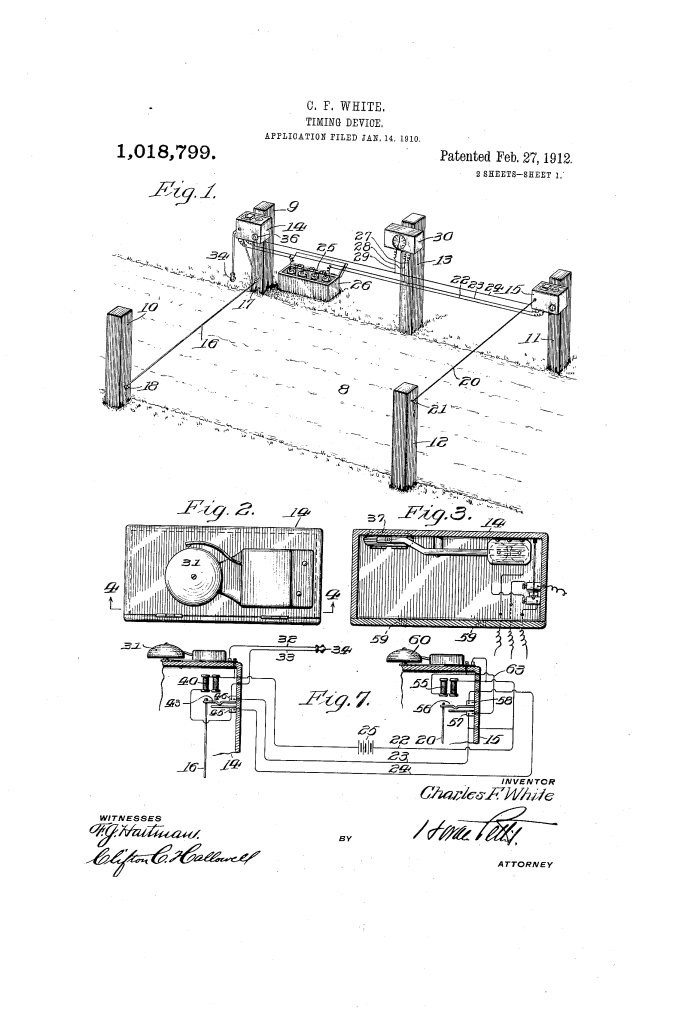

Timing Device (Charles Fred. White, No. 1,018,799)
The patent by Charles Fred. White of Philadelphia, Pennsylvania, describes a Timing Device (Patent No. 1,018,799, 1912). The invention is an electrical system designed for racing events to accurately determine and contemporaneously indicate the exact time consumed by a racer traversing a track from the start line to the finish line. The system utilizes stopwatches at multiple stations that are triggered automatically and simultaneously by the movement of the racer.
Inventor Background: Charles Fred. White
Charles Fred. White was an African-American inventor and professional based in Philadelphia. His invention of the automatic timing device solved a major problem in early 20th-century athletics: the inaccuracy of manual human timekeeping. By replacing the handheld stopwatch operated by a judge with a synchronized, electrical system, White pioneered the concept of automatic sports timing. His background in engineering and his involvement in the sporting community allowed him to create a portable, reliable system that ensured fairness and precision in competition.
Invention and Mechanism (Simplified)
The system consists of two portable cases (one for the starter and one for the judge) connected by wires and a battery, using fragile tapes as automatic triggers.
1. Synchronized Dual-Station Timing
- Timing Cases (14 and 15): Two identical cases are placed at the starting line (14) and the finish line (15). Each contains a high-quality stop watch (36, 51).
- Electrical Connection: The cases are linked by line wires (22, 23, 24) to a central battery (25).
- Function: Because the watches are in the same circuit, they are contemporaneously started and stopped. This ensures the time shown at the judge’s stand is identical to the time shown at the starter’s station.
2. Automatic Triggering (Fragile Tapes)
- Starting Tape (16): A fragile tape is stretched across the track at the starting line, connected to a switch (43) in Case 14.
- Finishing Tape (20): A second tape is stretched across the finish line, connected to a switch (56) in Case 15.
- Function: When the racer breaks the starting tape, the circuit momentarily closes, starting both watches. When the racer breaks the finish tape, the circuit closes again, stopping both watches instantly.
3. Electromagnetic Actuation (Key Innovation)
- Electromagnets (40, 55) and Levers (39, 53): Each watch is controlled by a centrally pivoted lever. One end of the lever hangs over the watch’s stem (38, 52), and the other end acts as an armature for an electromagnet.
- Function: When the circuit is closed by a broken tape, the magnets pull the levers, which press the watch stems to start or stop the timing. This eliminates the “human reaction time” error of a judge pressing a button.
4. Signaling and Portability
- Bells (31, 60): The starter’s case has a starting bell (31) operated by a hand-held push bulb (34), replacing the traditional pistol shot. A second gong (60) rings at the finish line when the race concludes.
- Carrying Case (35): The entire system—both timing cases, the battery box, and all wiring—is designed to fit into a small hand case (35) for easy transport between events.
Concepts Influenced by This Invention
White’s timing device influenced the development of modern sports technology and precision automated measurement.
- Automated Sports Timing: The core concept of using racer-actuated triggers (the tapes) to replace human timekeepers is the direct ancestor of modern “photo-finish” cameras, laser-gate timers, and RFID chip timing used in marathons today.
- Synchronized Remote Displays: The method of electrically slaving multiple timepieces to a single start/stop signal influenced the design of synchronized clock networks for industry and transit.
- Fail-Safe Automatic Resetting: The use of automatically resetting switches (43, 56) ensured the device was ready for the next race immediately after being triggered, a principle essential for high-frequency data collection in industrial testing.
- Portability in Specialized Tech: By packaging complex electrical and mechanical components into a single carrying case, White set a standard for “field technology”—specialized equipment that is as easy to transport as a briefcase but offers laboratory-grade precision.
