
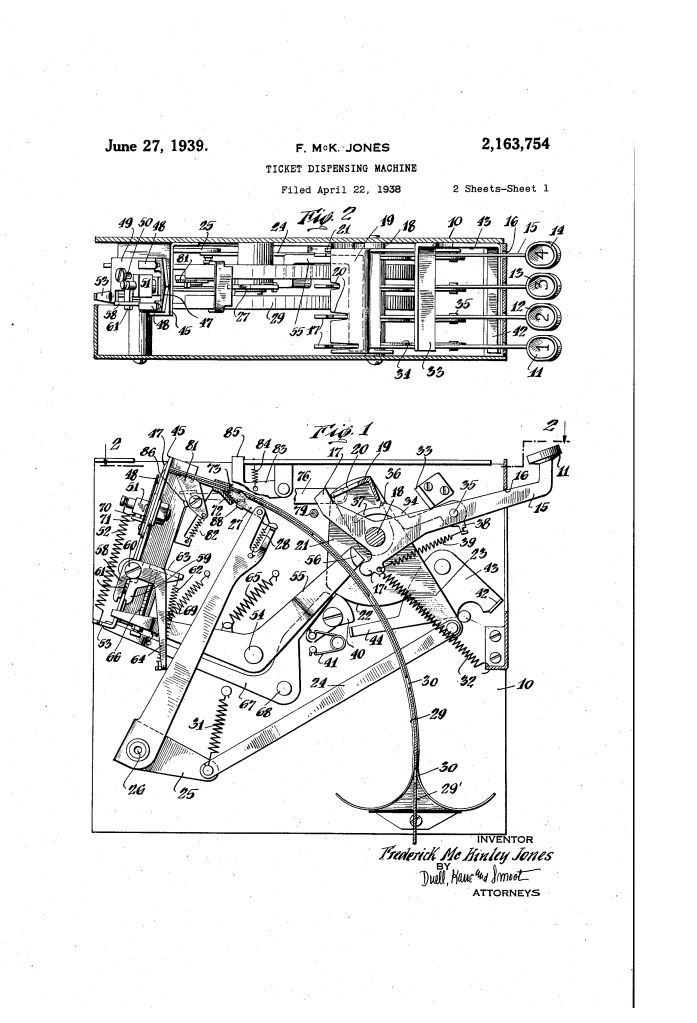
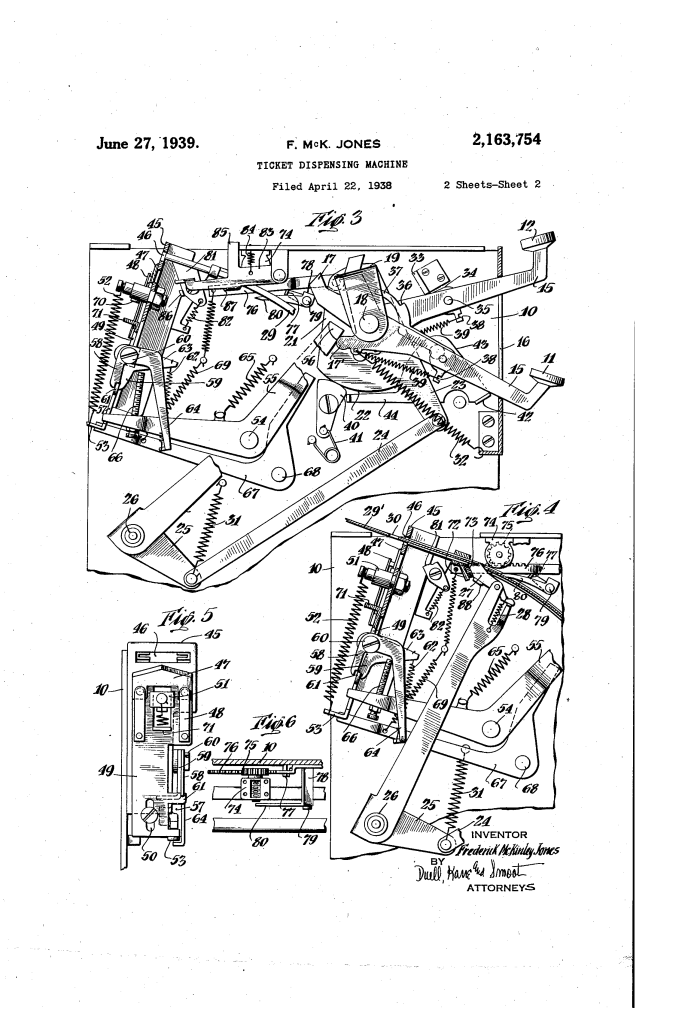
Ticket Dispensing Machine: Frederick McKinley Jones (Patent No. 2,163,754)
The patent by Frederick McKinley Jones of Minneapolis, Minnesota, describes a Ticket Dispensing Machine (Patent No. 2,163,754), granted on June 27, 1939. This invention is a high-reliability mechanical apparatus designed to automate the shifting, severing, and tabulating of paper ticket strips. By utilizing a “variable-depth” key system and a dual-latch cutting mechanism, Jones created a machine that eliminated the common “jamming” and “partial cut” issues that plagued early theater and transit ticket dispensers.
The “Why”
In the 1930s, ticket vending was often a source of frustration due to mechanical failure. The primary “pain points” were incomplete severing (leaving tickets hanging) and jamming caused by weak return springs. If a machine jammed, the operator was usually helpless. Jones sought to build a “fail-safe” machine with a manual override—ensuring that even if a spring failed, the operator could physically force the mechanism to complete the cycle. Furthermore, he addressed “vending fraud” by ensuring a key must be fully depressed before any tickets are released.
Inventor Section: Frederick McKinley Jones
Frederick McKinley Jones was a self-taught engineering genius and one of the most prolific African American inventors in history (best known for “Thermo King” refrigeration). His engineering philosophy was centered on mechanical resilience and logic. He didn’t just design for the “happy path”; he designed for failure. His inclusion of a “shoulder portion” (36) on the keys—which allows a user to pull a stuck machine back to its starting position—is a hallmark of his practical, “ruggedized” approach to industrial design.
Key Systems Section
1. Variable-Zone Actuating Member (19)
The machine features a central “actuating member” (19) provided with slots of varying depths (16).
- Modern Term: Variable Stroke Selector.
- When keys (11-14) are pressed, their arms travel different distances before hitting the bottom of the slot. This determines exactly how far the “pawl” moves, allowing the machine to dispense exactly 1, 2, 3, or 4 tickets based on the specific key pressed.
2. The Dead-Center Cam Lock (40)
To prevent “short-strokage” (where an operator only presses a key halfway), Jones installed a spring-loaded cam (40) against an arcuate edge (22).
- Modern Term: Anti-Reversal Logic Gate.
- Once a key starts moving, the cam locks the mechanism in that direction. The machine must complete its full travel and sever the ticket before the cam resets to allow the next operation.
3. Potentialized Severing Knife (47)
The cutting blade is not directly linked to the keys but is “potentialized” (loaded) against a heavy spring (52).
- Modern Term: Stored-Energy Shear.
- Pressing a key pulls the knife back and locks it behind two latches (58, 59). Only when the ticket strip has finished moving do the latches release, causing the spring to “violently” snap the knife across the strip for a clean, instant cut.
4. The Ticket-Dependent Totalizer (74)
The machine includes a counter or “totalizer” (74) to track sales.
- Modern Term: Conditional Mechanical Logic.
- Jones added a bridging arm (77) that only meshes the counter gears if a physical ticket strip is present in the track. This prevents the counter from advancing if the machine is “dry fired” without tickets.
Comparison Table
| Feature | Standard 1930s Dispensers | Jones’ Dispensing Machine |
| Reliability | Prone to “half-vends” and jams. | Cam-lock ensures full-cycle completion. |
| Failure Recovery | Requires technician if spring breaks. | Manual override via key-lift shoulder. |
| Cutting Action | Slow, manual tearing or slicing. | Instant “Potentialized” spring-snap cut. |
| Accounting | Counts every “click” of the handle. | Only counts when a physical ticket is detected. |
Significance Section
- Foundation of Modern Vending: The logic of “selecting quantity” via stroke-length is still seen in non-digital mechanical dispensers today.
- Human Factors Engineering: By making “jamming practically impossible,” Jones reduced the training requirements for theater ushers and transit workers.
- Accounting Accuracy: The “no-ticket, no-count” feature was a significant advancement in preventing internal theft and inventory discrepancies in the 1930s.
- Mechanical Persistence: His “Potentialized” knife is the direct ancestor to the high-speed thermal and mechanical cutters used in modern receipt printers.
