
Thorium Oxide or Thorium-Uranium Oxide with Magnesium Oxide (1967)
U.S. Patent No. 3,309,323, granted on March 14, 1967, to Edwin R. Russell, William E. Prout, Harold J. Groh, and George W. Watt (assigned to the United States of America as represented by the United States Atomic Energy Commission), describes an engineered nuclear reactor fuel material designed to dramatically accelerate chemical dissolution during nuclear fuel reprocessing. Edwin Russell, a notable chemist who contributed to the Manhattan Project, collaborated with research chemists at the Savannah River Laboratory and the University of Texas to address a major bottleneck in the thorium fuel cycle.
This invention solved a critical problem in nuclear energy recovery: high-density thorium oxide fuel particles, which are favored for modern reactor cores due to their superior stability, were notoriously refractory and chemically resistant, often resisting complete acid dissolution even after several hours of aggressive boiling in concentrated acid solvents.
The Innovation: Magnesia Doping via Sol-Gel
Thorium-232 serves as an abundant fertile nuclear material that transmutes into fissionable uranium-233 upon thermal neutron irradiation. When processed using the sol-gel method into high-density particles (exceeding 90% to 98% of theoretical density), the resulting ceramic fuel pellets and millimeter-sized fragments resist dissolution, requiring long cycle times in corrosive mixtures of nitric acid catalyzed with fluoride ions (13 M HNO3, 0.025 M HF, and 0.10 M Al(NO3)3).
Russell and his co-inventors discovered that introducing a minor proportion of magnesium oxide (0.5% to 1.6% by weight, optimally around 1.0%) into the activated thorium sol before gelation and calcining yielded a 3- to 5-fold acceleration in dissolution speed without compromising the material’s physical density, structural integrity, or neutron irradiation behavior.
Why Magnesium Oxide?
Enhanced Dissolution Kinetics: It alters the ceramic microcrystalline structure in a manner that facilitates rapid attack by mineral acids, cutting complete dissolution times from over 5 hours down to approximately 1 hour.
Uniform Distribution: Adding the magnesium component at the colloidal sol stage guarantees nanoscale dispersion throughout the entire refractory matrix.
Nuclear Integrity: The small addition does not degrade the core neutronic performance or fuel behavior under prolonged reactor irradiation, nor does subsequent irradiation alter the improved acid solubility.
Key Chemical Components
The fuel material is a high-density, multi-component ceramic particle system:
| Component | Function |
| Thorium Oxide (ThO2) | The primary fertile material (major proportion) designed to capture neutrons and convert to fissionable uranium-233. |
| Uranium Oxide (UO2) | Optional fissile component (up to approximately 8 weight percent) co-dispersed to create mixed thorium-uranium oxide fuels. |
| Magnesium Oxide (MgO) | The dissolution promoter (0.5 to 1.6 wt. %, ideally 1.0 wt. %) dispersed homogeneously through the ceramic structure. |
| Magnesium Precursors (e.g., Mg(NO3)2) | Soluble salts or oxide slurries introduced into the aqueous thoria sol that thermally decompose into intimately mixed MgO during calcining. |
| Acid Solvent (13 M HNO3, 0.025 M HF, 0.10 M Al(NO3)3) | The chemical reprocessing bath used to dissolve the irradiated fuel for downstream solvent-extraction separation of U-233. |
Performance: Accelerating Fuel Dissolution
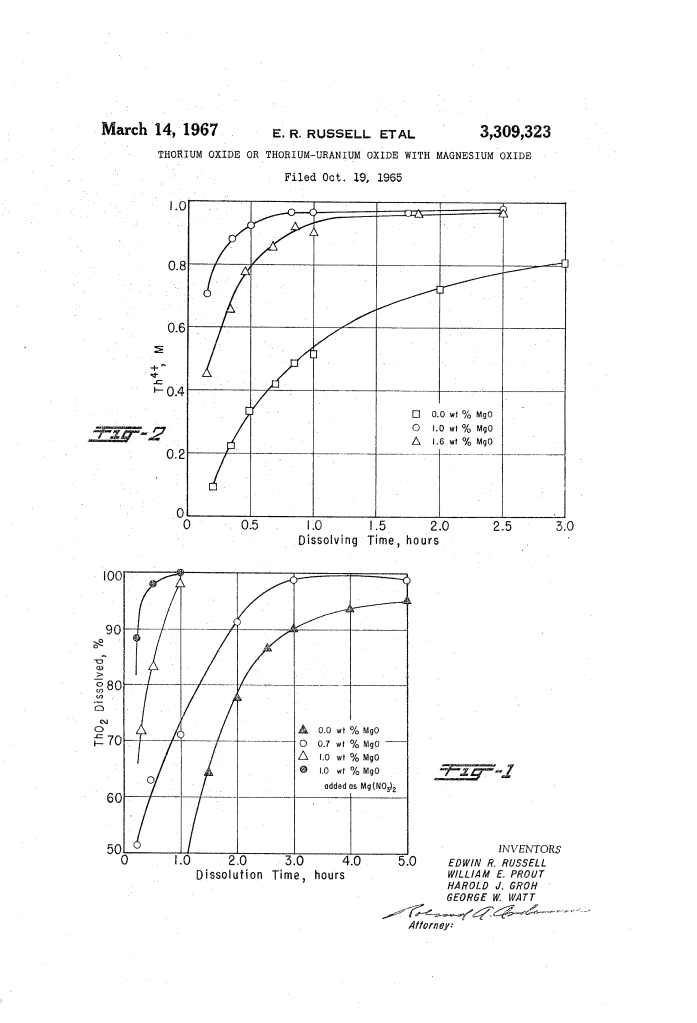
The patent provides comparative kinetic data demonstrating how trace magnesia cuts dissolution time in boiling, fluoride-catalyzed nitric acid:
Dissolution Rates in Acid Media:
High-density ThO2 with 0.0 wt. % MgO: Only 50% dissolved after 1 hour, 90% dissolved after 3 hours, and incomplete after 5 hours.
ThO2 with 0.7 wt. % MgO: Markedly faster breakdown, exceeding 80% dissolution within 1.5 hours.
ThO2 with 1.0 wt. % MgO (added as slurry): 100% completely dissolved in 1.0 hour.
ThO2 with 1.0 wt. % MgO (added as Mg(NO3)2): Reached complete (1 M Th4+) dissolution in under 1 hour, offering the fastest reaction kinetics.
ThO2 with 1.6 wt. % MgO: Complete dissolution in approximately 1.25 hours, demonstrating that concentrations above 1.0 wt. % yield diminishing returns.
The Manufacturing Process
The inventors integrated the magnesia additive directly into the standard sol-gel production cycle:
- Produce activated thorium oxide powder containing residual nitrates (around 0.03 mole nitrate per mole ThO2) via steam denitration below 475 C.
- Disperse the powder in an aqueous nitrate system with agitation at 80 C to 100 C to form a stable colloidal sol.
- Incorporate magnesium as a concentrated magnesium nitrate solution or fine magnesium oxide slurry.
- Dry the resulting doped sol slowly at 50 C to 100 C (optimally 80 C) to yield vitreous gel fragments.
- Calcine the dried gel in air (or in a hydrogen atmosphere if uranium is present) up to 1150 C at a heating rate no higher than 300 C per hour, holding for at least 3 hours.
About the Inventor: Edwin R. Russell
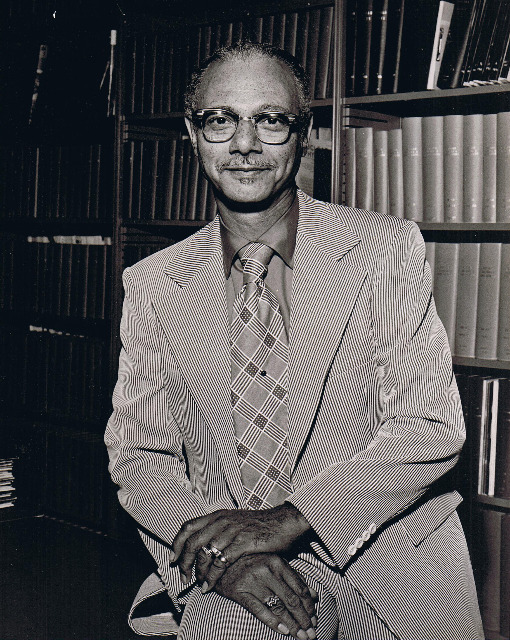
Edwin Roberts Russell was an influential African American research chemist who played an essential role in early American nuclear science.
Manhattan Project: During World War II, Russell worked at the University of Chicago Metallurgical Laboratory, collaborating closely with Glenn T. Seaborg on chemical extraction and separation techniques for newly discovered plutonium.
Savannah River Laboratory: Russell spent much of his career as a research chemist at the Savannah River Plant in Aiken, South Carolina, developing chemical separation processes, waste-treatment methods, and actinide fuel chemistry for the U.S. Atomic Energy Commission.
Academic and Scientific Legacy: Holding multiple nuclear chemistry patents, Russell later served as a professor and chair of the Department of Science at Allen University in Columbia, South Carolina, training future generations of scientists.
Summary of Claims
The patent explicitly claims:
- An oxide particle composition having improved dissolution properties in nitric acid media consisting essentially of thorium oxide or thorium-uranium oxide and between about 0.5 and 1.6 weight percent magnesium oxide intimately dispersed throughout.
- An improved nuclear reactor fuel material consisting of thorium oxide and 0.5 to 1.6 weight percent intimately dispersed magnesium oxide.
- A sol-gel preparation method comprising incorporating a magnesium compound (magnesium oxide, nitrate, chloride, bromide, or perchlorate) into an activated thoria sol, drying to a gel, and calcining into high-density oxide particles.
