
Thin Film Capacitor (1968)
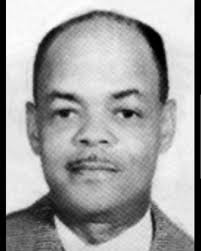
U.S. Patent No. 3,394,290, granted on July 23, 1968, to Otis F. Boykin, describes an advanced method for manufacturing thin film capacitors designed for high reliability and efficiency in printed circuitry. Otis F. Boykin, an inventive African American electrical engineer and inventor from Chicago, Illinois, was a major figure in miniaturized electronic components whose precision resistors and capacitors helped power the early computing, aerospace, and medical device industries.
This invention solved major performance and manufacturing bottlenecks in microelectronics: existing vacuum-evaporated capacitors suffered from fragile working voltages, high rejection rates during production, poor dissipation factors (around 5%), and prohibitive manufacturing costs. Boykin introduced an inexpensive liquid-solution screening and pyrolyzing method that produced robust, high-efficiency capacitors with superior breakdown resistance and dissipation factors under 0.25%.
The Innovation: Liquid Resinate Pyrolysis and Glass Bonding
Prior printed capacitors either relied on thick ceramic discs that required extreme kiln temperatures (around 2500°F) or delicate vacuum-deposited metal layers anodized into oxides. Anodized oxide films were self-limiting in thickness, leaving them prone to pinhole shorts and breakdown under modest voltage stress.
Boykin replaced these expensive, high-heat processes with liquid organometallic solutions (metal resinates) combined with glass-forming resinates. When screened onto a substrate and fired in a conventional oven at approximately 800°C, the organic carrier burns away while the metal oxidizes and fuses into a uniform, protective vitreous matrix.
Why Pyrolyzed Glass Matrix?
- Molecular Bonding: Glass particles formed in situ molecularly bond the dielectric metal oxides to each other and lock the dielectric layer tightly to the bottom and top electrodes.
- Tailored Thickness and Voltage: Dielectric layers can be screened in successive coats, eliminating substrate surface irregularities and permitting breakdown ratings exceeding 500 volts DC without adding excessive bulk.
- Liquid Homogeneity: Because all raw precursors (electrodes, dielectrics, and glass formers) are handled as liquid resinates, the constituents mix at the molecular level, ensuring consistent electrical properties throughout.
Key Technical Components
| Component | Description & Function |
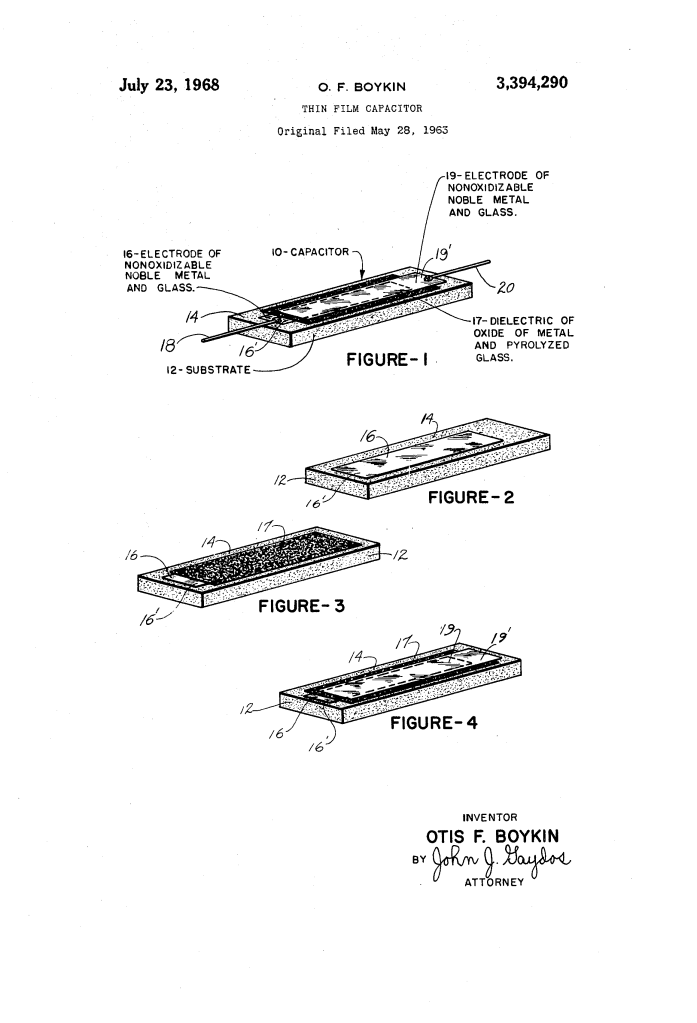
| Substrate (12) | A heat-resistant, electrically non-conductive base slab (typically alumina ceramic) supporting the printed layers. |
| First Electrode (16) | A conductive layer (approx. 50,000 angstroms thick) of a non-oxidizing noble metal, preferably liquid gold resinate mixed with powdered glass, fired to bond to the substrate. |
| Dielectric Film (17) | A layer composed of oxidized dielectric metal particles (e.g., tantalum pentoxide, titanium dioxide) embedded in a matrix of pyrolyzed glass formed from lead, boron, and silicon resinates. |
| Second Electrode (19) | A top conductive noble-metal film fused over the dielectric, co-extensive with the first electrode across its active area, with an extended contact terminal (20). |
| Contact Terminals (18, 20) | Electrical leads attached directly to exposed offset tabs (16 prime, 19 prime) of the lower and upper electrodes. |
Performance: High Efficiency and Voltage Stability
Boykin’s chemical architecture significantly improved component efficiency and durability compared to contemporary thin film technologies:
- Dissipation Factor: Slashed from roughly 5.0% in vacuum-deposited tantalum capacitors to under 0.25%, yielding a dramatically higher operating efficiency (Q factor).
- Voltage Breakdown: Capable of sustaining breakdown voltages in excess of 500 volts DC due to multi-pass layering that covers micro-imperfections in the ceramic substrate.
- Frequency & Thermal Stability: Tailored chemical formulations achieved linear capacitance across broad frequency bands and stable temperature coefficients.
Formulation Formats (Selected Dielectric Examples)
Boykin engineered specific chemical blends to target distinct operational environments:
| Formula | Primary Resinate Ingredients | Key Performance Advantage |
| Example II | Tantalum resinate, lead resinate, boron resinate | Produces tantalum dioxide and lead tantalate for stable, low-value capacitors. |
| Example III | Titanium resinate, barium resinate, calcium resinate, boron resinate | Forms calcium barium titanate; yields an extremely stable temperature coefficient. |
| Example IV | Strontium resinate, zirconium resinate, tantalum resinate, lead and boron resinates | Frequency-independent capacitance across an exceptionally broad operating spectrum. |
| Example V | Tungsten resinate, lead resinate, boron resinate | High-stability dielectric matrix tailored for compact printed circuit boards. |
The Manufacturing Process
Boykin designed the production sequence to utilize standard industrial screening and firing equipment rather than vacuum chambers:
- Prepare Electrode Ink: Formulate a liquid gold resinate with powdered glass and an organic screening vehicle (such as ethyl cellulose).
- Screen and Fire First Layer: Screen the lower electrode pattern onto the alumina substrate (12) and fire at approximately 800°C to burn off organics and fuse the gold-glass matrix.
- Formulate Dielectric Liquid: Blend organometallic solutions of dielectric-forming metals (tantalum, titanium, or zirconium) with glass-forming resinates (lead, boron, silicon).
- Apply and Pyrolyze Dielectric: Screen the dielectric mixture over the bottom electrode, leaving terminal tab 16 prime exposed. Fire in an oxidizing furnace to convert metals into oxides and pyrolyze the glass into a continuous binding matrix. Repeat in thin layers if higher breakdown voltage is required.
- Apply and Fire Top Electrode: Screen the second noble-metal electrode mixture (19) over the dielectric surface, extending an offset terminal tab (19 prime) onto the substrate, and fire to complete the capacitor stack.
About the Inventor: Otis F. Boykin
Otis Frank Boykin (1920–1982) was one of the most prolific African American inventors in modern electronics:
- Patents and Inventions: He held over 25 patents spanning precision electronic resistors, wire-type resistors, capacitors, and electrical control units. His precision wire resistor drastically cut manufacturing costs while boosting circuit reliability under severe temperature swings.
- Impact on Critical Industries: Boykin’s ultra-reliable circuit components became integral to guided missile systems, IBM computers, televisions, and life-support biomedical hardware—most famously providing the precision control element adapted into modern cardiac pacemakers.
- Legacy: Working independently and as a consultant across the United States and Europe, Boykin demonstrated that precision solid-state components could be manufactured economically without sacrificing extreme durability in demanding environments.
Summary of Claims
The patent explicitly claims:
- A capacitor constructed on a high-temperature non-conductive substrate with a fused conductive layer, a pyrolyzed dielectric film, and a co-extensive top electrode.
- A dielectric composition made of molecular-form metal oxide particles bonded together and to the conductive electrodes by uniformly sized particles of pyrolyzed glass.
- The use of dielectric metal constituents selected from barium, calcium, strontium, copper, nickel, lead, tin, tantalum, zirconium, niobium, aluminum, titanium, hafnium, and tungsten embedded within the fused vitreous matrix.
