
Thermostatic Controlled Hair Curlers, Combs, and Irons (1953)
Patented on August 11, 1953 (U.S. Patent No. 2,648,756), this invention by Solomon Harper provided a sophisticated solution to a common danger in the beauty industry: the unpredictable heat of styling tools. Before Harper’s invention, electric combs and curlers often reached temperatures that could scorched hair or burn the scalp, as they lacked precise, automatic regulation.
Harper, a prolific African American inventor based in New York, designed a system that used both thermostatic control and manual mechanical adjustments to ensure a constant, safe temperature tailored to different hair types.
Core Innovation: The Dual-Control System
Harper’s device didn’t just rely on a simple on-off switch. It used a “joint heat regulating” approach that combined electrical and physical cooling methods.
1. The Thermostatic Chamber
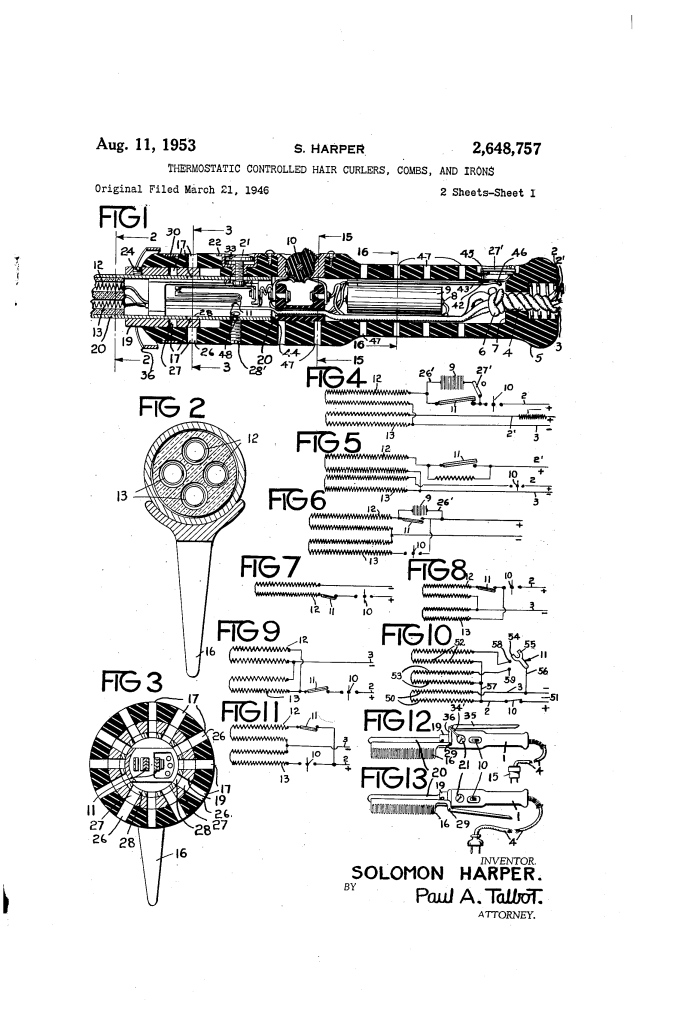
The heart of the handle contains a thermostat (11). Unlike modern digital sensors, this was a physical expansion member sensitive to the air temperature inside the handle.
- The Indirect Method: Instead of measuring the heating element directly, the thermostat measures the air affected by the heat conducting tube. This prevents the “jittery” on-off cycling that wears out electrical components.
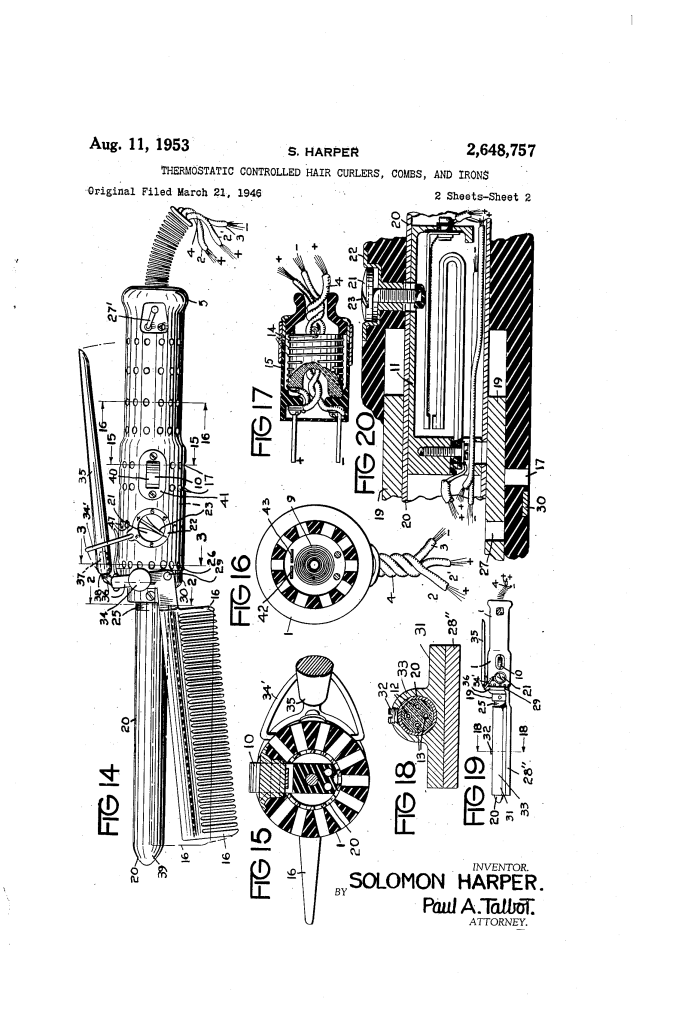
- Calibrated Dial (22): Harper included a dial and pointer, allowing the operator to set the device to “Low,” “Medium,” or “High” with mathematical accuracy.
2. The Sliding Heat Sleeve (19)
This was Harper’s unique mechanical contribution. A metal sleeve slides along the main heating tube.
- Heat Shifting: By moving the sleeve closer to or further from the handle, the operator physically changes how much heat is conducted back toward the thermostat.
- Venting: The sleeve and the tube have matching ventilating holes (17, 26). By rotating or sliding the sleeve, the operator can align these holes to let cool air in, manually “tricking” the thermostat to stay on longer or shut off sooner.
Key Technical Features
- Dual Heating Circuits: The device features two independent circuits. One stays on permanently to maintain a base temperature, while the second is controlled by the thermostat to provide the “working” heat.
- Arc Prevention: Harper included an electrical capacitor (9) shunted across the thermostat. This prevents the “spark” or arc that occurs when electrical points open, significantly extending the tool’s lifespan.
- Modular Attachments: The handle was designed as a “universal power unit.” By loosening a set screw, the operator could swap out a hair straightening comb for a curling iron or even a soldering iron.
Components & Operation Table
| Component | Part # | Functional Role |
| Heat Conducting Tube | 20 | Houses the heating elements and transfers thermal energy to the tool. |
| Thermostat | 11 | Automatically cuts off the circuit when the internal air reaches the set limit. |
| Slidable Sleeve | 19 | Manually adjusts heat conduction and airflow via registration holes. |
| Capacitor | 9 | Suppresses electrical arcs to protect the switch contacts. |
| Knot & Shoulder | 6, 7 | A “strain relief” design to prevent the cord from being pulled out of the handle. |
Historical Context: Solomon Harper
Solomon Harper was an inventive powerhouse who spent much of his life refining the technology of the beauty industry.
- Division of Invention: This 1953 patent was a “division” of a much larger body of work Harper started in 1946.
- Beyond Beauty: While this patent focuses on hair, Harper noted that the underlying principle—thermostatic control via air-vented sleeves—was equally useful for industrial tools like soldering irons and fur glazers.
- Safety Pioneer: His work was fundamental in moving the “pressing and curling” industry away from dangerous, unregulated fire-heated irons toward professional-grade, thermostatically safe electric tools.
Significance
Solomon Harper’s design transformed the styling tool from a simple “hot stick” into a precision instrument. By allowing the professional to “tune” the heat via both a dial and a physical sliding vent, he accommodated the diverse needs of different hair textures—recognizing that fine hair might need a “Low” setting while coarse or kinky hair required “High,” but both needed the safety of an automatic shut-off.
