
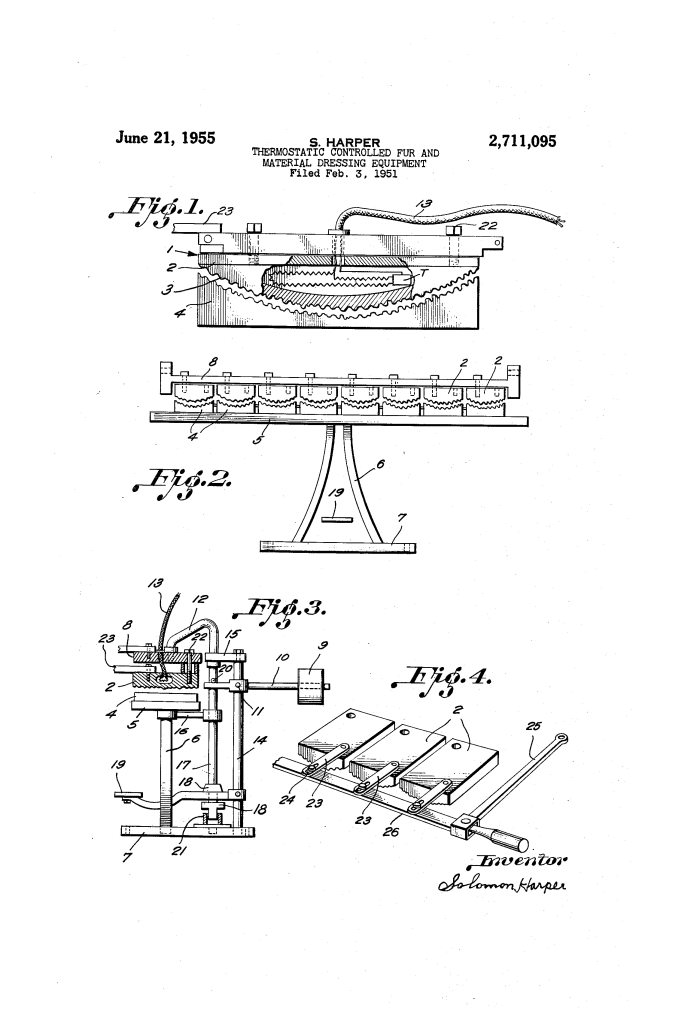
Thermostatic Controlled Fur and Material Dressing Equipment (1955)
Patented on June 21, 1955 (U.S. Patent No. 2,711,095), this invention by Solomon Harper addressed a specialized need in the high-end fashion industry: the decorative “dressing” or patterning of flat furs, such as beaver. Before Harper’s machine, creating wavy or irregular textures in fur was a painstaking manual process where workers pressed individual dies into the fur by hand.
Harper, who we previously saw innovating hair-styling tools, applied his expertise in thermostatic control and mechanical linkages to create the first semi-automatic fur decorating machine.
The Core Innovation: The “Press and Twist” Method
Harper’s machine didn’t just push a design into the fur; it used a coordinated mechanical movement to “set” the design permanently.
1. Vertical Precision
Most pressing machines of the era moved on an arc (like a clamshell). Harper’s machine used a vertical member (17) that moved straight up and down. This ensured the decorative dies hit the fur perfectly flat, preventing the design from smearing or shifting unevenly.
2. The Horizontal Shift (The “Curl”)
The most unique feature is the ability to rotate the dies while they are under pressure.
- Once the male dies (2) are pressed into the concave bed (4), the operator uses a transverse bar (26) to slightly shift the dies horizontally (usually about 1/4 of an inch).
- This “twist” under heat and pressure creates a permanent “curl” or ripple in the fur fibers that simple pressing cannot achieve.
Technical Features & Control
| Feature | Description |
| Dual Heating | The dies can be heated by either electricity (via coils) or steam (via flexible hoses). |
| Thermostatic Control | An adjustable thermostat (T) ensures the dies reach the precise temperature needed to set the fur without scorching the delicate pelt. |
| Mechanical Linkage | A series of parallel links (23) connects all the dies. When the operator moves one handle, every die on the plate rotates in perfect unison. |
| Treadle Operation | A foot treadle (19) controls the downward pressure, leaving the operator’s hands free to manage the fur and the rotation bar. |
| Counterbalance (9) | A heavy weight at the rear ensures the heavy pressing head automatically raises when the operator’s foot leaves the pedal. |
The Machine Components
- Male Dies (2): The “stamps” with ribs that create the design. These are interchangeable for different patterns.
- Female Bed (4): A concave “cradle” that supports the fur and matches the shape of the male die.
- Frame (8): A universal mounting plate that allows these decorative units to be attached to “old style” pressing machines, making it an affordable upgrade for 1950s factories.
Significance in Textile History
Solomon Harper’s invention bridge the gap between hand-craftsmanship and industrial automation.
- Efficiency: It allowed a single operator to decorate a whole fur piece in one “press,” whereas hand-tooling took hours.
- Consistency: By using a coordinated linkage, every “wave” or “ripple” in a fur coat would be identical in depth and angle.
- Versatility: Though designed for beaver fur, the patent notes it could be used for “tightening other fine furs” or even decorating heavy cloth, making it a staple for the mid-century garment district in New York.
About the Inventor: Solomon Harper
Solomon Harper was a master of thermal-mechanical integration. Whether he was working on hair curlers or industrial fur presses, his “underlying principles” remained the same:
- Precise temperature control to protect the material.
- Ergonomic foot-pedal operation.
- The use of mechanical “leverage” to reduce human fatigue.
