
Thermostat and Temperature Control System (1960)
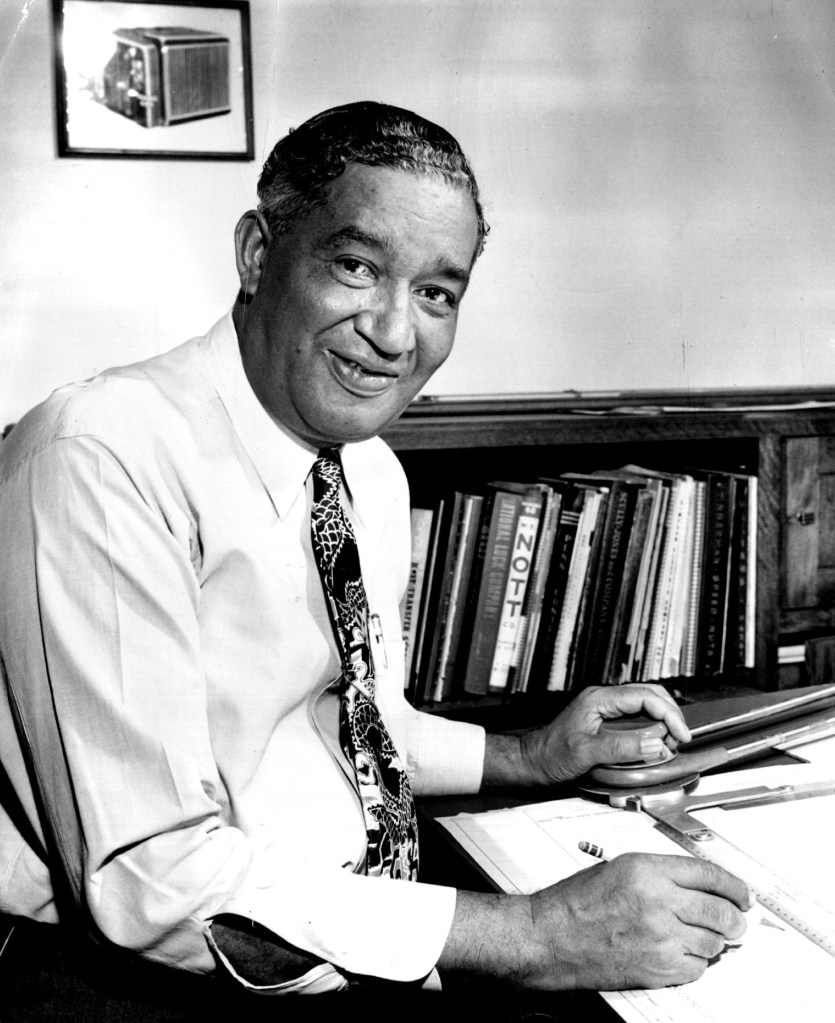
U.S. Patent No. 2,926,005, granted on February 23, 1960, to Frederick M. Jones, details an advanced temperature control system designed for the rigorous demands of long-haul transportation. Frederick “Fred” Jones, the legendary self-taught engineer and co-founder of Thermo King, was a pioneer in mobile refrigeration whose inventions revolutionized the global food supply chain.
This invention solved a critical problem in the shipping industry: maintaining precise, stable temperatures for perishable goods as trucks and railway cars traveled through wildly different climates—from scorching deserts to freezing mountain passes.
The Innovation: The Single-Thermostat Sequential Control
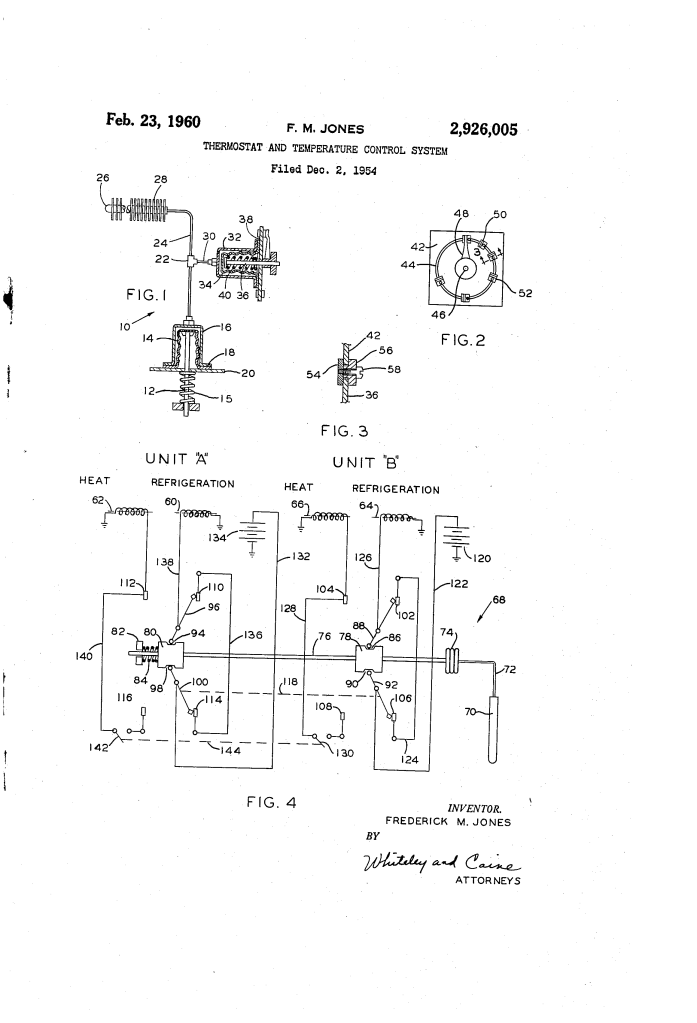
Before this patent, many systems relied on multiple thermostats to handle heating and cooling independently, which often led to “fighting” between units (where one would heat while the other cooled). Jones’s breakthrough was a single-thermostat system capable of managing two independent air conditioning units (Unit A and Unit B) to provide either cooling or heating as needed.
The system was designed for “all-purpose” use, meaning it could protect delicate fresh produce (like apples, which spoil if they rise above 35°F or freeze if they drop below 29°F) or maintain deeply frozen foods at -10°F.
The Core Design: The Expansion Reservoir
The heart of the hardware is a specialized liquid-filled thermostat designed to withstand the vibration and shock of rail travel while remaining highly sensitive.
- High-Capacity Bulb (26): A long, finned bulb filled with a constant-viscosity liquid (like kerosene) that reacts to the slightest temperature change.
- Variable Reservoir (32): Because temperatures can fluctuate extremely during loading or cleaning, Jones included a second bellows (34) that acts as a safety “overflow” for the liquid, preventing the instrument from breaking under extreme heat.
- Manual Calibration: A control knob (46) and adjustable stops (52) allow non-experts to set the desired temperature quickly and accurately.
How the Control System Functions
The system uses a unique mechanical linkage to “step” through different levels of heating and cooling based on the movement of a single driven rod (76).
| Step | Temperature Condition | System Action |
| 1. Maximum Cooling | Space is much too hot. | Units A and B both run their compressors to provide rapid refrigeration. |
| 2. Maintenance Cooling | Space is near target. | Unit B shuts down; Unit A runs intermittently to “top off” the cold air. |
| 3. Neutral Zone | Space is at the perfect set point. | Both units shut down to save fuel and reduce wear. |
| 4. Heating Mode | Ambient temp drops too low. | The system reverses the refrigerant cycle, turning the units into heaters. |
Key Safety Components
- The “Frozen Food” Lockout (130, 142): Jones included a manual switch that prevents the system from ever entering “Heat” mode. This is vital for shipping frozen meat; if the temperature drops to -20°F, the food is safe, but a thermostat “calling for heat” to reach a 0°F setpoint could accidentally thaw and ruin the cargo.
- Over-Center Snap Switches: The switch blades (88, 96) use a “snap action” to ensure they are either fully ON or fully OFF, preventing the electrical arcing that would occur with slow-moving contacts.
- Sequential Loading: By starting Unit A and Unit B at slightly different intervals, the system avoids a massive “surge” of power that could stall the engines or blow the electrical circuits.
About the Inventor: Frederick M. Jones
Frederick McKinley Jones was one of the most prolific African American inventors of the 20th century.
- Patents: He held over 60 patents, most of which were related to refrigeration, but also included portable X-ray machines and movie sound equipment.
- Impact: His “Thermo King” units allowed for the first time the long-distance transport of blood plasma, fresh produce, and frozen foods, effectively creating the modern grocery store’s frozen aisle.
- Legacy: In 1991, Jones was posthumously awarded the National Medal of Technology, the first African American to receive the honor.
Summary of Claims
The patent explicitly claims:
- A single thermostat responsive to space temperature that operably connects to multiple switching mechanisms.
- The use of electromagnetic control devices (relays) that can concomitantly or sequentially initiate cooling or heating.
- A manual lockout switch that allows a user to preclude the heating function entirely, protecting frozen cargo from accidental warming.
