
Thermostable Dielectric Material (1967)
U.S. Patent No. 3,316,178, granted on April 25, 1967, to James E. Millington and assigned to the Allis-Chalmers Manufacturing Company, details a method for thermally upgrading cellulosic insulating paper used inside oil-immersed electrical apparatus. Millington, a research chemist based in Milwaukee, Wisconsin, tackled a major limiting factor in high-voltage power transmission: the rapid embrittlement and mechanical failure of paper insulation under thermal electrical overload.
In oil-filled electrical transformers, cellulose paper wraps copper conductor windings to isolate extreme voltages. As electricity surges and transformer cores generate heat, the surrounding petroleum oil and cellulose decompose, releasing corrosive organic acids and water. These byproducts attack the cellulose chains, causing the paper to lose its flexibility and tensile strength. Once the paper turns brittle, routine mechanical vibrations from the transformer core shatter the insulation, triggering catastrophic short circuits. Millington solved this by treating the cellulose paper with specific hydroxyalkylamines that neutralize degradative acids and actively plasticize the fibers.
The Innovation: Hydroxyalkylamine Impregnation
Cellulose degradation doubles with every 8 to 10 C rise in operating temperature, strictly capping continuous transformer bulk oil temperatures at 105 C and hot-spot temperatures at 135 C.
Millington discovered that impregnating paper with aliphatic amines carrying both amino and hydroxyl functional groups provides a two-pronged defense:
- Acid Scavenging: The amino groups react directly with degradation acids (such as acetic acid) generated in the hot oil, converting them into neutral amides and preventing acid-catalyzed chain cleavage of the cellulose.
- Fiber Plasticization: The hydroxyl and alkyl structures act as internal plasticizers, keeping the cellulosic fibers pliant and drastically improving folding endurance so the paper flexes under mechanical vibration rather than snapping.
Why Hydroxyalkylamines?
Dual Functional Groups: The presence of at least one amino group (primary, secondary, or tertiary) provides high-affinity alkaline capture of organic acids, while the hydroxyl group maintains compatibility with the natural hydrogen-bonding network of cellulose.
Controlled Nitrogen Content: By maintaining an amino nitrogen content between 0.2% and 1.0% by weight (optimally 0.2% to 0.6%), the paper gains long-term thermal stability without altering electrical insulation values or leeching into the transformer oil.
Epoxy and Conductor Compatibility: The treated paper remains completely non-reactive with petroleum oil and epoxy-enameled copper magnet wire, preserving the dielectric strength of the entire internal transformer assembly.
Key Chemical Components
The treatment incorporates specific aliphatic hydroxyalkylamines into standard cellulose stocks (such as kraft paper, southern pine, northern pine spruce-balsam, rag stock, or rope stock):
| Component / Treatment Agent | Chemical Class | Primary Function |
| Triethanolamine | Tertiary hydroxyalkylamine | Outstanding acid scavenger; delivers top-tier tensile strength retention across extended thermal aging. |
| Ethanolamine | Primary hydroxyalkylamine | Rapidly reacts with acetic acid to form neutral 2-hydroxyethylacetamide and water, arresting cellulose breakdown. |
| Diethanolamine | Secondary hydroxyalkylamine | Provides balanced acid-neutralizing capacity and fiber plasticization. |
| Tetrakis(2-hydroxyethyl)-ethylenediamine | Polyamine polyol | Multi-functional amine delivering multiple acid-capture sites per molecule for prolonged stability. |
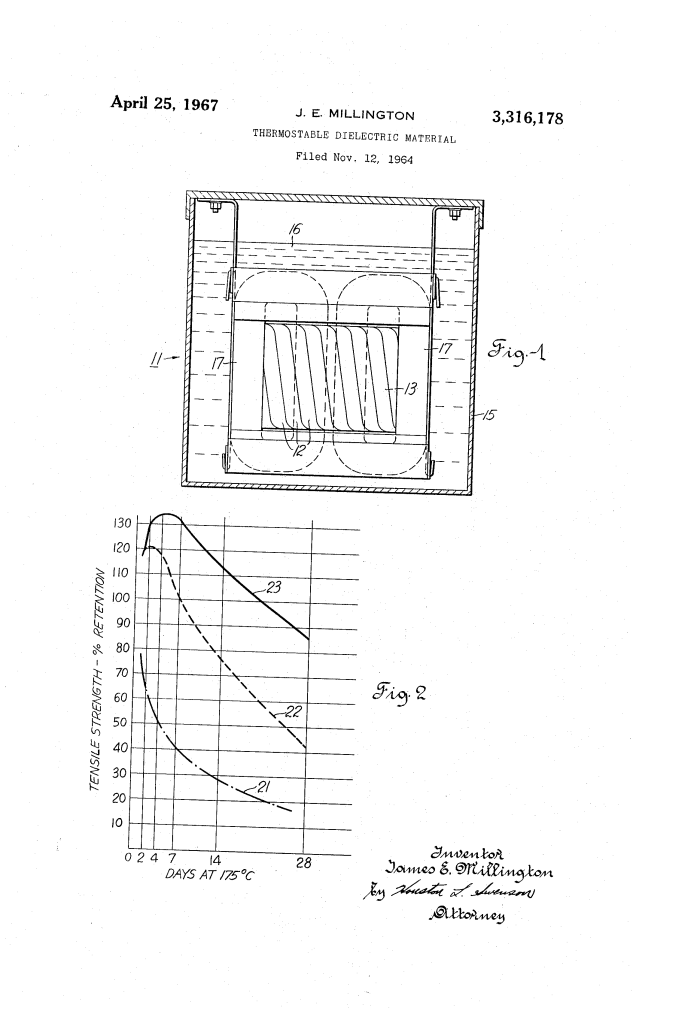
| Kraft Cellulose Base (12) | Lignocellulose sheet | The primary dielectric barrier wrapped around transformer windings (13). |
| Petroleum Insulating Oil (16) | Liquid dielectric | Coolant and high-voltage dielectric medium filling the transformer tank (15). |
Performance: Preventing Thermal Degradation
Accelerated aging trials conducted at 175 C in petroleum oil demonstrated dramatic improvements in mechanical durability over untreated electrical kraft paper.
Short-Term Accelerated Aging (24 Hours at 175 C in Oil):
- Untreated Kraft Paper: Retained only 58% of its tensile strength and just 4.3% of its folding endurance.
- Treated with Triethanolamine: Retained 84% tensile strength and 25.0% folding endurance (nearly 6 times the flexibility of untreated paper).
- Treated with Tetrakis(2-hydroxyethyl)-ethylenediamine: Retained 92% tensile strength and 28.0% folding endurance.
- Treated with Diethanolamine: Retained 85% tensile strength and 34.0% folding endurance (nearly 8 times the folding flexibility of untreated paper).
Long-Term Endurance (28 Days at 175 C in Oil):
- Standard Untreated Kraft (Curve 21): Deteriorated to approximately 17% tensile strength retention, representing severe embrittlement.
- Treated Southern Pine Kraft (Curve 22): Maintained 42% tensile strength retention.
- Treated Northern Pine Spruce-Balsam Kraft (Curve 23): Maintained 86% tensile strength retention.
- Service Life Extension: While untreated paper degraded to 17% strength after the equivalent of 21 years of continuous operation at 95 C, Millington’s triethanolamine-treated papers retained 42% to 86% of their strength over the same operational span.
The Manufacturing Process
Millington detailed three practical manufacturing routes to integrate the chemical treatment:
- Size Press Application (During Papermaking):
- Beat pulp to desired fiber length and lay onto a Fourdrinier wire.
- De-water via vacuum and pass over steam-heated drying rollers to form a continuous sheet.
- Route the sheet through a size press bath containing an aqueous solution of approximately 10% hydroxyalkylamine.
- Pass through final drying rollers and calender stacks to achieve a dry finished sheet containing 0.2% to 0.6% amino nitrogen.
- Immersion of Finished Paper:
- Submerge conventional dry kraft paper rolls into an aqueous bath containing roughly 10% by weight of the selected amine.
- Control web speed and exposure to achieve a 50% to 100% wet pickup.
- Dry the saturated sheet under heat.
- Wet-End Pulp Addition:
- Blend the chemical directly into the aqueous cellulose pulp slurry at a concentration of 3% to 10% prior to sheet formation.
- De-water and press into finished sheets with 0.02% to 1.0% nitrogen retention.
Technical Components
- Transformer Tank (15): The sealed housing encasing the high-voltage electrical components.
- Transformer Core (17) and Windings (13): The electromagnetic core and current-carrying coils subject to thermal expansion and alternating magnetic vibration forces.
- Treated Dielectric Paper (12): The hydroxyalkylamine-impregnated cellulosic wrap layered between coil turns and phase barriers.
- Petroleum Oil Bath (16): The insulating and heat-transfer fluid circulating around windings and paper.
Industrial and Grid Impact
Assigned to the Allis-Chalmers Manufacturing Company, Millington’s invention provided significant engineering and economic benefits to utility networks:
- Higher Transformer Overload Capacity: By raising thermal endurance limits, substations could handle heavy peak overloads for longer periods without triggering premature insulation breakdown.
- Substantial Life Extension: Slowing the rate of tensile and flexibility loss prevented vibration-induced mechanical cracking, extending transformer field life decades beyond standard designs.
- Chemical Simplicity: The aqueous sizing process integrated directly into commercial papermaking lines without requiring toxic organic solvents or redesigning existing transformer tank architectures.
About the Inventor: James E. Millington
James E. Millington was an industrial research chemist for the Allis-Chalmers Manufacturing Company in Milwaukee, Wisconsin. Focusing on polymer systems, dielectric materials, and organic synthesis, Millington held multiple patents covering insulating paper stabilization, wire coatings, and specialized resin systems. His developments in paper chemistry contributed directly to the modernization and ruggedization of heavy utility transformers during the post-war expansion of the North American power grid.
Summary of Claims
The patent explicitly claims:
- A thermally upgraded cellulosic paper dielectric for petroleum-oil-immersed transformers impregnated with a hydroxyalkylamine (including ethanolamine, diethanolamine, triethanolamine, methylethanolamine, methyldiethanolamine, 1,1-dimethylamino-2-propanol, t-butylaminoethanol, tetrakis(2-hydroxyethyl)-ethylenediamine, tris-hydroxymethylaminomethane, tetra(2-hydroxypropyl)ethylenediamine, 9-diethanolamino-10-hydroxystearylamine, or 1,9-bis(diethanolamino)-10-hydroxyoctadecane) to provide an amino nitrogen content of 0.2% to 1.0% by weight.
- Methods of extending the operating life of transformer paper by treating cellulose fibers with the specified hydroxyalkylamine compounds.
- Papermaking and post-treatment methods comprising sizing, immersing, or pulp-treating cellulosic materials with aqueous amine baths to achieve 0.2% to 1.0% finished amino nitrogen content.
