
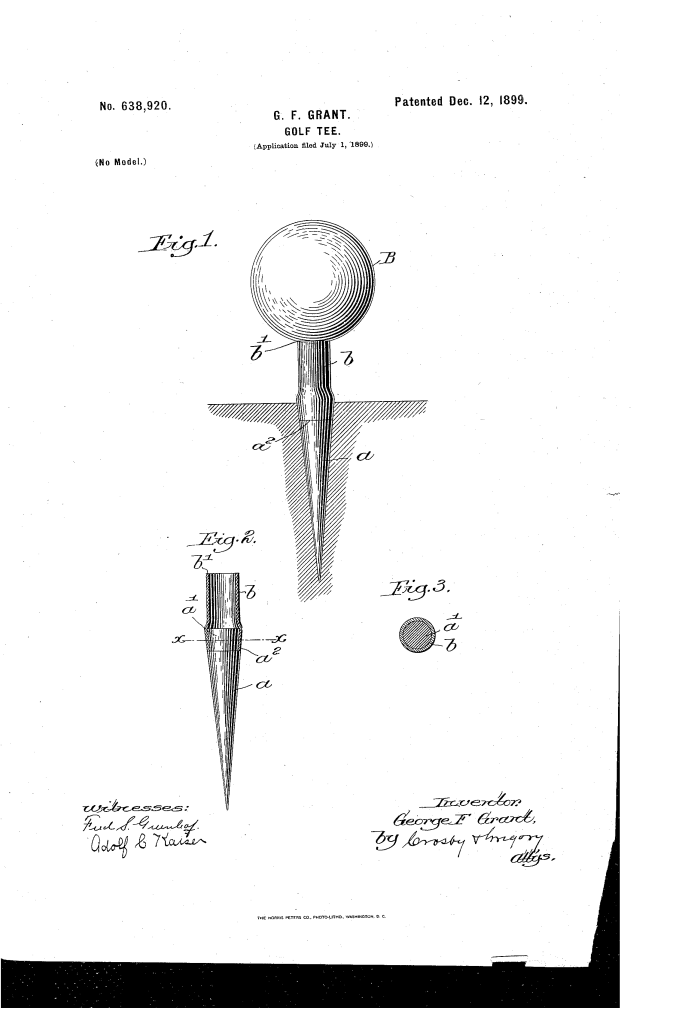
The patent document describes a Golf-Tee invented by George F. Grant of Boston, Massachusetts.
The patent number is 638,920, and it was granted on December 12, 1899.
Purpose of the Invention
The primary object of the invention is to provide a simple, cheap, and effective tee for the game of golf that obviates the need for the usual conical mounds of sand or similar material formed by the player’s fingers.
The tee must meet two critical requirements:
- It must firmly, yet lightly, support the ball until struck.
- It must be constructed so that it will not interfere with the swing or “carry through” of the club when making the stroke.
Key Components and Construction
The invention consists of two main parts: a rigid base and an attached flexible head.
1. The Rigid Base Portion ($a$)
- Material: Preferably made of wood.
- Shape: Tapers to a point at its lower end to be readily inserted (driven) into the ground.
- Shoulder: Near its upper end, the base is reduced in diameter (at $a’$) to create an annular shoulder ($a”$). This shoulder acts as a stop when the tee is inserted into the ground.
2. The Flexible Head ($b$)
- Material: Formed from a piece of rubber tubing.
- Attachment: One end of the tubing is stretched over the reduced portion ($a’$) of the base and drawn down to the shoulder ($a”$).
- Assembly: The inventor prefers to cement the head to the base around the reduced part ($a’$).
- Seat: The open upper end of the head presents an annular seat ($b’$) designed to cradle and support the golf ball.
Operation
- The player drives the base into the ground up to the shoulder ($a”$).
- The flexible head ($b$) projects upward approximately three-quarters of an inch, supporting the ball at a uniform height.
- When the ball is struck, the flexible head yields in the direction of the ball’s travel, ensuring it offers no obstruction to the ball’s flight or the club’s swing.
- The tee can be withdrawn and reused or left permanently in the ground. The use of this tee ensures the ball is uniformly elevated for every drive, overcoming the uncertainty of hand-formed sand tees.
