
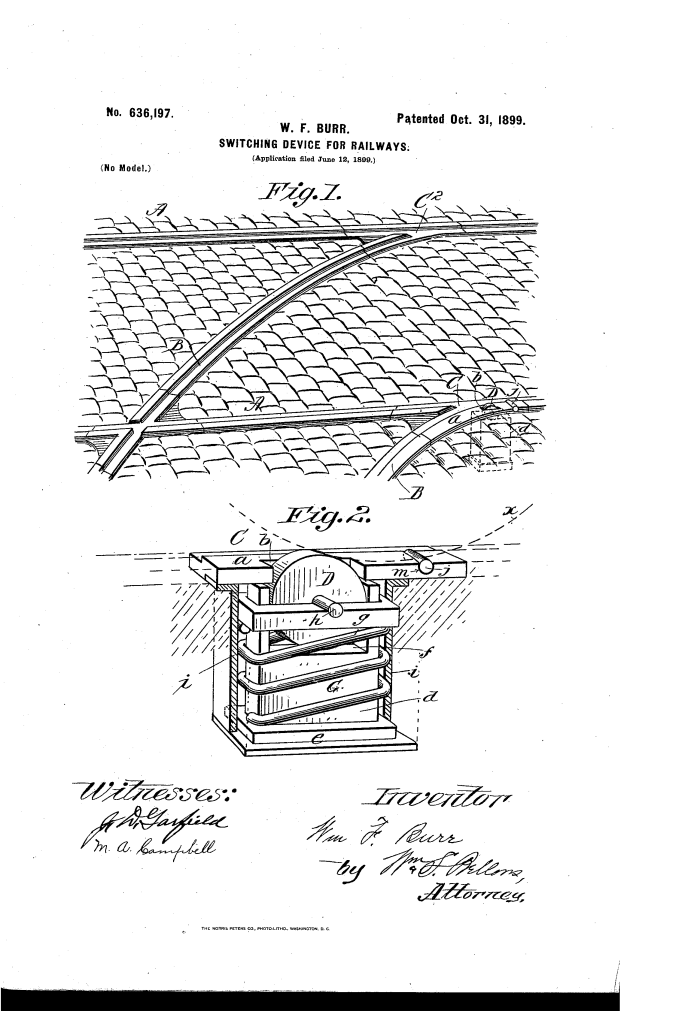
Switching Device for Railways (William F. Burr, No. 636,197)
The patent by William F. Burr of Agawam, Massachusetts, describes a novel Switching Device for Railways (Patent No. 636,197, 1899), particularly for street railways. The object is to provide an automatic mechanism to switch the car to the siding or ensure it stays on the main track, based on the car’s speed.
Inventor Background: William F. Burr
William F. Burr was an inventor focused on mechanical and safety solutions for the transportation industry. His invention addresses a logistical need in streetcar systems—automatically directing traffic at junctions based on driver intent, simplifying operations and reducing the need for manual track throwing.
Invention and Mechanism
The device uses spring-supported rollers set into the track. The speed of the approaching car determines whether the wheel maintains traction (goes straight) or loses traction on the rollers (is steered).
1. Track Structure and Rollers
- Frog (C): The junction point where the main track (A) meets the branch/siding rails (B).
- Large Roller (D): A roller rotatably mounted within an aperture ($b$) in the tread portion ($a$) of the frog. A portion of its periphery normally protrudes upwardly above the rail tread.
- Spring Support (G): The roller (D) is supported by a comparatively stiff spring (G) via a yoke/journal-support ($g$).
- Function: Under the weight of the car, the roller is bodily depressed, but the spring provides firm resistance.
- Small Roller ($j$): A smaller roller is located rearward of the main roller (D).
2. Automatic Switching Principle (Speed Differential) (Key Innovation)
The system works by using the speed of the car to control the point of contact between the wheel and the track:
- To Take the Siding (Slow Speed):
- The driver slackens the speed to a very slow rate.
- The foremost car-wheel comes to a rolling bearing against both rollers (D and $j$).
- Result: The wheel momentarily ceases to have tractional action on the rail tread and turns idly on the rollers. With the wheel effectively being a center of swinging motion, the car’s progressive movement causes it to swing onto the siding track rails (B). The roller (D) is depressed, and the car proceeds onto the siding.
- To Stay on the Main Track (Rapid Speed):
- The driver approaches and passes the switch at a comparatively rapid rate of speed.
- Result: The car is carried over the rollers too quickly to permit such steering action. The wheel maintains sufficient traction and inertia over the rail tread, and the car continues along the main track.
Concepts Influenced by This Invention
Burr’s switching device influenced subsequent automation and control systems by pioneering a mechanical method for sensing and reacting to vehicle speed.
- Speed-Dependent Actuation (Mechanical Logic): The core principle of using speed as the control variable to determine a mechanical outcome (steer vs. maintain path) influenced the design of early safety and control systems. This concept is used today in centrifugal switches and governors where inertia or speed triggers a mechanical change.
- Passive Steering Mechanisms: The reliance on momentarily reducing wheel traction to allow the vehicle’s own momentum/geometry to guide it onto a different path influenced the design of various guidance and steering systems, particularly those using simple rollers or guiding surfaces to alter the direction of travel.
- Track-Embedded Automation: The design of embedding the entire actuation system (spring, rollers, support) directly into the track structure (frog C) influenced the design philosophy of modern rail and traffic control systems where the sensing and actuation hardware is integrated invisibly into the infrastructure.
- Reducing Manual Intervention: The system aimed to eliminate the need for the motorman to stop and manually throw a switch, influencing the design of automated rail junctions and transit systems that prioritize continuous, hands-free operation.
