
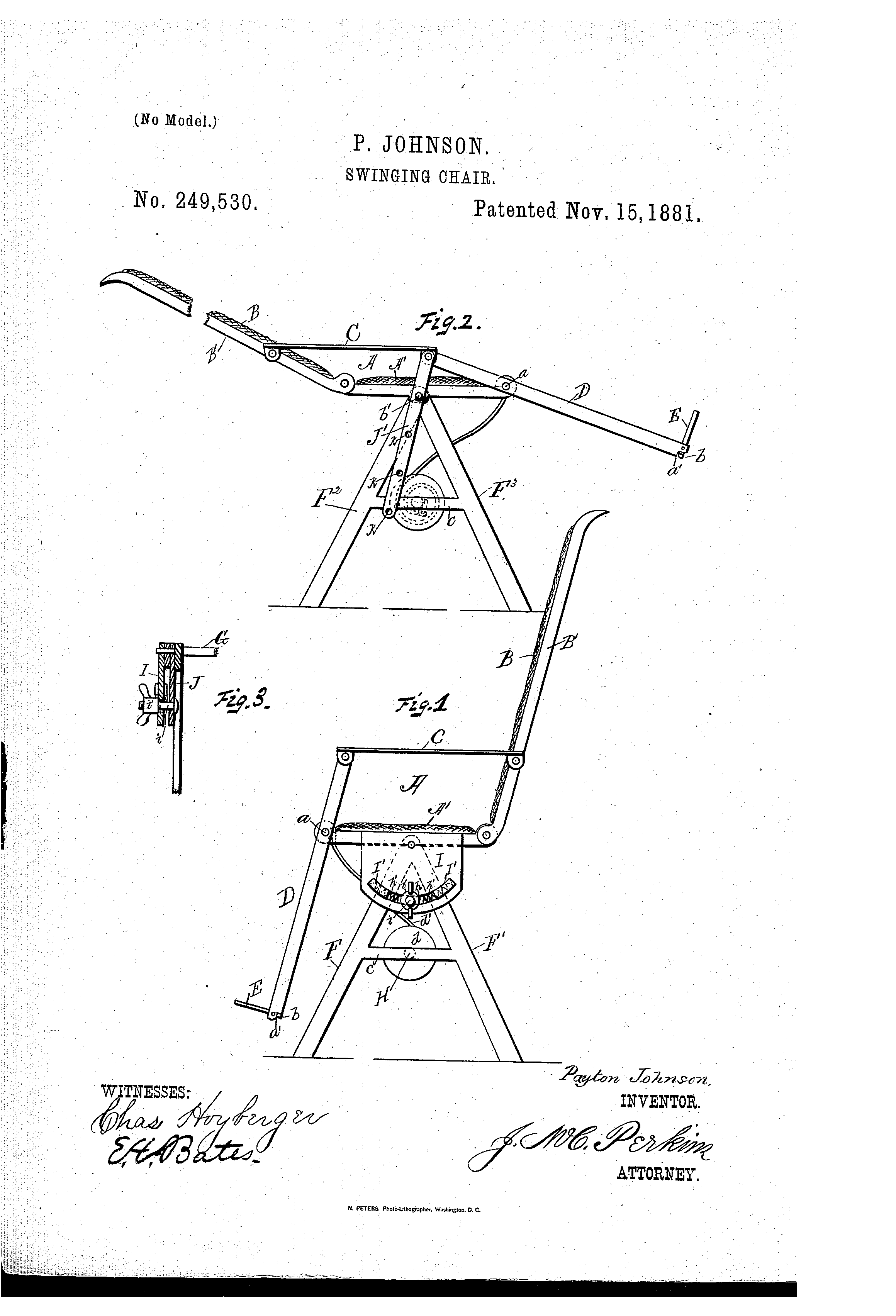
Swinging Chair (Payton Johnson, No. 249,530)
The patent by Payton Johnson of Akron, Ohio, describes an Improved Swinging Chair (Patent No. 249,530, 1881). The invention is a convertible chair that can be easily switched from a stationary seat to a rocking or fully reclining position using a simple locking system.
Inventor Background: Payton Johnson
Payton Johnson was an African-American inventor whose work focused on making everyday furniture more useful and comfortable. His chair combined several functions into one unit, addressing the 19th-century demand for versatile, multi-functional home furnishings.
Invention and Mechanism (Simplified)
This chair is designed to convert seamlessly between sitting, reclining, and rocking, giving the user control over the position.
- The Swinging Base: The chair’s seat is attached to the legs using a central metal bar that acts like a large hinge, allowing the entire seat assembly to swing or rock. A large, coiled spring is hidden beneath the seat and connected to the base. This spring helps smooth out the rocking motion and acts as a shock absorber.
- Converting to a Recliner: The chair back and the foot-rest are linked together by a system of connecting arms. When the user pushes the backrest down to recline, the system automatically raises the foot-rest at the same time, ensuring the user’s body is supported in a comfortable, near-flat position.
- Position Control (Setting the Angle): To choose a specific reclining angle, the user moves a special control lever attached to the chair arm. This lever locks into a pin on the central metal bar, allowing the user to set and hold the perfect angle.
- Stopping the Rocking: When the chair needs to be used as a stable, stationary seat (not a rocker), a simple clamping screw is used. This screw, which has a knob on the end, passes through a slotted metal plate and can be tightened to lock the seat firmly to the legs, preventing any swinging motion.
Core Concepts Utilized Today
Johnson’s chair influenced subsequent convertible and ergonomic furniture by introducing synchronized mechanical linkage and user-adjustable positioning.
- Synchronized Reclining: The main idea of having the back and foot-rest move together when reclining is the fundamental mechanical principle used in nearly all modern recliners .
- Adjustable Locks: The concept of using a screw and slotted plate to quickly lock a pivoting piece of furniture at any angle influenced the design of various adjustable mechanisms, such as those used in drafting tables, hospital beds, and folding chairs.
- Multi-Functional Furniture: The combination of a comfortable, stable seat with the option for rocking and full reclining into a single piece influenced the development of modular and convertible home furniture.
