

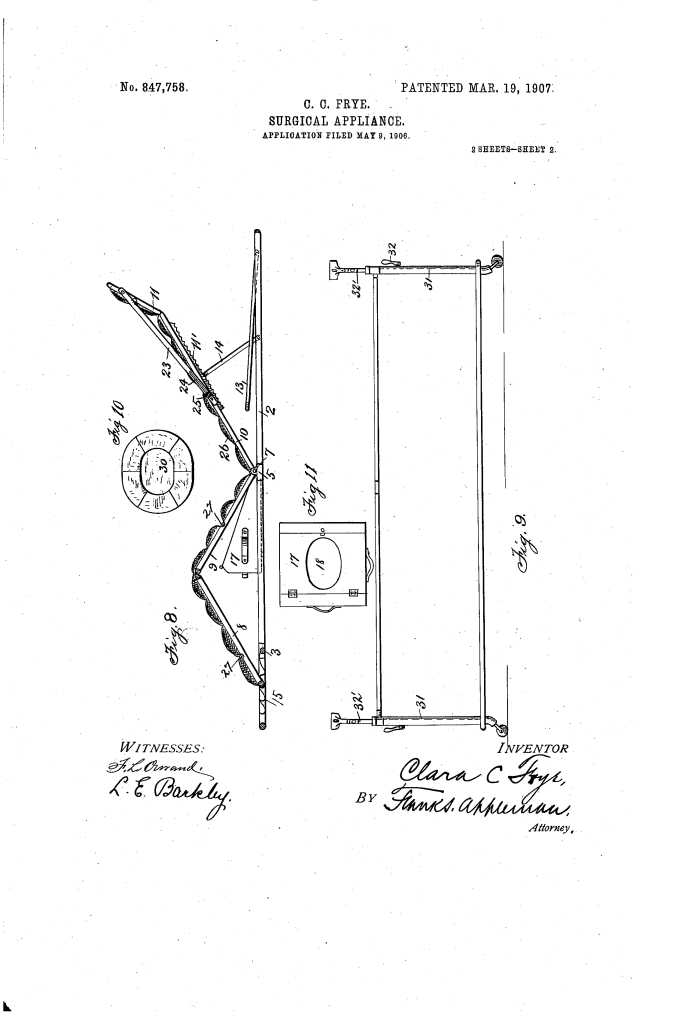
Surgical Appliance (Clara C. Frye, No. 855,103)
The patent by Clara C. Frye of Tampa, Florida, describes a Surgical Appliance (Patent No. 855,103, 1907) designed as a combination chair and bed. The invention’s object is to provide a novel device adapted for obstetrical purposes, fever cases, or general sickness that minimizes disturbance to the patient and offers flexible treatment options.
Inventor Background: Clara C. Frye
Clara C. Frye was an African-American inventor and nurse who resided in Tampa, Florida. She is best known for her humanitarian work: she founded and operated the Clara C. Frye Memorial Hospital (originally the People’s Hospital) in Tampa, providing crucial medical care to the Black community during segregation. Her invention is a direct result of her professional experience, solving practical problems in patient care, nursing, and surgery.
Invention and Mechanism (Simplified)
The appliance is a collapsible, multi-section frame that can quickly convert from a flat bed to an adjustable chair, with provisions for fluid therapy and waste management.
1. Frame and Conversion (Key Innovation)
- Main Frame (2): A large, rectangular support frame, preferably made of tubing.
- Pivoted Sections (8, 9, 10, 11): The chair is built from a series of pivotally connected sections: a foot-section (8), a base-section (9), a back-section (10), and a head-section (11).
- Function: The hinged sections allow the apparatus to be adjusted from a flat bed position (all sections aligned) to a reclining or upright chair position (various sections elevated and held by racks).
- Back Adjustment: Racks (11) on the sides of the back-section (10) engage yokes (13, 14), which are pivoted to the main frame, allowing the incline of the back to be finely adjusted and secured.
- Bed-Pan Access: The base-section (9) has an opening (19). Rack-strips (15) are engaged by the foot-section (8) to elevate the base-section for the insertion of a bed-pan (16) underneath.
2. Specialized Cushion and Therapy
- Inflatable Cushion (26): An inflatable cushion (the same shape as the chair) is secured over the chair sections by cords passing through apertures (28).
- Dual Fluid Capability: The cushion is provided with two valves: one for air and a larger valve for water or other fluid.
- Function: This allows the cushion to be used as an air-bed for comfort, or filled with hot water (for circulation/therapy) or iced water (for fever cases), depending on the patient’s need.
3. Obstetric/Surgical Accessories
- Adjustable Stand: The chair can be placed on a tubular stand with adjustable height extensions (32).
- Limb-Braces (33): Used when the chair is required for obstetrical purposes. These braces clamp onto the frame and feature an adjustable angular section with a padded leather bracelet for securing the limb.
- Handholds (34): Removable handholds provide the patient with a grasp for stability.
Core Concepts Influenced by This Invention
Frye’s surgical appliance influenced subsequent medical and patient care equipment by pioneering multi-functional, hygienic, and fluid-therapy integrated bed designs.
- Convertible Examination/Therapy Platform: The core concept of a pivoted, multi-section frame that converts from a flat cot to a specialized, adjustable chair influenced the design of modern:
- Hospital Beds: Beds that articulate the head, back, and foot sections via levers or motors.
- Examination and Birthing Chairs in medical facilities.
- Integrated Fluid Therapy Cushioning: The innovation of an inflatable cushion designed for both hot and iced water influenced the development of modern pressure-reducing mattresses and specialized medical pads that integrate temperature control (cooling/heating) for treating bedsores or fever.
- Quick-Access Waste Management: The design featuring a rack system (15) that elevates the base-section to allow for the easy, undisturbed insertion of a bed-pan influenced the ergonomic design of patient care equipment aimed at minimizing movement and inconvenience for the invalid.
- Modular Accessory System: The inclusion of simple clamping limb-braces (33) and handholds (34) that easily attach to the main frame tubing influenced the design of modular medical equipment that uses standardized clamps to secure various accessories.
