
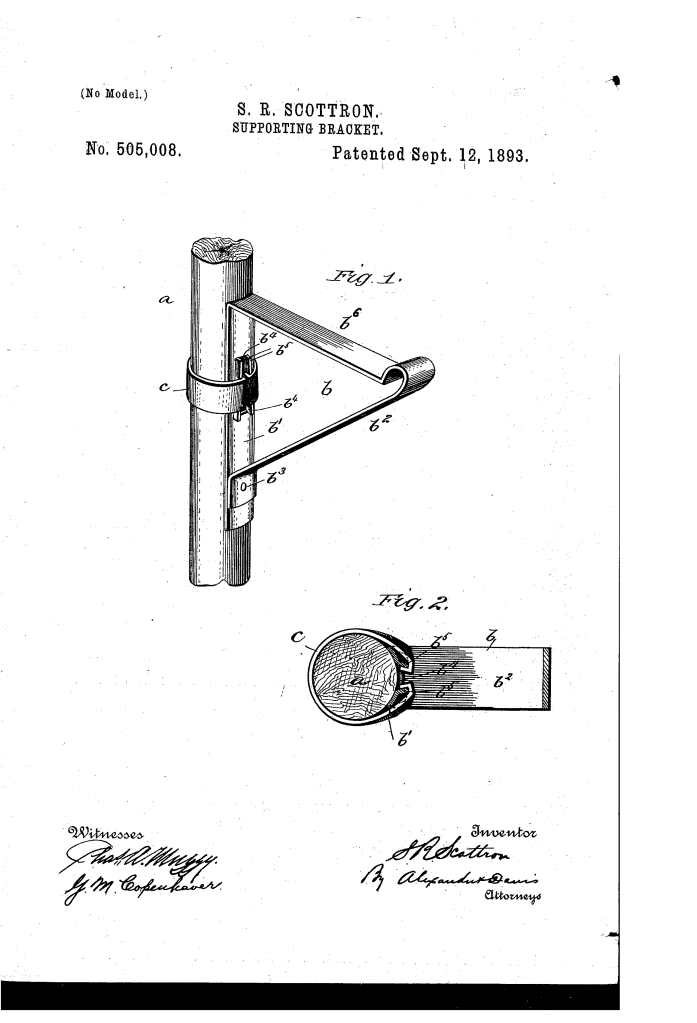
Supporting-Bracket (1893)
U.S. Patent No. 505,008, granted on September 12, 1893, to Samuel R. Scottron, describes an innovative, adjustable supporting bracket designed for shelving and displays. Samuel Scottron, a prominent inventor based in Brooklyn, New York, created a mechanism that eliminated the need for nails, screws, or bolts, which traditionally weakened and disfigured structural supports.
This specific invention solved a persistent problem in late 19th-century interior design and retail merchandising: how to construct a shelving system that could be easily adjusted vertically without damaging the mounting poles or standard bars.
The Innovation: The “Gravity-Locked Friction Band”
Traditional brackets of the era required permanent fasteners or drilled holes to lock into place. Scottron’s breakthrough was a geometric design that utilized the physical law of gravity: the heavier the item placed on the shelf, the tighter the bracket gripped its supporting rod.
The system relies on an open triangular bracket and a thin, flexible metal band. By using the weight of the shelf to pull the band tight, Scottron created a secure, non-destructive, and infinitely adjustable fastening mechanism.
Why This Design Works
- Damage Prevention: By avoiding nails or screws, the bracket leaves the supporting pole completely unmarred and structurally whole.
- Proportional Grip: The load itself creates the required friction. As weight increases, the clamping action of the band intensifies.
- Toolless Adjustment: To reposition the shelf, a user simply raises the bracket slightly while holding the band, which expands the loop and releases the grip.
- Lateral Stability: The vertical spine of the bracket is curved to mirror the contours of the support pole, preventing the shelf from shifting sidewise.
Key Structural Components
The apparatus is remarkably simple, consisting of a few interlocking parts where physics does the heavy lifting:
| Component | Function |
| Vertical Support (a) | The central pole or bar (round or rectangular) that serves as the backbone of the shelving structure. |
| Triangular Bracket (b) | A single band of metal bent into an open triangle consisting of a vertical ($b’$), horizontal ($b^2$), and oblique ($b^3$) arm, riveted together. |
| Wedge-Shaped Slot (b5) | An upwardly converging slot in the vertical arm that acts as a track to draw the clamping band together. |
| Oblique Flanges (b6) | Outwardly bent edges along the slot that hold the band away from the main pole, preventing it from defacing the wood or metal support. |
| Flexible Band | A thin metal loop that wraps around the main support pole and hooks over the bracket’s converging flanges. |
How the Apparatus Functions
The bracket relies on a quick, sequential mechanical interaction to lock, hold, and release:
| Step | Action | Mechanical Purpose |
| 1. Placement | The flexible band is wrapped around the support pole (a) and its ends are hooked over the oblique flanges (b6). | Secures the bracket to the pole using the full breaking strength of a thin, flexible band. |
| 2. Loading | A shelf or object is placed on the horizontal arm (b2), depressing the bracket. | Forces the vertical arm downward, causing the converging slot to draw the ends of the band tightly together. |
| 3. Clamping | The band frictionally clamps the support pole, while the curved vertical bar (b) braces tightly against it. | Creates a rigid, slip-free hold that steadies the bracket against lateral and vertical movement. |
| 4. Adjustment | The user lifts the horizontal arm slightly while holding the flexible band stationary. | Widens the band’s loop, instantly releasing the friction lock for easy repositioning. |
Historical and Scientific Impact
Samuel R. Scottron’s invention entered the market during a boom in urban commercial retail and modernized home interiors, offering several distinct advantages:
“It will be observed that the weight of the shelf or other article placed on the bracket will, by depressing the same, draw the two ends of the thin band toward each other and thereby frictionally clamp the support…”
- Material Efficiency: Because the design utilizes the breaking strength of the metal band rather than sheer thickness, Scottron was able to manufacture the product using incredibly thin, cost-effective sheets of flexible metal.
- Versatility: Though demonstrated on a round pole, the open architecture allowed the system to adapt seamlessly to rectangular or uniquely shaped architectural pillars.
- Labor Reduction: Handymen and store clerks no longer needed tools, drills, or hardware arrays to reconfigure window displays or stockrooms.
About the Inventor: Samuel R. Scottron
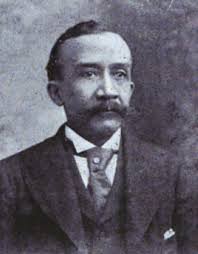
Samuel Raymond Scottron (c. 1841–1908) was one of the most prominent African American inventors, community leaders, and scholars in New York during the late 19th century.
- Patents: Beyond his adjustable bracket, Scottron secured numerous patents for household utilities, including an improved curtain rod (1892), a corniced window pole (1886), and a duclipe window mirror (1893).
- Public Service: A highly respected figure in Brooklyn, Scottron served on the Brooklyn Board of Education as its only Black member in the 1890s and was a passionate writer on race relations, economic self-reliance, and civil rights.
- Legacy: His engineering philosophy centered on optimizing common household items—making them cheaper to manufacture, easier to operate, and less destructive to the homes they were placed in.
Summary of Claims
The patent explicitly claims:
- The combination of a support pole and a triangular bracket where the vertical bar closely fits and braces against the support.
- A vertical bar equipped with an upwardly tapering, wedge-shaped opening with edges bent outwardly to form flanges.
- A flexible band embracing the support and partially wrapping over the converging flanges, terminating short of the support face to leverage frictional clamping.
