

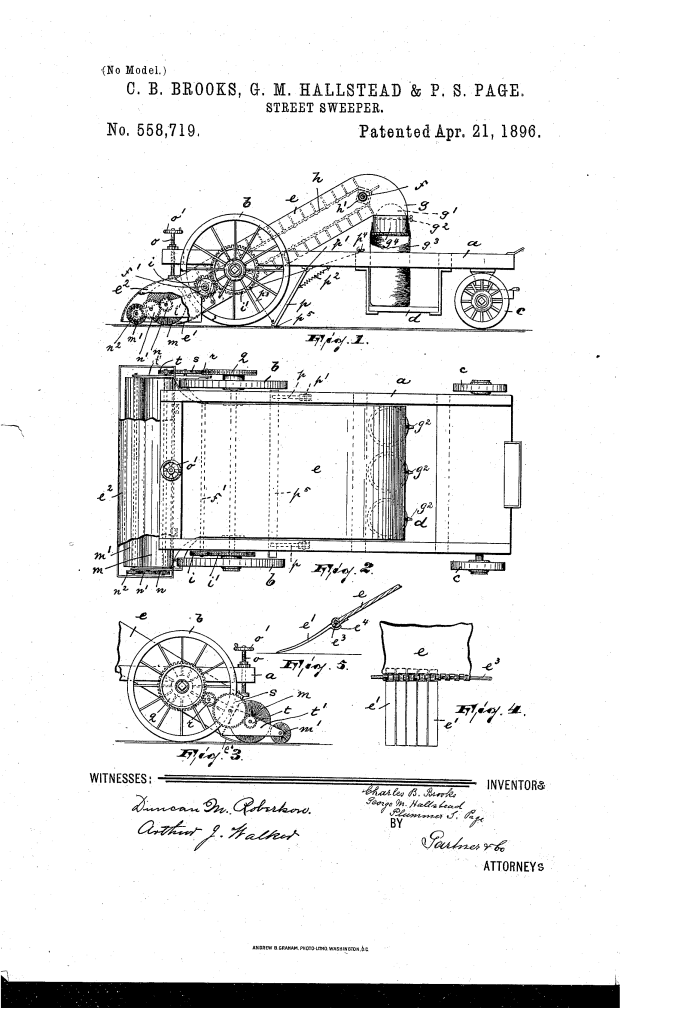
Street Sweeper (1896)
U.S. Patent No. 558,719, granted on April 21, 1896, to Charles E. Brooks, George M. Hallstead, and Plummer S. Page, describes a mechanical street sweeper and cleaner designed to collect debris efficiently without scattering dust and dirt into the air.
Charles E. Brooks (of Newark, New Jersey) along with George M. Hallstead and Plummer S. Page (of Scranton, Pennsylvania) engineered this system as an improvement over earlier mechanical sweepers. The invention solved a common 19th-century municipal problem: street sweepers often kicked up clouds of dust or left behind fine trailings that required secondary manual cleaning.
The Innovation: Dual Brushes and Dust Containment
Standard street sweepers of the era relied on a single revolving broom that frequently missed smaller particles and created airborne dust hazards. Brooks, Hallstead, and Page solved this by combining a dual-brush system operating inside a sealed hood with an enclosed elevator system and a flexible receiving pan.
How the Dual-Brush Mechanism Works:
- Primary Brush (m): A large revolving brush mounted at the rear of a sectional pan. It rotates in the opposite direction of the truck’s wheels, lifting heavy dirt, snow, or debris directly onto the receiving pan.
- Auxiliary Brush (m’): A smaller brush mounted directly behind and parallel to the primary brush. Rotating in the same direction as the main brush, it sweeps up any residual fine dust missed by the first pass and hurls it forward onto the primary brush to be carried into the elevator.
- Protective Hood (6): A casing mounted over both brushes and the receiving pan, preventing dust and debris from flying around during operation.
Key Mechanical Components
| Component | Function |
| Sectional Receiving Pan (e’) | A series of narrow, flexible strips pivoted on a shaft (a) at the bottom of the elevator. Individual arms (e”) limit downward movement, allowing the pan to conform to uneven street surfaces without jamming. |
| Primary & Auxiliary Brushes (m, m’) | A two-stage sweeping assembly driven by gear trains (q, r, s, t and n, n, n) connected to the rear wheels, ensuring continuous sweeping action synchronized with truck movement. |
| Elevator Casing (e) & Bucket Chain (h) | An inclined housing containing a chain of scoops running over squared cylinders (h’). It elevates debris from the receiving pan to the upper hopper chamber. |
| Hoppers (g’) & Dampers (g³) | Downward-extending chutes at the top of the casing fitted with individual rotating dampers (g³). These allow workers to close off a hopper while swapping out full bags (g²) without stopping the sweeping operation. |
| Knife-Edged Scraper (p³) | A spring-controlled blade (p³) mounted forward of the elevator casing. Operated via chains (p⁴) and arms (p’), it scrapes stubborn, stuck-on mud or dirt off smooth asphalt before the brushes arrive. |
| Elevator Screw (o) | A hand-wheel (o’) mechanism at the top of the hood that allows the operator to raise or lower the entire elevator casing, hood, and brush assembly simultaneously to clear obstacles or for transport. |
How the Apparatus Functions
The machine operates in a continuous, automated sequence driven by the forward motion of the vehicle:
- Scraping & Loosening: The spring-tensioned front scraper (p³) scrapes packed dirt or dried mud off the pavement.
- Dual-Stage Sweeping: The primary brush (m) sweeps loose debris onto the sectional receiving pan (e’). Any fine dust that passes under or over the main broom is caught by the trailing auxiliary brush (m’) and thrown forward into the primary brush’s path.
- Elevation: The endless bucket chain (h), driven by a pinion (i) off the main wheel gear (a’), scoops the debris off the sectional pan and carries it up the inclined casing (e).
- Bagging & Containment: Debris drops through top chamber (g) into hoppers (g’) and fills attached bags (g²). Operators close the internal dampers (g³) to safely swap out filled bags onto the lower platform (d) while the vehicle remains in motion.
Historical and Practical Impact
The Brooks, Hallstead, and Page design represented a significant leap forward in late-19th-century municipal sanitation technology:
- Dust Suppression: By fully enclosing the sweeping zone under a fitted hood (6) and directing dust straight into an elevator casing, it protected urban pedestrians and workers from noxious city dust.
- High-Efficiency Collection: The dual-brush arrangement eliminated the need for double-pass sweeping on municipal streets.
- Continuous Operation: The double-hopper system with shut-off dampers allowed cities to clean miles of roadway without stopping the vehicle to empty a central bin.
About the Inventors
Charles E. Brooks, George M. Hallstead, and Plummer S. Page were late-19th-century inventors working in the industrial centers of New Jersey and Pennsylvania. Their collaborative efforts focused on solving practical municipal engineering and public sanitation challenges during a period when rapidly growing American cities were transitioning from horse-drawn clearing methods to mechanized infrastructure maintenance.
Summary of Claims
The patent explicitly claims:
- A street sweeper combining a wheeled truck, an inclined elevator casing, a receiving pan, and a primary revolving brush with a smaller parallel auxiliary brush behind it, rotating in the same direction.
- A protective hood covering the brush assembly and receiving pan to contain airborne dust during operation.
- A single elevation control mechanism (o, o’) capable of simultaneously raising and lowering the elevator casing, brush frame, and protective hood.
- A drive system utilizing gear trains connected to the vehicle’s rear axle to power both brushes in a direction opposite to the rotation of the wheels.
