
Street Sweeper (1896)
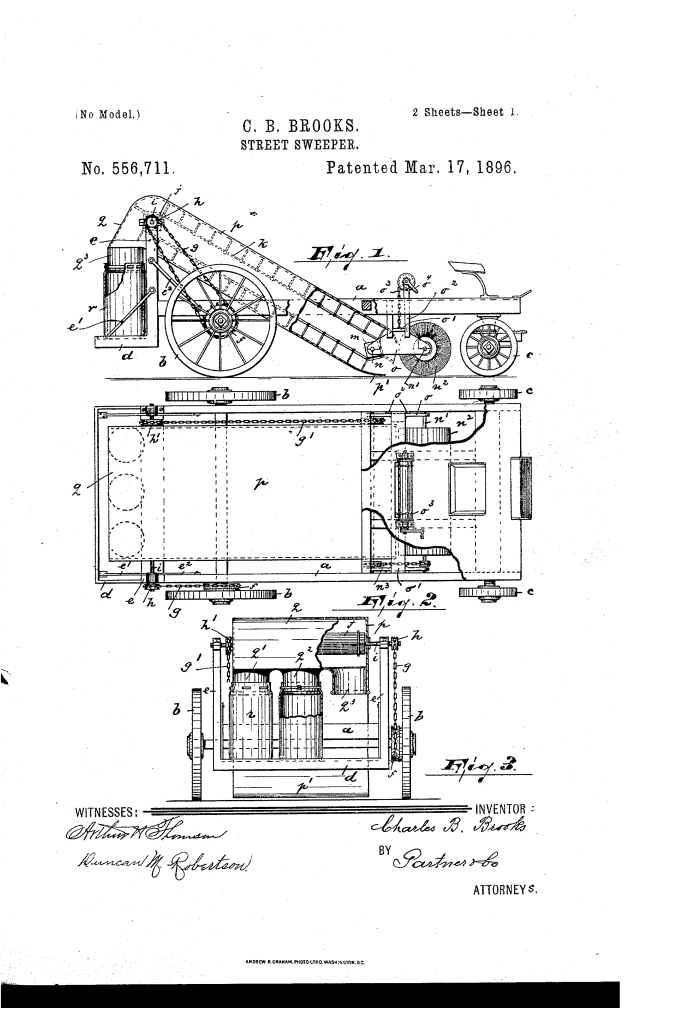
U.S. Patent No. 556,711, granted on March 17, 1896, to Charles B. Brooks, details an improved, self-contained street sweeping and cleaning machine. Charles Brooks, an inventor residing in Newark, New Jersey, assigned a two-thirds interest in the patent to Plummer S. Page and George M. Halstead of Scranton, Pennsylvania.
This invention addressed key operational and environmental challenges in late 19th-century municipal sanitation: reducing atmospheric dust during sweeping, efficiently collecting refuse directly into detachable containers, and preventing mechanical clogging from stubborn debris.
The Innovation: Dust Contraint & Self-Cleaning Drives
Traditional street-sweeping apparatuses often generated clouds of dust and frequently suffered from debris accumulation within their drive systems. Brooks introduced a closed-circuit collection mechanism paired with a unique, self-cleaning drive system.
Key Mechanical Innovations
- The Restricted Dust-Proof Mouth: The elevator casing curves inward at its lower opening near the rotating brush. This restricted mouth traps dust stirred up by sweeping while directing debris straight into the collection pan.
- Squared-Shaft Elevator Drive: Rather than standard circular sprockets, the elevator chains travel over squared shafts. As the chain links hit the flat faces and corners of these revolving square shafts, the resulting agitation creates a “self-cleaning” jarring motion that knocks off clingy, wet dirt into the collection pan or exit chutes.
- Direct Bag-Loading System: Refuse is carried to the top of the elevator casing and dropped through a series of hoppers directly into heavy-duty fabric bags secured by interlaced straps. Once full, these bags can be detached and replaced without spilling dust or litter into the street.
Technical Components
The system coordinates several moving sub-assemblies powered directly by the rear axle drive wheel:
| Component | Function |
| Drive Wheel ($b$) & Chain Drive | Transfers kinetic motion from the rear wheel axle to the upper drive shaft via sprocket chains. |
| Revoluble Brush ($p^2$) | Sweeps street refuse forward and upward into the receiving pan of the elevator chute. |
| Elevator Casing ($p$) | An enclosed, inclined chute fulcrumed at its upper axle, protecting the mechanism and surrounding air from dust. |
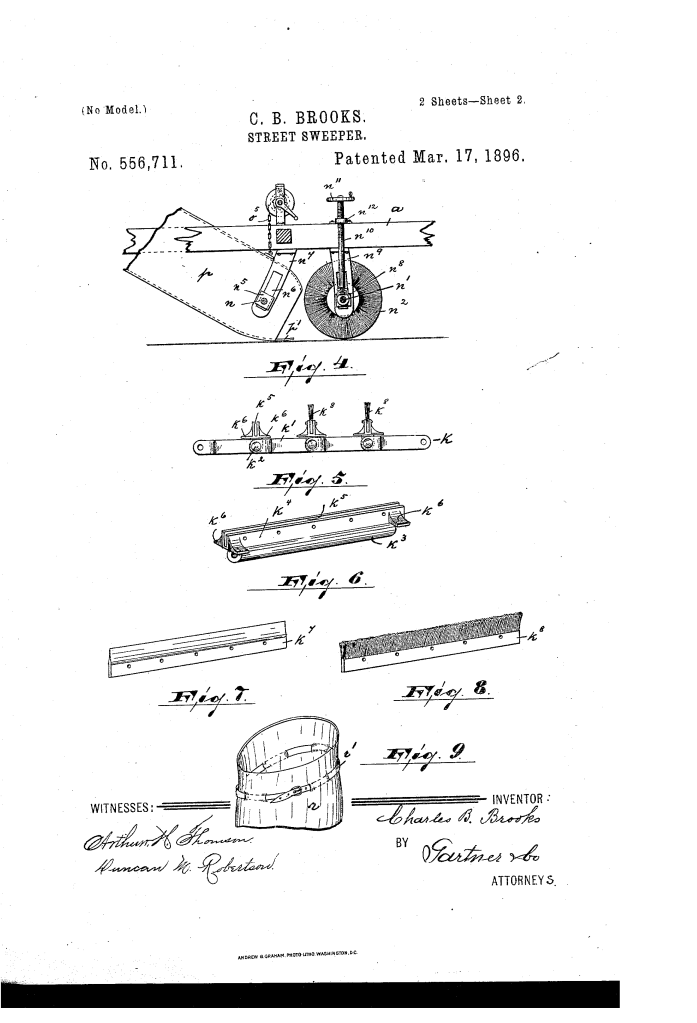
| Interchangeable Buckets ($k^1, k^2$) | Mounted on continuous chains via specialized bucket-holders; allows switching between brushes for light dust and scrapers for heavy snow, ice, or stones. |
| Receiving Hoppers ($q^1, q^2$) & Bags ($r$) | Directs elevated refuse straight into secured, strap-buckled collection bags riding on a lower platform. |
System Operation & Adjustment
The apparatus follows a continuous mechanical sequence to sweep, elevate, and package debris:
- Sweeping: The revolving rear brush sweeps refuse off the street surface into the forward-projecting elevator pan ($p^1$).
- Elevating: Continuous chains carrying interchangeable bucket-scrapers scoop up the material and transport it up the enclosed chute.
- Self-Cleaning: As the chain links wrap around the squared driving shafts ($j, m$), the rhythmic mechanical impact knocks stuck debris off the elevator links.
- Bagging: Material reaches the top of the chute and falls through a conical funnel system directly into closed collection bags mounted on the platform ($d$).
Independent Height Adjustment
Brooks provided a modified version of the drive frame using swiveled elevator screws ($n^7$) and hand-wheels ($n^6$). This design allowed operators to adjust the height of the revoluble brush and the elevator chute independently to accommodate uneven road surfaces, heavy snowpack, or varying gutter depths.
About the Inventor: Charles B. Brooks
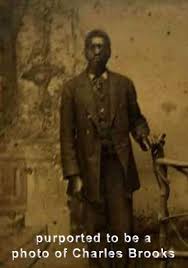
Charles B. Brooks was a prolific 19th-century African American inventor based out of Newark, New Jersey.
- Patents: Beyond his landmark 1896 street-sweeper design, Brooks developed multiple patents, including improvements to dust-proof ticket punches for railway conductors.
- Impact: His street-sweeper design significantly advanced municipal sanitation by moving away from open-air sweeping—which scattered particulate matter and pathogens—toward a dust-contained, organized bagging process.
- Legacy: Brooks’s incorporation of interchangeable attachments (scrapers vs. brushes) created an early blueprint for year-round, multi-weather municipal utility vehicles.
Summary of Claims
The patent explicitly claims:
- An inclined elevator casing fulcrumed at its upper shaft, complete with guide brackets, side bushings, and lower-end height adjustment mechanisms.
- A specialized bucket-holder design featuring a slotted upper side, a lower sleeve for chain-connecting rods, and stabilizing end-lugs to space the elevator chains evenly.
- The combination of overlapping chain links and cross-connecting rods through a sleeved holder to maintain bucket stability during high-impact debris elevation.
