
Street-Car Fender (1895)
U.S. Patent No. 531,908, granted on January 1, 1895, to Matthew A. Cherry, describes an innovative safety device designed for streetcars and other motorized vehicles to prevent injury to pedestrians. Matthew A. Cherry, an inventor based in Washington, D.C., sought to provide an absolute safeguard against injury to individuals struck by rapidly moving transit vehicles.
This specific invention solved a persistent problem in the late 19th-century urban environment: the frequent and often fatal accidents involving pedestrians and the newly introduced electric, cable, or steam-powered streetcars. Traditional vehicles lacked effective front-end protection, often pulling victims underneath the wheels. Cherry’s design provided a simple, durable, and yielding platform to catch individuals safely.
The Innovation: The Right-Angled Yielding Frame
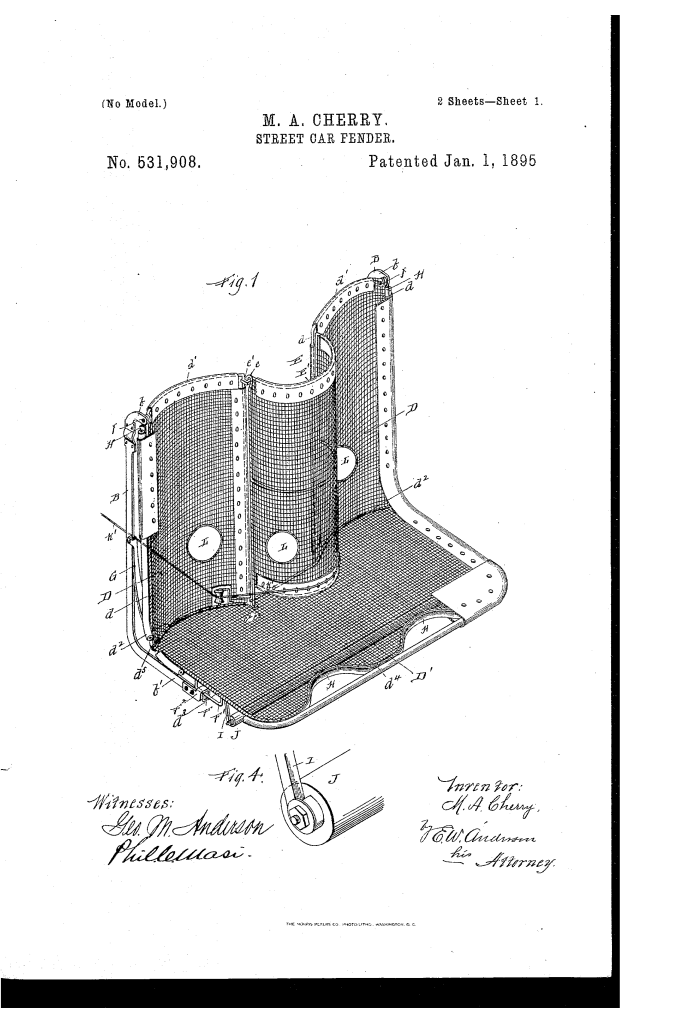
Cherry’s breakthrough was a right-angled fender combining a vertical shield and a horizontal platform made of a rigid rod frame filled with a strong wire netting. What set this design apart was its ability to swing backward upon impact against a set of springs, absorbing the shock of hitting a person, rather than acting as a rigid battering ram.
Why the Sinuous and Cushioned Design?
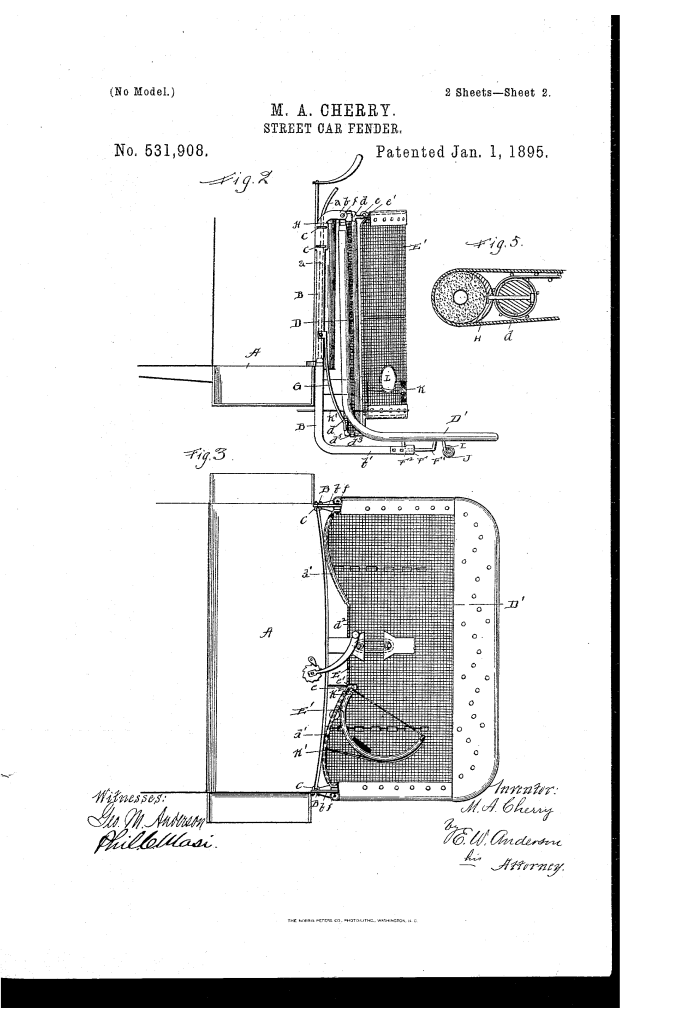
- Shock Absorption: The upper vertical portion of the fender is pivotally attached to main supports, while the horizontal platform has a sliding socket connection. When it strikes an object, it swings backward against heavy springs, minimizing the initial force of the blow.
- Anti-Deflection: The front rod of the platform features a unique “sinuous” shape with strategic backward and forward bends. This geometry, combined with a thick rubber tube guard, ensures that a struck pedestrian is caught securely on the platform rather than being thrown off to the side into the path of other traffic.
- Track Clearance: The weight of an object or person landing on the horizontal platform forces a transverse roller into contact with the track or pavement, allowing the fender to glide smoothly without dragging or breaking.
Key Technical Components
The composition of Cherry’s fender utilizes a precise balance of structural rigidity and flexible elements:
| Component | Function |
| Main Supports (B) | Rigid metal bars attached to the car frame that anchor the fender and guide its sliding and pivotal movement. |
| Fender Frame (D, D’) | A right-angled rod framework with wire netting strong enough to support the weight of any live object it receives. |
| Rubber Tube Guard (H) | A thick, hollow rubber tube seated in a concave strip running entirely around the frame to prevent direct metal-on-body impact. |
| Semi-Cylindrical Gate (E’) | A wire-filled central gate operated by cords that opens to accommodate train couplings or closes to guard the coupling bar. |
| Under-Bearing Roller (J) | A transverse roller suspended beneath the platform that safely meets the pavement under the weight of an object. |
How the Apparatus Functions
The fender operates dynamically sequence-by-sequence during a collision to ensure pedestrian safety:
| Step | Action | Safety Purpose |
| 1. Encounter | The streetcar approaches a pedestrian; the thick, rubber-coated front edge makes initial contact. | Softens the impact and prevents severe fractures or lacerations. |
| 2. Absorption | The force of the impact pushes the vertical frame backward against the springs (G). | Absorbs the kinetic energy of the moving vehicle to protect the pedestrian. |
| 3. Capture | The pedestrian is safely caught by the horizontal platform’s high-strength wire netting. | Keeps the individual from falling under the chassis or wheels of the car. |
| 4. Stabilization | The weight of the captured person drops the under-bearing roller (J) onto the track. | Ensures the fender glides smoothly along the ground without breaking or throwing the person off. |
About the Inventor: Matthew A. Cherry
Matthew A. Cherry was an inventive mind active in Washington, D.C., during the late 19th century.
- Patents: Beyond his notable safety enhancements for transit systems like the street-car fender, Cherry is also widely recognized for inventing a velocipede (an early form of the bicycle/tricycle) and an improved street-sprinkling wagon.
- Impact: His engineering focus targeted the practical safety challenges of urban industrialization. By introducing flexible, spring-loaded, and rubber-cushioned mechanisms, his work anticipated modern automotive safety bumpers and pedestrian protection systems.
- Legacy: Cherry’s adaptable design specifically accounted for cars made up in trains (common on cable and electric lines), allowing operators to control internal gates via a system of cords without leaving their post.
Summary of Claims
The patent explicitly claims:
- A car fender combining a support attached to a car frame, a rigid right-angled frame with both pivotal and sliding connections, and intervening springs.
- A platform featuring a sinuous frame bar at its forward portion backed by a yielding guard.
- A vertical portion having a central vertical opening enclosed by a semi-cylindrical or convex gate to accommodate car couplings.
