
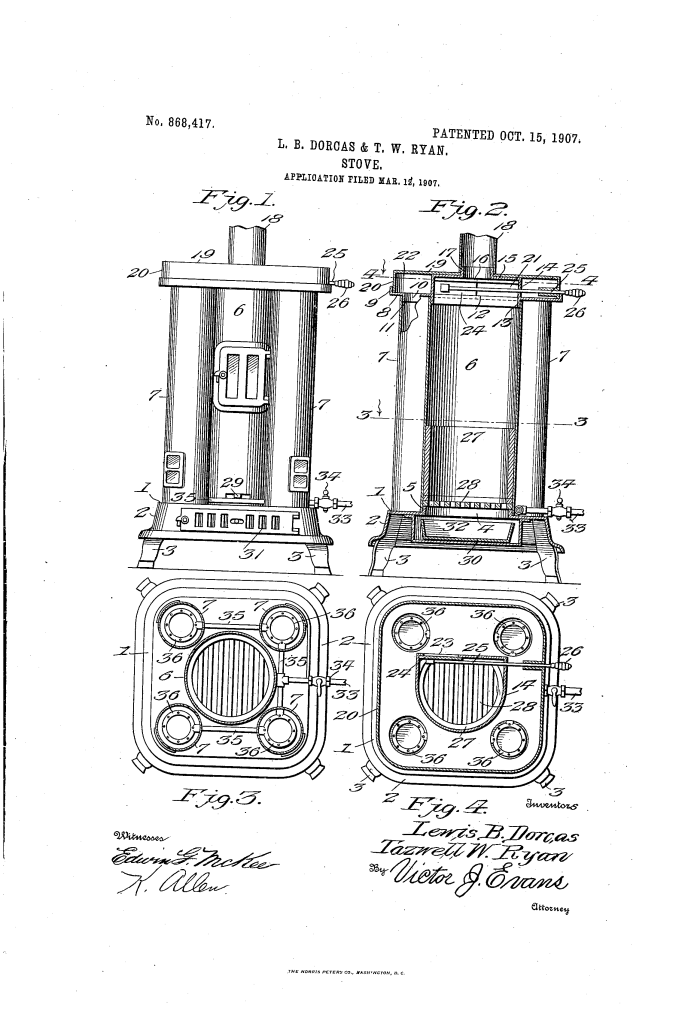
Stove (Lewis B. Dorgas & Tazwell W. Ryan, No. 868,079)
The patent by Lewis B. Dorgas and Tazwell W. Ryan describes new and useful Improvements in Stoves (Patent No. 868,079, 1907). The invention relates to a stove designed for the use of either a gaseous or solid fuel. The main object is to create a single stove that is equally effective with gas (natural or artificial) and solid fuels (wood, coke, or coal), allowing operation to continue without interruption when the gaseous fuel supply is interrupted.
Inventor Background: Lewis B. Dorgas and Tazwell W. Ryan
Lewis B. Dorgas and Tazwell W. Ryan were inventors working in West Virginia, likely within or near the natural gas regions mentioned in the patent. Their invention addresses a common commercial and domestic problem of their time: the unreliability of early natural gas infrastructure, which made gas-only stoves impractical. Their solution was a dual-fuel stove that offered essential continuity of service.
Invention and Mechanism (Simplified)
The stove is a modular assembly where the central firepot can be quickly removed or inserted, converting the stove between solid fuel and gas modes.
1. Frame and Combustion Chambers
- Base Plate (1): The foundation of the stove. It has a central opening (4) surrounded by a retaining flange (5).
- Cylindrical Body (6): The main combustion chamber, designed to fit snugly over the flange (5) on the base plate.
- Burner Tubes (7): Gas burner tubes are secured upon the base plate outside the central cylinder (6).
- Head Plate (8) and Cover (19): These form the top of the stove, creating an enclosed space.
2. Fuel Versatility (Dual Mode) (Key Innovation)
- Fire Pot (27): A removable fire pot (with a grate 28 and shaking means 29) is designed to be seated directly inside the central cylindrical body (6).
- Solid Fuel Mode: When the fire pot (27) is inserted, the stove functions as a conventional coal, coke, or wood stove.
- Gaseous Fuel Mode: When the fire pot (27) is removed, the space is clear. Gas is supplied to the burner tubes (36) which direct heat upward through the space.
3. Flue and Heat Control
- Dual Chamber Top: The space between the head plate (8) and cover (19) is divided by a wall (14) into two chambers: a central chamber (21) (communicating with the solid fuel cylinder 6) and an annular chamber (22) (communicating with the gas burner tubes 7).
- Damper (24): The wall (14) has an opening (23) controlled by a sliding damper (24).
- Function: When using solid fuel, the damper may be closed. When using gas, the damper is opened, allowing the products of combustion from the burner tubes to mix with the central exhaust and escape through the central flue (18).
Concepts Influenced by This Invention
The Dorgas and Ryan stove influenced subsequent appliance design by pioneering modular, dual-fuel capability and integrated heating zone controls.
- Modular Dual-Fuel Conversion: The core concept of using a removable central combustion chamber (fire pot 27) to switch a device between two entirely different fuel sources (solid vs. gas) influenced the design of modern:
- Hybrid Heating Systems: Furnaces, outdoor grills, and utility heaters that use interchangeable modules or inserts for different fuels (e.g., wood pellet inserts for wood stoves, dual-fuel ranges).
- Integrated Zoned Airflow/Flue Control: The use of a damper (24) to control communication between the two separate combustion zones (central cylinder 6 and annular chamber 22) and the common flue influenced the design of zoned combustion systems and high-efficiency appliances that must manage airflow for different operating modes.
- Rapid Service Continuity: The design’s explicit goal of providing continuity of service (switching fuels practically without interruption) influenced the engineering philosophy of critical utility systems and appliances where reliability must be maintained despite fuel supply variability.
- Snug-Fit Modular Assembly: The use of simple mechanical features like the retaining flange (5) on the base plate to ensure the cylindrical body (6) fits snugly and securely influenced the design of modular appliance components.
