
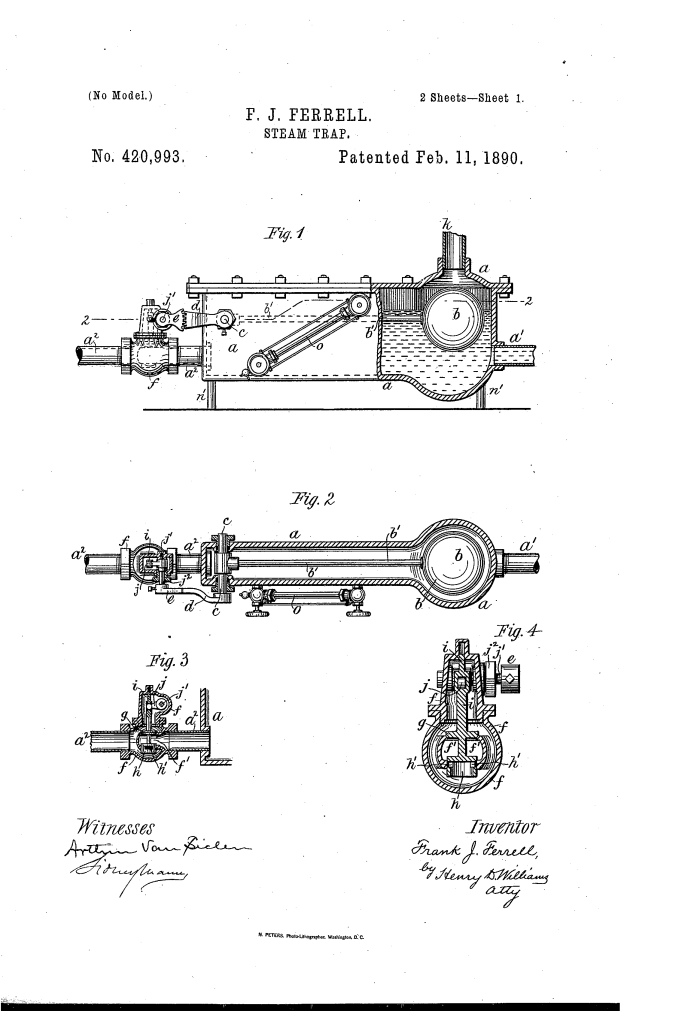

Steam-Trap, Frank J. Ferrell, Patent No. 420,993
The patent by Frank J. Ferrell of New York, N.Y. describes a Steam-Trap (Patent No. 420,993). This invention is an automatic mechanical separator designed to discharge water of condensation from steam systems without allowing precious live steam to escape, utilizing a balanced valve system triggered by a float mechanism.
The “Why”
In the late 19th century, steam was the lifeblood of industry and heating. However, as steam cools, it reverts to water (condensate). If this water accumulates in pipes, it causes “water hammer” (destructive knocking), reduces thermal efficiency, and can damage engines. Existing traps were often unreliable, prone to leaking steam, or unable to handle varying pressures. Ferrell sought to create a device that was “perfectly balanced,” ensuring the valve could open and close effortlessly regardless of the internal steam pressure.
Inventor Section: Frank J. Ferrell
Frank J. Ferrell was a prolific Black inventor and skilled machinist active in the post-Reconstruction era. His engineering philosophy centered on precision and fluid dynamics. Operating in New York during a period of intense industrial competition and systemic racial barriers, Ferrell focused on high-utility mechanical improvements that addressed the core vulnerabilities of steam power. His work on valves and traps was not merely incremental; it was foundational to making steam systems safer and more autonomous, reflecting a sophisticated understanding of pressure equilibrium.
Key Systems Section
1. The Buoyancy Actuation System
The heart of the device is a hollow float-ball attached to a pivoted lever arm.
- Modern Translation: This is a liquid-level sensor. As condensate fills the chamber, the float rises, converting vertical displacement into rotational torque through a shaft.
- Mechanical Principle:
Shutterstock Explore
2. Synchronized Gear Linkage
Unlike simpler traps that used flimsy wires, Ferrell employed a robust external gear interface.
- Modern Translation: A rack-and-pinion style gear segment. A toothed arm on the float shaft meshes with a toothed arm on the valve shaft. This ensures a 1:1, non-slip transfer of motion from the float to the valve stem.
3. Dual-Element Balanced Valve
This is the “Pathological” highlight of the patent. The stem features two distinct valve heads: a conical top and a cylindrical bottom.
- Modern Translation: A pressure-compensated poppet valve. By making the diameter of the lower cylinder equal to the seat of the upper cone, the steam pressure pushing “up” equals the pressure pushing “down.”
- Physics Note: The net force $F_{net}$ on the valve stem is minimized because:$$F_{net} = P(A_{upper} – A_{lower})$$Where $P$ is internal pressure and $A$ is the surface area. Ferrell designed it so $A_{upper} \approx A_{lower}$, resulting in $F_{net} \approx 0$.
4. The Multi-Configuration Discharge
The trap was designed to be modular. It could either dump water directly to a sewer or, in a more advanced setup, act as a pilot controller for a steam pump to return water to the boiler.
- Modern Translation: Process Control Integration.
Comparison Table
| Feature | Standard Methods (1890s) | The Ferrell Innovation |
| Valve Resistance | High; steam pressure held valves shut, requiring huge floats. | Balanced; operates smoothly regardless of high steam pressure. |
| Durability | Frequent leaks due to uneven seat wear. | Self-Correcting; the cylindrical lower valve maintains a seal even if the upper cone wears. |
| Efficiency | Constant “simmering” or loss of live steam. | Positive Seal; ensures only liquid water is evacuated. |
| Maintenance | Difficult to access internal linkages. | External Linkage; gears are outside the main pressure vessel for easy inspection. |
Significance Section
- Precursor to Modern HVAC: The logic of automatic condensate removal is still used in every commercial steam heating system today.
- Fluid Control Evolution: The “balanced valve” principle is a direct ancestor to modern hydraulic control valves used in heavy machinery.
- Industrial Safety: By preventing water hammer, Ferrell’s design significantly reduced the risk of pipe explosions in crowded urban tenements and factories.
- Pioneer in Automation: One of the earliest examples of a “closed-loop” mechanical feedback system created by a Black engineer.
